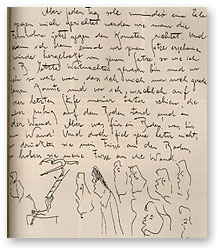
30.5.08

'What we both strove after...'

On the balance between work and writing

I've spent several rainy lunchtimes reading Max Brod's biography of his friend, Franz Kafka. Great criticism has been leveled against Brod for his decisions as executor of Kafka's literary estate. He has been attacked not only for his decision to publish the work in the first place, but the way he has structured and manipulated Kafka's incomplete work to promote particular interpretations. This has all been discussed at length by numerous writers in the last fifty years, and I don't care to go into any further detail today.

Instead, I'd like to share a passage I came across in a chapter named 'To earn one's living or live one's life'. Max Brod and Franz Kafka were both ambitious young writers restrained by daily employment in the civil service, and the passage in question expresses this very neatly. If you ask me, there's also something sweetly naive about it:
'What we both strove after with burning ardour was a post with a 'single shift' - that is, office from early morning till two or three in the afternoon - now I can write this 'or' so easily as though to us at the time it didn't seem as if the whole health of our souls depended on this one hour - and none in the afternoon. Jobs with commercial firms, which meant being in the office mornings and afternoons, didn't leave any continuous stretch of the day over for literary work, walks, reading, the theatre, and so on. And even when one came home after three, by the time one had eaten, recovered a little from the soul-destroying work and was ready to switch over into a state of freedom one had been looking forward to - there was already very little of the day left.'
Well, my lunchtime is over. Time to get back to work.
28.5.08

Powers of Ten

A short film

Powers of Ten (1977), a film by Charles and Ray Eames. Surely the most epic film about a picnic ever made.
21.5.08

The Next Village

On moving house


In two months my flat-mates and I are packing up and shipping out. To put it simply: we're moving to a new house, and taking on board two new crew members. We all know each other rather well, and we're all familiar with each other's character traits. Some of these traits are charming, some of them are attractive, and some are just plain irritating; but they're traits nonetheless, and we wouldn't be who we are without them.

To diffuse the excitement of moving into the new property, we've started to anticipate the kind of antics we can get up to. For instance, we're looking at ways that the property will offer space for new and interesting pastimes: soon we will have a garden, and I can already imagine groups of friends gathering around a barbecue for hot food and cold beer. Weather permitting, of course. But we've also opted for a few games to keep things interesting, and make the transition from our currently property to the new one that little bit more lively.

Chris has suggested that we install a notice-board on one of the walls of the house, and that we use the notice-board to express the unique character traits that we observe in our fellow flat-mates. For instance, Adrian has a knack for particular clumsy actions from time to time, and whether he's spilling chips all over the floor or stubbing his toe there will be room to document each and every event. Kieren, another future housemate, has a tendency to spin ridiculously grandiose yarns: peculiar speculations ranging from tabloid conspiracy to full-blown paranoia. There will be space for each and every. I, on the other hand, have been labelled as someone with a weakness for fads, transitory interests that never amount to very much - and I'm prone to agree.

Ever since I can remember I have had a need to pursue one interest or another. After awhile, my interest grows and begins to swallow up my free time. I'm reminded by Norman Bates' ominous words regarding his taxidermy collection in Hitchcock's Psycho: 'A hobby should pass the time, not fill it.' I seem to have a knack for filling it. Whether it's the novels of J. G. Ballard and Samuel Beckett, or the music of Bob Dylan or Joy Division, or more recently Charlie Parker, I just can't seem to get enough. But just before I reach some kind of apex, what I would consider an ideal of understanding of any given subject, I move on to something else.

When I was around thirteen years of age I was a keen chess player. I spent every school lunch-break in the library trying to whip round competitors, and nagged parents to compete with me on trips away. It became an addiction. I started to study opening and endgame theory, bought books devoted entirely to the subject and studied the games of the leading grandmasters. I even joined a regional team and began playing in all-weekend tournaments. I remember one tournament when I shared a caravan with a few fellow players, and we spent the night lying in the dark playing blindfold chess across the room. For me, chess was all-encompassing, but I moved onto new obsessions at just the point where my abilities were beginning to blossom.

When my friends claim that I have fads, or obsessions, they are right. I do, and there is no point in denying it. But what strikes me as most interesting is that while the interests never completely fade away (I am still a keen chess player, whenever I get the chance, and am still a fan of Ballard, Dylan and Joy Division) I am always driven to keep moving on. It's as though some part of me is driven to be a jack of all trades but a master of none. I just can't seem to commit myself to that one decisive thing.

But why am I telling you all this? What's gotten into me to bring up the subject in the first place? Well, I'll tell you. I was reading a short story by Kafka this evening, and somehow it strikes the nail on the head. It's called 'The Next Village', and was translated by Willa and Edwin Muir:

'My grandfather used to say: 'Life is astoundingly short. To me, looking back over it, life seems so foreshortened that I scarcely understand, for instance, how a young man can decide to ride over to the next village without being afraid that - not to mention accidents - even the span of a normal happy life may fall far short of the time needed for such a journey.'
To me, life does feel astoundingly short. And to avoid wasting it on a single journey to a single village I feel driven to shoot off in every direction at once - to cover every territory and master every district. Of course, it goes without saying that I'll never succeed, but that's to be expected.
19.5.08

Closing

A short story
We arrive sometime in the mid-afternoon, parking the car in one of twenty empty spaces. We are here to see my grandfather, a man who has spent the last ten years in slow inexorable decline. The hospital is now all but abandoned, a once-thriving NHS outpost deep in the valley, lost to dust. The entrance hall is deserted, and each corridor had been stripped of every defining detail. There is a smell of disinfectant. Only one ward remains open, where my grandfather sleeps, attended by a skeleton crew of three or four. I turn a corner and pass along the final corridor, through two security doors, and wonder whether this time he will wake up.
15.5.08

Paris, Texas

Wim Wenders' European take on the great American landscape

On Sunday afternoon Neil, Jennifer and I met up at Chapter Arts Centre to see a film. It was a bright sunny day and the air was warm: perfect weather for a cold glass of beer. Neil (being Neil) opted for a hot cup of coffee. We sat around the table for about forty to forty-five minutes, shooting the breeze with idle banter. I guess you could call it a catch-up chat.

We had decided to catch a screening of Paris, Texas that afternoon, shown as part of a Wim Wenders season of films. The British Film Institute has been touring the UK with a print of Alice in the Cities (of which there is a new DVD in the pipeline), and Chapter had seized the opportunity to bring out the big guns. Wim Wenders is a director who often draws strong opinions: for many his sometimes esoteric style can come across as precious and self-indulgent, and even his fans have reservations regarding certain parts of his career. But Wenders has made one or two films on which there is an unreserved consensus, and an enthusiastic following: one of those films is Paris, Texas.

What struck me most directly about Paris, Texas was the soundtrack coupled with the film's cinematography. Wenders has a foreigner's eye for detail, and seems to revel in American iconography; whether we are looking at a desert landscape, a road-side motel, or a dollar bill, Wenders is committed to an almost mythological image of what America is or could be. The landscapes are vast, the roads are long, and the neon burns brightly in the rain. Every turn feels full of hope and possibility, and there is something innately attractive about this. It's an exciting and liberating vision of America seen by a stranger in a strange land.

Ry Cooder's acoustic score is a solo performance, modifying a theme by blues guitarist Blind Willie Johnson to bring mystery and intrigue to the American landscape. Against the backdrop of the desert it sounds like an epic score, but when played against the emotional development of the characters it sounds sensitive and intimate. The score is always the same, and yet always different, and Cooder constantly develops it using dozens of almost imperceptible variations. It is a contribution that has a lasting impact. (I've been listening to the soundtrack all week.)

After the film Jennifer made a few comments about the geographical layout of some of the locations featured in the film. Hills and roads and airports are misplaced and rearranged in a way that would distract and baffle anyone familiar with the shooting locations. But of course, it's common Hollywood practice to shoot locations in a way that serves the narrative, rather than serving the truth. After all, Wenders is a filmmaker and not a cartographer. So it comes as perhaps no big surprise that there are spacial inaccuracies in Paris, Texas, and that when taken literally the mise-en-scene leads characters through places that do not exist, and that never will.

But I can't help thinking that Jennifer's observation is an interesting one, and it's probably central to my appreciation of the film as a whole. There are a number of characters in Wenders' films that wander through the narrative like empty signifiers: they're strangers for us to identify with, on whom we can imbue the meanings and preoccupations that are important to us. In Alice in the Cities there is the German journalist struggling to navigate the American landscape, in Paris, Texas it is Travis that catches the audience's eye. Although he does not speak for the first major scenes of the film, it is him we are drawn to identify with, and it is through him that we begin to see and understand his strange all-American world.

After wandering America alone for four years, and finally being found by his brother, Travis' first word is 'Paris'. And it's an interesting choice. Not only is Paris a specific place that many are familiar with, but it carries a whole host of popular assumptions rooted in a European sensibility of what is considered romantic or idealistic. Of course, the audience's understanding of the word is already tempered by the title of the film, Paris, Texas, which lends an interpretation adverse to what one might expect. Instead of a preconceived romantic image, we remain rooted to America. And so instead of an idealistic fantasy we are perhaps led more towards the grounded and mundane realities of the American south.

But the title: Paris, Texas. It has a two-pronged effect. On the one hand it takes something romantic and normalizes it; on the other hand, it takes something mundane and romanticizes it. To come back to Jennifer's observation that Wenders presents a false picture of the American landscape, his vision is his own creation - the perspective of an outsider. Wim Wenders' vision of America is not simply rooted in the real or the mundane, but in the ideal and the romantic. And for me, that's what makes Paris, Texas such a compelling film.
11.5.08

Keeping a diary

Franz Kafka's journal

Summer is on the way, and there's no doubt about it. A blazing bright summer sun and warm air tossing in and around the garbage and the blossoms. There's a parade passing by my window: I can see lollypops, flip-flops and lobster skin, but not even the sight of sunburn can spoil my day. There's too much to enjoy: the sound of ice-cream vans, children playing and couples arguing. Ah yes, summer is on the way, and there's no doubt about it.

I've been sitting at my window for the better part of the morning, drinking hot coffee and reading Kafka. As a younger man - such a great phrase, that, but don't get me wrong: I'm still young, and like to think I'm getting younger everyday - but I'm not - I connected with Kafka's writing in a very direct way. His journals alone were a treasure trove of familiar identifications, they were my notes from the underground, a tirade against the troubles and difficulties of modern life. They were a kind of teenage hormone therapy.

It feels different to be reading them now, in a light and optimistic frame of mind; each passage seems filled with cynicism and self-loathing, the soul of a man treading water through the twentieth century. Having said that, there was one wonderful little passage that stood out:

'One advantage in keeping a diary is that you become aware with reassuring clarity of the changes which you constantly suffer and which in a general way are naturally believed, surmised, and admitted by you, but which you'll unconsciously deny when it comes to the point of gaining hope or peace from such an admission. In the diary you find proof that in situations which today would seem unbearable, you lived, looked around and wrote down observations, that this right hand moved then as it does today, when we may be wiser because we are able to look back upon our former condition, and for that very reason have got to admit the courage of our earlier striving in which we persisted even in sheer ignorance.'
I think I'll leave it at that for today.
6.5.08

Lessness

Samuel Beckett sitting in the study of his apartment in Paris. Photograph by Henri-Cartier Bresson

'Where would I go, if I could go, who would I be, if I could be, what would I say, if I had a voice, who says this, saying it's me? Answer simply, someone answer simply.'

Samuel Beckett, Texts for Nothing
I continue to wind my way through Paul Auster's novels, poetry and criticism and find that he's series editor of the Grove Centenary edition of Samuel Beckett's works. There are definite links between Auster and Beckett, not only thematically but stylistically as well. But picking up one of the four Beckett tomes this afternoon made me remember what's truly great about him. For a moment I forget Auster and glance over these new bright pages.

I charge the book to my library card and count the minutes to lunch. At one o'clock, prompt, I tuck it into my knapsack and head out into the daylight. Finding a comfortable spot in the dirt under a tree, I kick off my boots and spend the entire hour reading - dipping into short stories that run and move more like prose poems than structured narrative. I love the simple, pared-down austere approach he brings to each thing that he writes; Beckett has a bare bones minimalism that communicates a limit. He's a master of restraint, and somehow manages to say very much with very little.

I started today's entry with a Beckett quote that I love, taken from Texts for Nothing. I'll fizzle out with another, taken from Fizzle 5: Still. Beckett's first line is a beautiful way to start, and a fitting way to finish:

'Bright at last close of a dark day the sun shines out at last and goes down.'
4.5.08

T4

My experience of temporary spinal paralysis
The human spine

After looking forward to it for weeks, the day finally arrives: an old friend has come to visit. We were studying at different universities back then, and despite regular contact we rarely saw each other. But tonight would be an exception: a few drinks at a bar, followed by a concert at the students' union. A chance to catch up.

As the evening approaches I begin to get ready. I arrange my clothes neatly on the bed and decide to take a quick shower, but something's not right. As I climb out of the shower and step onto the tiles I suffer from a sudden dizzy spell. It doesn't last long, but I make myself something to eat to keep me grounded. The idea of drinking alcohol tonight suddenly becomes unappealing, and as I finish a small snack I begin to feel weak at the knees.

Reluctantly, I call my friend to let him know that I'm unwell. I tell him to go to the concert without me, but to report back every detail the next morning. I pull the clothes of my bed, turn off the light and try to get some rest.

The next day I feel worse. The dizziness has reached a stage where I have difficulty focussing on the objects in my room, and I'm suddenly terribly weak. Nothing like this has ever happened to me before, so I begin to feel worried and call my parents for reassurance. They sound fairly reasonable and objective on the phone, and offer to visit me where I'm staying. As they live only half an hour or so away, I don't object, but I'm hoping they arrive as fast as they can.

I can still remember the look on my mother's face when she saw the way I was moving around. I opened the door to let them into the house, which I was sharing with four other final-year students, and hobbled along the corridor. With every step I took I was unsure of my footing, and felt a terrible weakness around my knees and thighs. By this time I started to have difficulty urinating, and I began to worry that something was seriously wrong. My parents both decided to take me to hospital and have me checked over, helping me step-by-step into the back of the car.

After a lengthy wait in the A&E department, we were introduced to a nurse who made an initial assessment of my case. I remember feeling that I was in good hands, and felt only a twinge of embarrassment about my inability to urinate. By this time, it was simply a relief to be among professionals, and I would have told them anything if it meant getting better faster.

I was referred to a doctor who recommended I stay in overnight for observation. I was placed on a bed and given a catheter to relieve my discomfort. After a series of diagnostic tests, I was sent to a ward to get some rest for the night. The next day I was paralysed from the chest downwards.

My first feelings were of ugly shock and disbelief. Here I am in a hospital bed and can no longer feel or move my legs. The doctors that visit me that day warn me of the problems that may lie ahead.

After conducting a lumbar puncture procedure at the base of my spine, I'm diagnosed with a spinal infection. It has travelled as high as the T4 vertebrae, and the doctors are concerned it could travel higher and possibly begin to affect my lungs. I am told this by a friendly young doctor who is careful and considerate with her words, but I cannot take my eyes off my toes. They are at the foot of the bed, and no matter how much I will them to move they refuse.

I start to feel disconnected from the rest of my body. I can still speak, move my head and upper torso, and I can move my arms - for now, at least - but the rest of me feels like someone else. I try to catch up on some reading for an English Literature module I'm taking, but my mind always returns to the same worries and the same concerns. In just one day, with no warning to speak of, my body had begun to fail me.

I was never told exactly what caused my spinal infection, and to this day it remains a mystery to all involved. I was treated with a course of medication which is thought to have halted its progress, and after a few weeks in a hospital bed I began to make my first steps around the ward. My blood pressure was extremely low at this time, so standing up straight induced nausea and fainting. I remember one incident alone in a hospital bathroom when I collapsed while splashing water onto my face: I can still see all the colours of the water as it swirled towards the plug, and I remember thinking I had never seen such colours before. Little by little, I was able to increase the amount of time I spent standing and slowly became mobile again.

Learning to walk again, as though from scratch, was the strangest experience I'd ever had. At first I was still unable to feel my legs, which made walking on them a mental rather than intuitive and physical act: with each step, I would have to tell my foot what to do, and watch that it acted correctly. It was as though my hips were balancing on jelly, or even on water, the sensation was so strange. As feeling began to return, it was as though my body could not interpret tactile sensations and overacted to everyday stimuli. There was one occasion where cold water was spilled onto one of my legs, and I felt what I can only describe as an electrical jolt. It was agonizing.

I found my friends to be my most valuable asset through the whole ordeal. Initially, many were shocked at my state, the weight I had lost, and the unsightly catheter bag hanging out of the side of my bed. Conversations began awkwardly, and I sometimes felt as though I had become someone else in their eyes; but once we began to talk, no matter who it was, the tension would lift and the atmosphere would become relaxed.

I think it was the support and sense of humour of my friends that ultimately helped me through that difficult time, that made it bearable, and that made it possible. I later finished my degree, a year later than the others, and everyone moved off in separate directions. But we're still in touch.