10.11.08

How Beckett Can Save Your Life

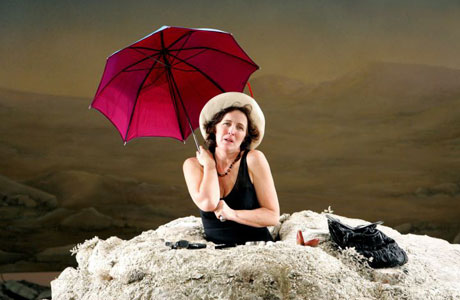
Fiona Shaw as Winnie in Samuel Beckett's 'Happy Days'
"WINNIE: [gazing at zenith] Another heavenly day."

Samuel Beckett, Happy Days
One night last week I sat down to watch Samuel Beckett's Happy Days, a production from the Beckett on Film project. I had been looking forward to it for some time, being a fan of the writer's work, and up until that point had never seen or read the text. Or so I thought. I settled myself into a comfortable position on my bed, pressed the Play button of my remote control, and a strange realization began to dawn on me. I had encountered the text before, and my memories of reading it began to emerge.

A few years ago I had found myself in a hospital bed with a spinal infection. My illness had left me paralyzed from my chest downwards, and without any physical sensation. It had been a terrible distressing time for me, and I can remember using various coping mechanisms to get me through. I was an undergraduate at the time, studying English Literature and Cultural Criticism at Cardiff University. It was the beginning of the Autumn semester, and while my return suddenly seemed unlikely, my parents had brought a neat little box filled with all of my set texts for the weeks and months ahead.

Ever the optimist, I remember reaching down into that box three or four times a day, between meals, check-ups, medication and conversation. Time passes slowly on a hospital ward, and the idea of working was not only a great distraction, but a way of looking to the future instead of dwelling on my sorry predicament. I can remember reading a Postcolonial discourse reader, and annotating several of the articles inside for the sheer hell of it. I really knew how to live back then. I can remember skimming through one of the photocopied handouts that came with some of the modules. And I can even remember looking at a dog-eared paperback of Dan Brown's Da Vinci Code, which my Auntie had contributed to the box. I didn't get around to reading that one. Time doesn't pass that slowly.

But what I couldn't remember, for the life of me, was picking up Samuel Beckett's Happy Days. I can see it now, settled snugly to the left, a slim Faber & Faber paperback edition. It was the set text for an English Literature module on modern drama, but failed to draw my attention in any fantastical way. The cover looked pretty mundane and unassuming, although I remember liking the typeface of the title. Very clean, very simple. But that's for another time.

Watching the Beckett on Film production I suddenly became violently aware of myself in hospital again, reading the text on a ward for serious brain and spine injury/infection. It was beginning to get dark, and I had stretched out to turn on my reading light. I could see the city out through the windows on my left, and to my right the lights of the corridor and the nurse's station. A member of staff would visit each bed in each ward on the hour, every hour, to check on every patient and administer drugs or pain relief.

I lay in wait for a painless injection into the side of my stomach, which to this day I'm still confused about, but I suspect it was to prevent my muscles from wasting. It was at this time that I sat up, as best I could, and read Happy Days in the dark. My first experience of Samuel Beckett's writing, and one I would soon completely forget.

What strikes me now, more than anything, was the apposite nature of the play in relation to my situation at the time. The lead protagonist, Winnie, is trapped up to her waist in earth, completely unable to move from this point down and permanently rooted to the spot. She still has agency, of a sort, and retains a sense of life and independence through language, but there is no denying her physical condition. In the second act it worsens still. 'Still' being the appropriate word. Winnie finds herself buried to her neck, but continues to speak to her mostly unseen companion Willie to the very end of the play.

I suddenly remembered feeling very disturbed by Winnie's position, as it felt so completely close to my own. I had been informed that there was a risk my spinal infection may spread further upward, paralyzing my lungs. But we managed these risks as best we could, and those caring for me took every precaution and every care. They were magnificent, I must say. But despite their reassurances, I still felt a terrible anxiety about my position and began to relate ever more to the absurdity of Winnie's.
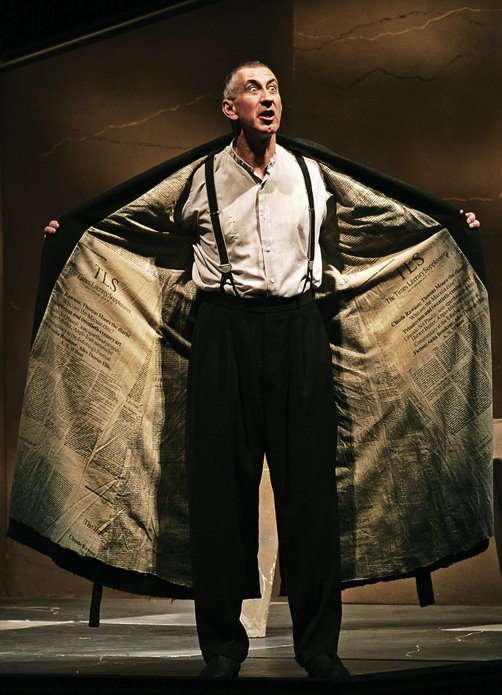
Barry McGovern performing 'I'll Go On', a monologue adapted by Gerry Dukes and Barry McGovern from Samuel Beckett's 'Trilogy'.

Although I forgot my hospital experience of Beckett's play (had I repressed it?), I find it strange to discover that I began reading his work in earnest exactly one year later. I'm always a little depressed around this season when I remember my time on the wards, and perhaps I was looking to regain the comfort I had found back then. But whatever the case, I found it, and continue to find it in Samuel Beckett's work.

The physical similarities between Winnie and myself are, in retrospect, irrelevant. They were simply the hook that drew me in, that enabled me to relate and identify myself with the character. After that, I began to identify with different qualities in different places. Whether I was reading a short dramatic work, or one of Beckett's novels, there is a questioning tone that explores themes running through our lives, and which appealed to me.

I'm not talking about political or ethical or even philosophical types of questioning, but something else. Beckett's work, while doubtlessly relevant to these areas I mention, also represents the quiet times that individuals experience. Whether we call it solitude, or loneliness, or waiting, Beckett has a distinctive knack for representing it: those quiet times we meet with humour, or bitterness, or melancholy, or joy, or the searching out of a friend. For me, Samuel Beckett's work reflects this strange space in a reassuring way. His prose and dramatic work manage to capture those quiet times without the trite sentimentality that creeps into this blog from time to time: it's naked, it's bare and it feels truthful. And I love it.

When I read Happy Days a few years ago, I thought I needed it to relate to and to comfort me. But now that I have fully-recovered, I feel I need it still. Perhaps more than ever.
4.5.08

T4

My experience of temporary spinal paralysis
The human spine

After looking forward to it for weeks, the day finally arrives: an old friend has come to visit. We were studying at different universities back then, and despite regular contact we rarely saw each other. But tonight would be an exception: a few drinks at a bar, followed by a concert at the students' union. A chance to catch up.

As the evening approaches I begin to get ready. I arrange my clothes neatly on the bed and decide to take a quick shower, but something's not right. As I climb out of the shower and step onto the tiles I suffer from a sudden dizzy spell. It doesn't last long, but I make myself something to eat to keep me grounded. The idea of drinking alcohol tonight suddenly becomes unappealing, and as I finish a small snack I begin to feel weak at the knees.

Reluctantly, I call my friend to let him know that I'm unwell. I tell him to go to the concert without me, but to report back every detail the next morning. I pull the clothes of my bed, turn off the light and try to get some rest.

The next day I feel worse. The dizziness has reached a stage where I have difficulty focussing on the objects in my room, and I'm suddenly terribly weak. Nothing like this has ever happened to me before, so I begin to feel worried and call my parents for reassurance. They sound fairly reasonable and objective on the phone, and offer to visit me where I'm staying. As they live only half an hour or so away, I don't object, but I'm hoping they arrive as fast as they can.

I can still remember the look on my mother's face when she saw the way I was moving around. I opened the door to let them into the house, which I was sharing with four other final-year students, and hobbled along the corridor. With every step I took I was unsure of my footing, and felt a terrible weakness around my knees and thighs. By this time I started to have difficulty urinating, and I began to worry that something was seriously wrong. My parents both decided to take me to hospital and have me checked over, helping me step-by-step into the back of the car.

After a lengthy wait in the A&E department, we were introduced to a nurse who made an initial assessment of my case. I remember feeling that I was in good hands, and felt only a twinge of embarrassment about my inability to urinate. By this time, it was simply a relief to be among professionals, and I would have told them anything if it meant getting better faster.

I was referred to a doctor who recommended I stay in overnight for observation. I was placed on a bed and given a catheter to relieve my discomfort. After a series of diagnostic tests, I was sent to a ward to get some rest for the night. The next day I was paralysed from the chest downwards.

My first feelings were of ugly shock and disbelief. Here I am in a hospital bed and can no longer feel or move my legs. The doctors that visit me that day warn me of the problems that may lie ahead.

After conducting a lumbar puncture procedure at the base of my spine, I'm diagnosed with a spinal infection. It has travelled as high as the T4 vertebrae, and the doctors are concerned it could travel higher and possibly begin to affect my lungs. I am told this by a friendly young doctor who is careful and considerate with her words, but I cannot take my eyes off my toes. They are at the foot of the bed, and no matter how much I will them to move they refuse.

I start to feel disconnected from the rest of my body. I can still speak, move my head and upper torso, and I can move my arms - for now, at least - but the rest of me feels like someone else. I try to catch up on some reading for an English Literature module I'm taking, but my mind always returns to the same worries and the same concerns. In just one day, with no warning to speak of, my body had begun to fail me.

I was never told exactly what caused my spinal infection, and to this day it remains a mystery to all involved. I was treated with a course of medication which is thought to have halted its progress, and after a few weeks in a hospital bed I began to make my first steps around the ward. My blood pressure was extremely low at this time, so standing up straight induced nausea and fainting. I remember one incident alone in a hospital bathroom when I collapsed while splashing water onto my face: I can still see all the colours of the water as it swirled towards the plug, and I remember thinking I had never seen such colours before. Little by little, I was able to increase the amount of time I spent standing and slowly became mobile again.

Learning to walk again, as though from scratch, was the strangest experience I'd ever had. At first I was still unable to feel my legs, which made walking on them a mental rather than intuitive and physical act: with each step, I would have to tell my foot what to do, and watch that it acted correctly. It was as though my hips were balancing on jelly, or even on water, the sensation was so strange. As feeling began to return, it was as though my body could not interpret tactile sensations and overacted to everyday stimuli. There was one occasion where cold water was spilled onto one of my legs, and I felt what I can only describe as an electrical jolt. It was agonizing.

I found my friends to be my most valuable asset through the whole ordeal. Initially, many were shocked at my state, the weight I had lost, and the unsightly catheter bag hanging out of the side of my bed. Conversations began awkwardly, and I sometimes felt as though I had become someone else in their eyes; but once we began to talk, no matter who it was, the tension would lift and the atmosphere would become relaxed.

I think it was the support and sense of humour of my friends that ultimately helped me through that difficult time, that made it bearable, and that made it possible. I later finished my degree, a year later than the others, and everyone moved off in separate directions. But we're still in touch.