5.8.12

Roger Ebert on Alfred Hitchcock's Vertigo

American film critic reflects on the subtleties of Hitchcock's 1958 film
A still from Alfred Hitchcock's Vertigo (1958)
Film critic Roger Ebert (Chicago Sun-Times) reflects on the news that Alfred Hitchcock's Vertigo has displaced Citizen Kane as the BFI's Greatest Film Ever Made (thanks to Michael John Goodman for the link): 'The king is dead. Long live the king. Welles' "Citizen Kane" has been dethroned from the Sight & Sound list of the greatest films of all time, and replaced by Hitchcock's "Vertigo." It's not as if nobody saw this coming. The list first appeared in 1952, and "Vertigo" (1958) made the list for the first time only in 1982. Climbing slowly, it placed five votes behind "Kane" in 2002. Although many moviegoers would probably rank "Psycho" or maybe "North by Northwest" as Hitch's best, for S&S types his film to beat was "Notorious" (1947). That's the one I voted for until I went through "Vertigo" a shot at a time at the University of Virginia, became persuaded of its greatness, and put it on my 2002 list.' [Read More]

Also at A Piece of Monologue:
27.8.11

Coppola's notes on Puzo's The Godfather

How the original novel was adapted for the screen

A page from Francis Ford Coppola's copy of Mario Puzo's novel The Godfather, annotated in preparation for the film (link via 3:AM Magazine) [Read More]

Also at A Piece of Monologue:
22.5.11

Apocalypse Now Storyboards

The Guardian publishes storyboard images from Coppola's Vietnam war epic
Image: Zoetrope Studios
Francis Ford Coppola's Vietnam war epic, Apocalypse Now!, loosely based on Joseph Conrad's Heart of Darkness, is being re-released this month in a restored digital print (27 May). It's to be followed by a Blu-ray release on 13 June. In celebration, The Guardian's Guide supplement has published the original storyboards of one of the film's most memorable scenes.

See the Gallery: 'The Apocalypse Now Storyboards', The Guide, The Guardian, 22 May 2011

Also at A Piece of Monologue:
1.9.10

Heart of Darkness: Graphic Novel

Catherine Anyango and David Zane Mairowitz adapt Conrad's iconic text
Catherine Anyango and David Zane Mairowitz's Heart of Darkness.
Source: The Guardian
Sam Jones of The Guardian website reports that Catherine Anyango, artist, and David Zane Mairowitz, author of Introducing Kafka, have collaborated on a graphic adaptation of Joseph Conrad's Heart of Darkness.
In the 108 years since it was published, Joseph Conrad's colonial fable Heart of Darkness has infected TS Eliot, been excoriated for racism by Nigerian writer Chinua Achebe and transplanted to Vietnam by Francis Ford Coppola.

Now the book has been reinterpreted as a graphic novel in whose monochrome pages Conrad's exploration of power, greed and madness plays out as disturbingly as ever.

Catherine Anyango, whose drawings are peppered with David Zane Mairowitz's adaptation of the text, had her doubts about tackling the Polish-born novelist's most famous work.

Those reservations had more to do with the original medium than the enduring controversy over Conrad's views or the familiarity of Heart of Darkness.

"I wasn't sure initially if it was a good subject for a graphic novel as the writing is so dense and the style of it is partly what attracts me to the book," she said.

"As I knew we couldn't keep most of the text in, I tried to make the drawings very rich in detail and texture so that immersive feeling you get, especially when he describes the river and the jungle, was carried across." [Read the article]

Also at A Piece of Monologue:
6.12.09

Disjecta: This week's links


Rare photographs of John Coltrane on the updated official website

Literature:

J. G. Ballard: Rick McGrath's Letter from London: The J. G. Ballard Memorial
William S. Burroughs: Mark Dery on Naked Lunch at Fifty
The Atlantic Online: Index of Literary Interviews
Samuel Beckett: Zadie Smith compares 50 Cent to Samuel Beckett
Book of the Year: The Guardian rounds up possible contenders

Philosophy & Critical Theory:

Friedrich Nietzsche: Review of Writings from the Early Notebooks
Karl Marx: Michael Doliner on the oft-quoted phrase, 'The first time as tragedy, the second time as farce.'

Music:

Ella Fitzgerald: Ella Fitzgerald, repackaged by Verve
John Coltrane: Avant Garde Jazz and the evolution of My Favourite Things
John Coltrane: The official website now online with photographs and multimedia
Blues: Desktop Blues, An interactive blues music soundboard
David Bowie: A 42 year old letter from David Bowie to his first American fan
Harvey Pekar: An archive of jazz reviews for the Austin Chronicle
Harvey Pekar: An archive of jazz reviews for Jazz Times

Film

Francis Ford Coppola: Apocalypse Now! tops London critics 30th Anniversary poll

Etc.

Will Self: On the UK National Lottery
Stewart Lee: The incomparable Stewart Lee interviewed in The Guardian
1.10.09

The Godfather at BFI's Southbank

Francis Ford Coppola's masterpiece returns to the big screen
Marlon Brando as Don Vito Corleone in Francis Ford Coppola's The Godfather
A new print of Francis Ford Coppola's seminal classic, The Godfather, has been granted an extended run at the BFI Southbank in London:
Constantly scoring very highly in best-ever film polls, Coppola's newly restored classic broke new ground in its focus on organised crime and paved the way for the 'movie brat' film-makers who would transform Hollywood.

Charting the fortunes of the New York-based Corleone clan in the years immediately following World War Two, the film centres on the transition from the traditional cosa nostra values held by Don Vito Corleone (Marlon Brando) to the Mafia's growing involvement with narcotics. At once a parable about the corrupting influence of power, a dark dynastic saga of trust, loyalty and betrayal, and a consistently gripping succession of superbly staged set-pieces punctuated by subtly nuanced scenes of family life, the film introduced the world to a host of young stars (not least Al Pacino as Vito's son Michael), a lyrical score, and such memorably resonant phrases as 'We made him an offer he couldn't refuse.'


The Godfather runs at the BFI Southbank until 14th October.
6.7.09

Werner Herzog speaks to Time Magazine

Interview with the Bavarian filmmaker
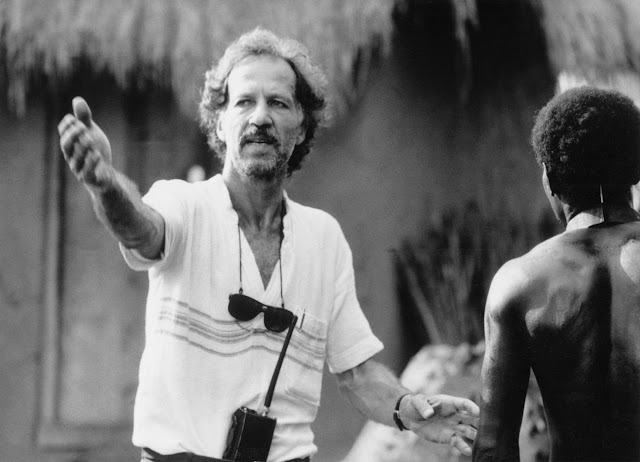
Werner Herzog
Following the recent post on Bavarian director Werner Herzog, I came across an interview in Time Magazine published earlier today. Herzog is asked a series of questions about his new book, Conquest of the Useless, which is based on the production journals of one of his signature films, Fitzcarraldo. He shares a few anecdotes on the difficulties of making the film, and recounts conflicts with the late Klaus Kinski, a troubled but brilliant actor who was also a close personal friend.

The conversation is available to read at the Time Magazine website, or to watch as an online video, in which you can see the austere but affable European director speaking candidly with his chirpy and enthusiastic interviewer:
As you were poring over your memories, were there things you had forgotten, or that you now found particularly fascinating or traumatizing to experience all over again?

Many things I had forgotten, yes. Traumatizing, no, I wouldn't say that. I have enough stability inside of me to not be traumatized. If I were a solider I would not be the one to come back with Post-Traumatic Stress Disorder because I think I have fortified myself with enough philosophy.


Reading your stories, I was reminded of the problems Francis Ford Coppola faced with Apocalypse Now. You say at one point in the book that you were flat broke and that you traded two bottles of shampoo for four kilos of rice. Is that the low point?

The distinction between Apocalypse Now and my film is that Coppola always resolved films with ready cash. There was always a lot of money flowing around. In my case, because I had to produce the film myself, I was down to the utmost limit. So I lived in a chicken coop and had nothing to eat any more. But I remembered from Miami I had two bottles of shampoo — well one was shampoo and the other was conditioner — and I traded it at the local market for four kilos of rice and I ate rice for three or four weeks. That's how I survived. No one can imagine how far down I was sometimes.

Was that the low point?

There were lower points because there were more dramatic events, like if you're building a camp for 1,100 people in the middle of the jungle and a border war breaks out and local people attack your camp and burn it to the ground. That's a serious sort of thing. Besides that, there were accusations that I was committing human rights abuses — which were all fabricated — and a tribunal was set up against me. These things are hard to handle and of course I still feel the pain.

It's also what makes the book quite dramatic. I'm wondering if you're too close to the book to really appreciate how shocking these revelations are.

That's probably the reason I couldn't touch it for over 20 years, and my own wife who knows me well only managed to read up to page 80 and cannot continue. It's so hard for her to take what I have gone through...it's something which deeply touched my existence.


4.7.09

Conquest of the Useless: Werner Herzog on Fitzcarraldo

Review of a new memoir by the Bavarian filmmaker
Werner Herzog on the set of 'Fitzcarraldo' (1982)
Danny Leigh of The Guardian has posted an online review of Werner Herzog's new book, Conquest of the Useless, recording the arduous and infinitely troubled production of Fitzcarraldo:
"Caracas, 21 June 1979: No one came to meet me. My passport was confiscated immediately because I had no visa."

[...] The quote comes from Herzog's diaries of the mythic two-year shoot in the jungles of Peru, just published in the US, excerpted in the New York Times and picked up by blogs including the IFC Daily. All proof, if needed, that I'm not the only one fascinated by this epic folly of a movie – a grand mission statement in which an ascendant young director flung himself into a comically hostile terrain, endangering career and health in the name of a notion of art that seemed quaintly old-fangled even at the time.

But vivid as the first-person, present-tense account of the production (the camp being burned down by troops in the midst of a border war and crew members cutting off their feet after snakebites, etc) surely is, one of the most striking aspects about the book is the apparent weight it gives to Herzog's stay prior to the shoot with none other than Francis Ford Coppola. The American director was then in San Francisco recovering from a hernia operation. Not only does this provide some beautifully deadpan Herzogian moments ("Coppola did not like the pillows and complained all afternoon") – the pairing takes on a special significance because of his host's other malady, the still-fresh trauma of making Apocalypse Now.

I am fascinated by Werner Herzog's philosophical approach to life, and what he refers to as ecstatic truth. His early filmmaking roughly corresponds to the New German Cinema, a movement which sought to activate new ways to represent and discuss culture and reality. Ecstatic truth, as an idea, remains true to this bold and progressive ambition, hoping to capture a sense of reality that goes beyond straightforward empirical facts, or the contemporary conventions of European cinema. 

Instead, ecstatic truth is a kind of spiritual affirmation that exists between the lines, or behind the superficial gloss of the on-screen images; and yet it is not spiritual in any theological sense, nor does it adhere to any cultural set of beliefs. To borrow a phrase from the title of Alan Yentob's BBC documentary on Herzog, it is a truth 'beyond reason': highly subjective and deeply personal.

For me, what is most interesting about Herzog's work is that he seeks to find a sense of ecstatic truth in the most extreme circumstances. Perhaps this is the only place it can be found, if it is to exist at all. His films are often structured around characters who are in some way at odds with the world, strangers in a universe divested of meaning and surrounded by 'chaos, hostility and murder'. It sounds like a very fatalistic, Germanic philosophical approach, but I think that to dismiss it as negative or nihilistic is to miss Herzog's point.

Klaus Kinski in Werner Herzog's 'Fitzcarraldo' (1982)
The concept of ecstatic truth ties into a loose cultural idea of spiritual enlightenment and individual empowerment, but it is without sentiment or naive idealism. It is a way of looking at the world as both brutal and chaotic, but embracing those qualities in nature for what they are. It accepts that humankind cannot dominate or control nature as such, but is enthusiastic about the engagement. On the set of Fitzcarraldo, deep in the jungle, Herzog speaks of the 'obscenity of the jungle', stating that even 'the stars look like a mess', and yet, in spite of this, he continues to love and admire the nature that surrounds him - perhaps 'against [his] better judgment'. 

Ecstatic truth does not imply security or stability, there are no great discoveries and no guarantees of empirical knowledge: in this sense it is a necessary conquest of the useless, a journey with no signposts or destinations. It is a continual task, undertaken not for the benefit of mankind but for the benefit of oneself. And I think that there is something perversely romantic and aspirational about Herzog's approach; in many ways it feels reminiscent of Nietzsche roaming the wild mountains and finding peace in the wilderness. 

To seek one's individual sense of truth among the elements is surely as noble a project as any, and many of Werner Herzog's films seem to be pursuing exactly that kind of philosophical aim: it is an attempt to create one's place in the universe, or, as Herzog puts it, to continually search for 'a deeper stratum of truth' about oneself and the wider world.

More on Werner Herzog: