26.12.14

Blue Note: Uncompromising Expression: The Finest in Jazz Since 1939

A beautiful, fully-illustrated history of the legendary jazz label
Blue Note: Uncompromising Vision: The Finest in Jazz Since 1939
ABlue Note: Uncompromising Vision: The Finest in Jazz Since 1939
Blue Note: Uncompromising Vision: The Finest in Jazz Since 1939
From Thames & Hudson, what promises to be a fantastic (and beautiful) new book celebrating the pioneering jazz label, Blue Note Records: 'Released to commemorate the 75th anniversary of the coolest and best- known label in jazz, this book celebrates over seven decades of extraordinary music from a company that has stayed true to its founders commitment to Uncompromising Expression. Tracing the evolution of jazz from the boogie- woogie and swing of the 1930s, through bebop, funk and fusion, to the eclectic mix Blue Note releases today, the book also narrates a complex social history from the persecution of Jews in Nazi Germany to the developments in music and technology in the late 20th century. Blue Note is not only known as the purveyor of extraordinary jazz but is also famous as an arbiter of cool. The photography of co-founder Francis Wolff and the cover designs of Reid Miles were integral to the labels success and this highly illustrated, landmark publication featuring the very best photographs, covers, and ephemera from the archives, including never-before-published material commemorates Blue Notes momentous contribution to jazz, to art and design as well as to revolutionizing the music business.'

Find on Amazon: US | UK

Also at A Piece of Monologue:
1.7.14

A Love Supreme: Rare Photographs of John Coltrane

Chuck Stewart reveals rarely glimpsed images of Coltrane in the 1960s
Left to right: McCoy Tyner, Archie Shepp, John Coltrane and Bob Thiele, 10 December 1964. Photograph: Chuck Stewart
John Coltrane, 10 December 1964. Photograph: Chuck Stewart
John Coltrane in Rudy Van Gelder's recording studio, Engelwood Hills. Photograph: Chuck Stewart
John Coltrane on a break in Rudy Van Gelder's recording studio. Photograph: Chuck Stewart
John Coltrane in April 1966. Photograph: Chuck Stewart
From Nelson George (Smithsonian.com):
On December 9, 1964, saxophonist John Coltrane led a quartet that featured pianist McCoy Tyner, drummer Elvin Jones and bassist Jimmy Garrison into Rudy Van Gelder’s studio in Englewood Cliffs, New Jersey, where countless jazz recording sessions were held in the 1950s and ’60s. For photographer Chuck Stewart, Van Gelder’s was a short drive from his home in Teaneck.

That day nearly 50 years ago the band recorded a Coltrane composition titled A Love Supreme, a profound expression of his spiritual awakening divided into four movements—“Acknowledgement,” “Resolution,” “Pursuance,” “Psalm.” For its soaring ambition, flawless execution and raw power, it was hailed as a groundbreaking piece of music when it was released in February 1965, and it has endured as a seminal part of the jazz canon. The work and its composer will be highlighted anew this April during Jazz Appreciation Month, an annual event launched in 2001 by the National Museum of American History, whose collection includes Coltrane’s original manuscript for A Love Supreme.

For Stewart, whose photographs have graced thousands of album covers, from Ellington to Davis, from Basie to Armstrong, that session with Coltrane—a friend of his since 1949—was no different from countless others. “When I did a session I would go in and shoot the rehearsal before they did any takes,” the 86-year-old photographer recalls, sitting in his cozy, picture-filled living room in Teaneck. “I couldn’t shoot during the take because the recording equipment would pick up the clicks. So what I did was meander around the studio. When I saw a picture I thought worked, I’d take it.”

Stewart still has the Rolleiflex camera he used at the session, and the contact sheets as well. Many of the images he shot have been seen on CDs, as well as in numerous books and magazine articles. But 72 photographs from six rolls of film never made it beyond the contact-sheet stage, and so haven’t been published. Stewart’s son David recently rediscovered those images in his father’s collection, and now Stewart is scheduled to include some of them in a donation to the museum this month.

Looking over the contact sheets from those rolls, Stewart picks out two favorites. One finds Coltrane reclining on a staircase and talking with someone in the studio. The other, taken from a distance, shows him sitting at a piano, lost in thought. “I was looking for a decisive moment,” recalls Stewart. [Read More]

Find A Love Supreme on Amazon: US | UK

Also at A Piece of Monologue:
26.6.14

On Miles Davis' Bitches Brew

Revisiting the seminal jazz/rock fusion record
Artwork for Miles Davis' 1970 album, Bitches Brew
From Paul Tingen (Jazz Times):
August of 1969 marked Miles Davis’ boldest venture yet into undiscovered country. This time there was no more holding back, no more tentative experimentation, no more “walking on eggshells.” The album that emerged, Bitches Brew, was groundbreaking, beginning with its stark title and Abdul Mati Klarwein’s memorable cover painting. Made on Miles’ personal invitation, Klarwein’s expressionistic work captured the zeitgeist of free love and flower power, depicting a naked black couple looking expectantly at an ocean, a huge vibrant, red flower beside them. The background of the title is unknown, but a clue is provided by the absence of an apostrophe at the end of the word “bitches,” making “brew” a verb, not a noun. Carlos Santana speculated that the album was a “tribute” to “the cosmic ladies” who surrounded Miles at the time and introduce him to some of the music, clothes, and attitudes of the ’60s counterculture.1 Gary Tomlinson, on the other hand, assumed that “bitches” referred to the musicians themselves.2 Just like “motherfucker,” the term “bitch” can be used as an accolade in African-American vernacular. Whatever the title meant, it sounded provocative. Teo Macero remarked, “The word ‘bitches,’ you know, probably that was the first time a title like that was ever used. The title fit the music, the cover fit the music.”

The music on Bitches Brew is indeed provocative, and extraordinary. For Miles it meant a point of no return for the musical direction he had initiated with the recording of “Circle in the Round” in December of 1967. Until August of 1969 he had remained close enough to the jazz aesthetic and to jazz audiences to allow for a comfortable return into the jazz fold. But Bitches Brew’s ferocity and power carried a momentum that was much harder to turn around. The hypnotic grooves, rooted in rock and African music, heralded a dramatic new musical universe that not only gained Miles a new audience, but also divided it into two groups—each side looking at this new music from totally different, and seemingly unbridgeable, perspectives. In the words of Quincy Troupe, these two groups were like “oil and water.”

Bitches Brew signaled a watershed in jazz, and had a significant impact on rock. In combination with Miles’ fame and prestige, the album gave the budding jazz-rock genre visibility and credibility, and was instrumental in promoting it to the dominant direction in jazz. The recording’s enormous influence on the jazz music scene was bolstered by the fact that almost all the musicians involved progressed to high-profile careers in their own right. In the early 1970s, Joe Zawinul and Wayne Shorter (with percussionist Airto Moreira) were involved in Weather Report, Herbie Hancock and Bennie Maupin set up Mwandishi, John McLaughlin (with Billy Cobham) created Mahavishnu Orchestra and Chick Corea founded Return to Forever with Lenny White.

Bitches Brew was not a sudden dramatic move in a completely new direction for Miles, though. In line with his long-standing, step-by-step working methods, the recording was maybe a large, but nevertheless logical step forward on a course he had set almost two years earlier. In terms of personnel, musical conception, and sonic textures, the album was a direct descendant of its predecessor, In a Silent Way. Teo Macero remarked that with the latter album, the music “was just starting to jell. [In a Silent Way] was the one before [Bitches Brew]. Then all of a sudden all the elements came together.”

Bitches Brew and In a Silent Way are both dominated by circular grooves, John McLaughlin’s angular guitar playing and the sound of the Fender Rhodes electric piano. However, Miles related in his autobiography how he wanted to expand the canvas on Bitches Brew in terms of the length of the pieces and the number of musicians. While In a Silent Way featured eight musicians and was recorded in one single session, Bitches Brew included 13 musicians and was the result of three days of recording. On the third day the rhythm section consisted of as many as 11 players: three keyboardists, electric guitar, two basses, four drummers/percussionists and a bass clarinet. Miles had pulled out the stops in his search for a heavier bottom end.

Uncharacteristically, Miles’ live quintet also influenced Bitches Brew. Miles’ live and studio directions were strongly diverging around this time, with the studio experiments pioneering new material—incorporated elements of rock, soul and folk that only gradually filtered through to the live stage. But in July of 1969 Miles’ live quintet began performing “Spanish Key,” “Miles Runs the Voodoo Down” and “Sanctuary,” all of which would appear on Bitches Brew. (“Sanctuary” had, of course, already been recorded by the second great quintet on February 15, 1968.)

Having broken in this new material, Miles felt confident enough to book three successive days of studio time. He began by calling in the same crew that had recorded In a Silent Way: Wayne Shorter, Chick Corea, Joe Zawinul, John McLaughlin and Dave Holland; only Tony Williams and Herbie Hancock were missing. Miles gave preference to live-band drummer Jack DeJohnette because of his “deep groove,”6 invited Lifetime organist Larry Young instead of Hancock, and also added session bassist and Columbia producer Harvey Brooks. Together with Zawinul and McLaughlin, Young and Brooks had played on a session Miles organized for his wife, Betty Mabry, a few weeks earlier to record her first and ultimately unsuccessful solo album, They Say I’m Different. Miles also summoned 19-year-old drummer Lenny White who, like Tony Williams, is reported to have been brought to his attention by saxophonist Jackie McLean. Drummer/percussionist Don Alias had been introduced to Miles by Tony Williams, and brought along percussionist Jim Riley, also known as “Jumma Santos.” Tenor saxophonist and bass clarinettist Bennie Maupin was recommended by Jack DeJohnette. A finishing touch, and a stroke of genius, was Miles’ instruction to Maupin to play only the bass clarinet, adding a very distinctive and enigmatic sound to the brew. [Read More]
Miles Davis
From Langdon Winner's 1970 review in Rolling Stone:
Miles' music continues to grow in its beauty, subtlety and sheer magnificence. Bitches' Brew is a further extension of the basic idea he investigated in his two previous albums, Filles De Kilimanjaro and In A Silent Way. In a larger sense, however, the record is yet another step in the unceasing process of evolution Miles has undergone since the Forties. The man never stops to rest on his accomplishments. Driven forward by a creative elan unequaled in the history of American music, he incorporates each successive triumph into the next leap forward.

The wonderful thing about Miles' progress is that he encourages others to grow with him. Within the context of his sound there is more than enough room for both his musicians and his listeners to pursue their own special visions. Looking back on the history of Miles' ensemble, we find the likes of John Coltrane, Cannonball Adderley, Bill Evans, Tony Williams, Ron Carter, and Wayne Shorter. He always seems to select the best young jazzmen in the country and then gives them the freedom to develop their own unique modes of playing. Miles is known to be a stern disciplinarian, but never a tyrant. When a man has performed with the group long enough to gain a firm footing, he leaves as a recognized giant on his instrument.

[...]

The freedom which Miles makes available to his musicians is also there for the listener. If you haven't discovered it yet, all I can say is that Bitches' Brew is a marvelous place to start. This music is so rich in its form and substance that it permits and even encourages soaring flights of imagination by anyone who listens. If you want, you can experience it directly as a vast tapestry of sounds which envelop your whole being. You'll discover why fully one third of the audience at Miles' recent Fillmore West appearances left the hall in stunned silence, too deeply moved to want to stay for the other groups on the bill. As a personal matter, I also enjoy Miles' music as a soft background context for when I want to read or think deeply. In its current form, Miles' music bubbles and boils like some gigantic cauldron. As the musical ideas rise to the surface, the listener also finds his thoughts rising from the depths with a new clarity and precision. Miles is an invaluable companion for those long journeys you take into your imagination. [Read More]

On the Cover Artwork


From Kyle Fowle (Esquire):
Mati Klarwein, a German painter, created the gatefold cover for the original LP, which works to not only represent the music inside, but also the thematic elements. There's the push and pull of the light and dark worlds Klarwein depicts on the cover, part examination of racial tensions, part illustrated depiction of jazz fusion, where seeming opposites are brought together to form a new whole. While it's easy to see this album cover as an exercise in contrasting opposites to expose contradictions and illuminate similarities, Bitches Brew, the music and the cover art, is more about tandems than dichotomies, about how shared experience coupled with the acknowledgement of individual perspectives can create an otherworldly experience — and what could be more otherworldly than the 20-minute "Pharaoh's Dance" that opens up this album? After all, jazz music has long been about (as much as a very broad genre label can be about anything) how disparate elements can be connected through creativity and imagination.

The contrasting images that adorn the cover — the heads, the hands, the scenery — also seem to foreshadow much of the critical reaction to the record. Some saw the album as Davis abandoning his jazz roots, adopting "white" rock music signifiers for commercial success. Others saw the album as a way forward, with Davis navigating the shifting political climate through bursts of electric guitar and piano. "Forward" may be the best word to describe what was happening with this album: There's a sense of movement and significance throughout the record, and Klarwein's cover hints at the creation (or destruction) of worlds and histories, of reinterpreting how we view boundaries, be they social, political, or musical. The art aims for monumental, as if Bitches Brew is a historical landmark, a reading made all the more poignant by that tiny byline above the album's title: "Directions in Music by Miles Davis." A fitting description for an album and artist that mapped out the possibilities of genre experimentation in the early '70s. [Read More]

Find on Amazon: US | UK

Also at A Piece of Monologue:

Jackie McLean on Musical Influences

A 2000 interview conducted by Steve Lehman
Jackie McLean (left) pictured with John Coltrane (right) in 1957. Photograph: Esmond Edwards
From Steve Lehman (Do the Math):
The following interview took place on April 3, 2000 at Jackie McLean’s home in Hartford, CT. I’ve idolized J-Mac since I was about twelve-years old, and his concept of music continues to be an incredibly important point of definition for my own work. I began studying with Jackie in 1997 (auditing classes at the Hartt School of Music), and I also taught saxophone lessons to young children at the Artists Collective (cultural center he co-founded with his wife, Dollie, in 1970) from 1998-1999.

As I recall, my original “plan” for this interview was to try and focus on aspects of J-Mac’s career that had been somewhat overlooked in his previous interviews with people like Ken Burns, Terry Gross, Gil Noble, Ben Sidran, A.B. Spellman, and Valerie Wilmer, especially his work as a composer and his ability to keep his playing in a constant state of evolution. As a twenty-one-year-old “kid” studying at Wesleyan University and writing a senior thesis about my idol, I wasn’t particularly well-equipped to steer the conversation. But, in typical fashion, J-Mac was very generous during this somewhat sprawling interview. Needless to say, this is a precious memento from the years I spent studying with Jackie, and I’m so pleased to have it hosted here and to share it with everyone for the first time.


---

Steve Lehman: If I asked you who some of your influences were as a composer, would some stuff come to mind at all?

Jackie McLean: OK. Alright. It would be like, I guess…it’s a funny combination of people whose music I can get a feel for. Thelonious would be one of them. Thelonious, Tadd Dameron, kind of, and then a little later on, Gil Evans, his interpretations of some of that harmony and stuff. But all of them come from Duke, I learned that later on, you know, that they all come from Duke. But I had never thought of Duke as my inspiration for writing. I mean, I always loved his stuff. The more I learn about music the more amazed I am at what he was doing so early.

SL: His concept.

JM: Yeah, you know. But for the time that I came along, it was Thelonious, and then Bud and Bird together, kind of their compositional style.

SL: Stuff like “Quadrangle,” the opening where it’s two horns and just a drummer, or maybe just drums and bass, it made me think a little bit of like the beginning to “Ko-Ko.”

JM: “Ko-Ko.” Right. Yeah, those kind of things. And then of course, there’s some harmony that I draw from, like for instance, on that piece that I did….I think it was (on the chord changes to) “Star Eyes” on “Capuchin Swing,” on the bridge, I stole that right out from Bach: a direct line from him.

SL: Wow. Another thing that made me think of possible Classical influences...the chord, the voicing for “A Fickle Sonance”, that stacked harmony. Or is that something you just heard?

JM: No, I think I just heard that. But I did steal from Poulenc on “A Ballad for Doll.”

SL: On Jackie’s Bag.

JM: Yeah, the second to last section, that harmony at the end of the melody, those chords coming down I took from Francis Poulenc, a French composer that I liked a lot.

I can’t explain what it is about him that I like. He’s got a little sense of humor or something in his classical concept.

SL: He’s hard to categorize.

JM: Yeah [laughs]. [Read More]

Find on Amazon: US | UK

Also at A Piece of Monologue:
21.6.14

50 Years of Eric Dolphy's Out to Lunch!

NPR revisits a Blue Note jazz masterpiece
Eric Dolphy
From NPR:
1964 was a great year for cutting-edge jazz records like Albert Ayler's Spiritual Unity, John Coltrane's A Love Supreme and Andrew Hill's Point of Departure. But none sounds as far ahead of its time as Eric Dolphy's masterpiece Out to Lunch, recorded for Blue Note on Feb. 25, 1964. Half a century later it still sounds crazy in a good way. The organized mayhem starts with Dolphy's tunes, often featuring wide, wide leaps in the melody and ratchet-gear rhythms. His composition "Straight Up and Down" was inspired by the careful walk of a drunk striving to stay upright. He improvised with that same kind of angular energy, and an excitable tone like a goosed goose.

The heart of Out to Lunch is its singular vibes-bass-and-drums rhythm trio, starting with Miles Davis' 18-year-old drum wonder Tony Williams. The following year, Williams would propose to Davis' band that they play "anti-music" — the opposite of what anyone would expect. Williams is already testing that idea on Out to Lunch, rethinking the drum set's components; his hi-hat alone makes this one of his classics. On "Hat and Beard," the title a nod to Thelonious Monk, Williams finds myriad ways to provoke Dolphy's yawping bass clarinet, an instrument Dolphy had pretty much to himself as a soloist. [Listen/Read More]

Find on Amazon: US | UK

Also at A Piece of Monologue:
3.6.14

Sam Stephenson on Writing a Life of Coltrane

From an article in The Paris Review
John Coltrane. Photograph: Jim Marshall.
From The Paris Review:
A few years ago I found a used, first-edition hardcover of Dr. Cuthbert Ormond Simpkins’s 1975 book, Coltrane: A Biography, online for $150. I had long admired its feverish, street-pulpy story about the saxophonist John Coltrane, whose powerful music increasingly seemed capable of altering one’s consciousness before he died in 1967, at age forty. Posthumously, the mythology and exaltation of Coltrane, as well as his musical influence, only grew. But by that point, Simpkins had already researched and written Coltrane’s story, expressing an uncompromising, unapologetic black voice rarely found in the annals of jazz before or since.

I forked up the money for the hardback. The dust jacket bears an impressionistic black-and-white painting of Coltrane playing soprano saxophone. The rounded, sans serif font resembles that of Soul Train, the popular TV show that premiered in 1971. On the back cover is a photograph of a young, Simpkins sporting a West African dashiki shirt, a high Afro, thick sideburns, and a beard.

Simpkins’s idea for the book was conceived during his senior year at Amherst, in 1969; he worked on it during breaks from Harvard Medical School in the early seventies. Simpkins possessed no credentials in jazz or literature. The publisher of the original hardcover is Herndon House; quick Google and Library of Congress searches yield no other books from that publisher. There are identical typographical errors in all three editions—first and second hardback, and paperback. (Sarah Vaughan’s name, for instance, is spelled once as “Vaughn,” and Nesuhi Ertegun appears as “Nehusi.”) All indications point to the book having been self-published, the original piece preserved in two later editions. [Read More]

Find John Coltrane on Amazon: US | UK

Also at A Piece of Monologue:
28.12.11

One Down, One Up: A Jazz Website

Online jazz resource gets a fresh new look

Jazz music has long been a passion of mine. I listen to almost anything I can get my hands on, from the earliest New Orleans music, to swing, fusion, free jazz, bebop and beyond. Some readers might be aware that I maintain a second website dedicated to my interest, named One Down, One Up (after a John Coltrane side). As the site enters its fourth year, I've updated the interface with a clean new look. One Down, One Up features photographs and record artwork alongside links to recent news items, forthcoming events and related publications. If you are a jazz fan, or simply curious about its rich cultural history, take a look and see what you think at onedownoneup.tumblr.com.
7.10.11

Will Self on the Symphony and the Novel

Self talks about the historical development of literature and classical music
Gustav Mahler. Photograph: Picture-Alliance/Österr
On The Guardian website, Will Self traces the development of the novel alongside that of the musical symphony. For two hundred years the two artistic forms appear analogous to one another: 'The search for motifs, or themes, the creation of an alternative world in words, the struggle for authenticity of narrative voice, the counterpointing of different protagonists' views – these are key artistic objectives shared by the novelist and the symphonist, and not to anything like the same degree by other musical and literary practitioners. Indeed, I'd go further: the symphonist and the novelist have more in common with each other than they do with others working in their own respective art forms. ' But whereas music could be argued to have exceeded the symphonic form, moving into greater realms of experimentation, Self suggests that literature remains stalled in the past. Self is appearing at the Notes & Letters festival at Kings Place at 5pm on Saturday 8 October. [Read More]

Also at A Piece of Monologue:
6.12.09

Disjecta: This week's links


Rare photographs of John Coltrane on the updated official website

Literature:

J. G. Ballard: Rick McGrath's Letter from London: The J. G. Ballard Memorial
William S. Burroughs: Mark Dery on Naked Lunch at Fifty
The Atlantic Online: Index of Literary Interviews
Samuel Beckett: Zadie Smith compares 50 Cent to Samuel Beckett
Book of the Year: The Guardian rounds up possible contenders

Philosophy & Critical Theory:

Friedrich Nietzsche: Review of Writings from the Early Notebooks
Karl Marx: Michael Doliner on the oft-quoted phrase, 'The first time as tragedy, the second time as farce.'

Music:

Ella Fitzgerald: Ella Fitzgerald, repackaged by Verve
John Coltrane: Avant Garde Jazz and the evolution of My Favourite Things
John Coltrane: The official website now online with photographs and multimedia
Blues: Desktop Blues, An interactive blues music soundboard
David Bowie: A 42 year old letter from David Bowie to his first American fan
Harvey Pekar: An archive of jazz reviews for the Austin Chronicle
Harvey Pekar: An archive of jazz reviews for Jazz Times

Film

Francis Ford Coppola: Apocalypse Now! tops London critics 30th Anniversary poll

Etc.

Will Self: On the UK National Lottery
Stewart Lee: The incomparable Stewart Lee interviewed in The Guardian
9.8.09

Miles Davis' Kind of Blue: 50th Anniversary Retrospectives

Seminal jazz album celebrates its fiftieth year

I'm not generally one to promote commercials at this site, but in this case I thought I'd make an exception. Legacy Recordings has made a short retrospective of Miles Davis' Kind of Blue, which celebrates its fiftieth anniversary this year. The short video, which includes the reflections of Bill Evans, Cannonball Adderley, and a host of prominent jazz musicians, promotes the Collector's Edition Boxset that was released earlier this year. You can watch it by clicking above, or by visiting Youtube.

Below, you can also find Scott Timburg's observations on the album's fiftieth anniversary, Ashley Kahn on the relationship between Davis and Evans, and Made in Heaven, a documentary on Kind of Blue's creation and legacy.

More:
27.7.09

The Sound of Isolation: Miles Davis' Kind of Blue

Richard Williams celebrates a high jazz standard
Recording sessions for Kind of Blue. From left: John Coltrane, Cannonball Adderley, Miles Davis and Gil Evans at the pianoRichard Williams writes on Miles Davis's seminal jazz record, Kind of Blue, which celebrates its fiftieth anniversary this year:
It is the most singular of sounds, yet among the most ubiquitous. It is the sound of isolation that has sold itself to millions. Lovers give each other Kind of Blue, even though its mood offers no consolation, let alone ecstasy. But those who give it want to share its richness of spirit, its awareness of the infinite, and its extraordinary quality of constantly revealing more to those who know it best.

For many people, it is the only jazz album they own. They may have bought it after hearing it at a friend's house, or in a record shop, or floating in the background at a restaurant: something that imprinted itself during a casual encounter. But Kind of Blue is not the equivalent of a temporary and aberrant fad for the sound of Irish pipes or Bulgarian female choirs. It is not, in that sense, a phenomenon. Its increasing success over 50 years has been the result of a wholly organic process, the consequence of its intrinsic virtues and of its special appeal to a particular layer of the human spirit.

It began life with a series of warm reviews and the admiration of other musicians. They were swift to understand its implications and to replicate its methods and mannerisms, but its essence could never be recaptured. Not even, as it turned out, by the man who made it. Davis spent the remaining 30 years of his life as the leading figure in jazz, initiating trends great and small, often putting himself at the centre of the music's frequent crises of identity. But he never tried to do again the thing that he and six other musicians had done during the course of a mere nine hours spread over two days in the spring of 1959.

If it could not be counterfeited, what happened to it was something much more interesting, an effect that could only be seen in hindsight. Kind of Blue's atmosphere - slow, rapt, dark, meditative, luminous - became all-pervasive. It was as if Davis had tapped into something more profound than a taste for a particular set of musical sounds: he had uncovered a desire to change the scenery of life.

Before Kind of Blue there had been slow jazz, mournful jazz, romantic jazz, astringent jazz. But there had never been anything that so carefully and single-mindedly cultivated an atmosphere of reflection and introspection, to such a degree that the mood itself became an art object. Kind of Blue seemed to have taken place in a sealed environment, with all its individual sensibilities pointing inwards. In its ability to distill its complexity of content into a deceptive simplicity, in its concern for a sense of space within the music, for a unity of atmosphere, and for the desire to create a mood of calm contemplation in which the troubled western soul can take its rest, it has become one of the most influential recordings of our time. [Read more]

26.12.08

Kind of Blue: The Fiftieth Anniversary Edition

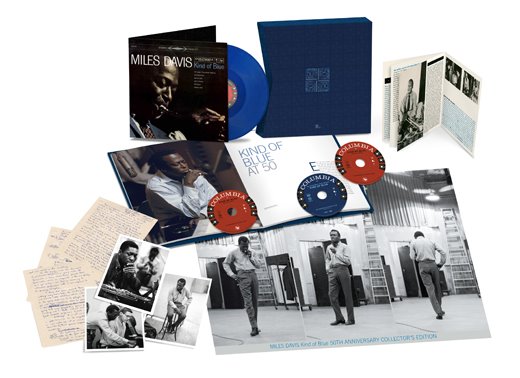
Miles Davis, 'Kind of Blue 50th Anniversary boxset

I'm speechless. I am without speech. One of my favourite albums of all time, one of the finest records ever made, has been released in an ultra-deluxe new edition. Kind of Blue, the best-selling jazz record of all time, with an ultra-stellar line-up of musicians, including Miles Davis, John Coltrane, Cannonball Adderley and Bill Evans, is being re-released (again) to celebrate its fiftieth anniversary. The package sounds like an absolute must for fans and newcomers alike.

The 'Super-Deluxe' 12-inch slipcase box set contains:
  • Two CDs (original album plus studio sequences, false starts, and alternate takes from 1958-59 sessions, plus 17-minute “So What” live in Holland, 1960)
  • DVD: newly-produced documentary featuring superstars of jazz
  • 60-page ‘perfect-bound’ 12x12 full-color book, tons of photos
  • 180-gram blue vinyl 12-inch LP– first time ever in a Legacy box set !
There are also in-depth liner note essays written by award-winning Miles Davis authorities Francis Davis and Gerald Early; session transcripts by Ashley Kahn; detailed 1957-60 quintet/sextet timeline by Bob Belden and Ken Vail. Box set memorabilia: 3-page hand-written liner notes by Bill Evans; reproduction of 1959 Columbia promo brochure; six 8x10 photos; and 22x 33 foldout poster.

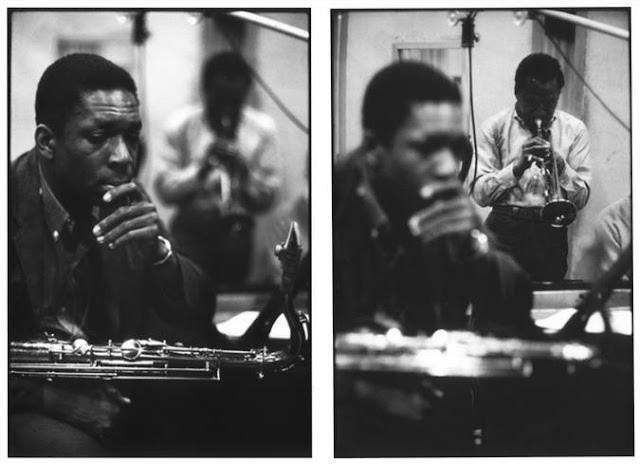
John Coltrane and Miles Davis in the studio, recording 'Kind of Blue'
And as if that wasn't enough, Miles-Davis.com announces more:
'Of special importance to Miles Davis aficionados around the globe is the DVD produced by Nell Mulderry: Celebrating A Masterpiece: Kind Of Blue. The new DVD incorporates material from the 2004 mini-documentary, Made In Heaven, including black-and-white still photography of the recording sessions and the voices of Miles (at the sessions), as well as excerpts of radio interviews with the late Bill Evans and Cannonball Adderley. There are interviews with musicians and luminaries including composer/performer David Amram, the late Ed Bradley, Ron Carter, Jimmy Cobb, Bill Cosby, Herbie Hancock (who demonstrates “So What” at the piano), Eddie Henderson, Shirley Horn, Dave Liebman, the late Jackie McLean, funk-rocker Me’Shell Ndege'Ocello, hip-hop's Q-Tip, Carlos Santana, John Scofield, Horace Silver, and many others.

'The DVD also unearths the group’s entire 26 minute in-session appearance on “Robert Herridge Theatre: The Sound of Miles Davis,” a CBS television program recorded in 1959 and broadcast in 1960. Another bonus feature is the gallery of images captured by Columbia staff photographer Don Hunstein, covering the original recording sessions, as well as a key performance at New York’s Plaza Hotel in September 1958. (Hunstein is prominently represented in the 50-plus images in the KIND OF BLUE: 50th book.) In conjunction with the latter, an unprecedented four-week exhibit of Miles Davis photography will be mounted at New York’s downtown Morrison Hotel Gallery in November-December 2008 (also featuring live music); the exhibit will then travel to other Morrison Hotel locations and Starwood Hotels in 2009. [...]
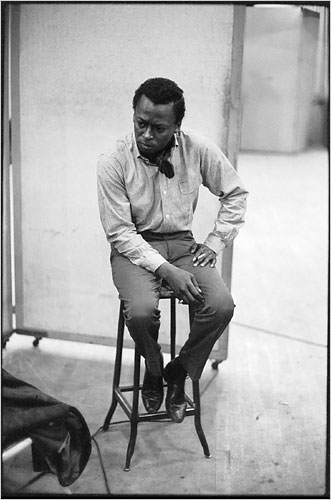
Miles Davis in the recording studio
[...] 'Celebrating A Masterpiece: Kind Of Blue was directed by Chris Lenz, known for his work on the bonus DVD of interviews and performances that accompanied the 2003 Legacy Edition of Jeff Buckley Live At Sin-É. The new DVD was executive produced by Adam Block, co-produced by Ashley Kahn, and written by Michael Cuscuna.

'At the absolute core of KIND OF BLUE: 50th is the original 45-minute album program, whose five titles – “So What,” “Freddie Freeloader,” “Blue in Green,” “All Blues,” and “Flamenco Sketches” – are indelibly etched in our contemporary musical DNA, be it jazz, rock, third through fifth stream classical, or beyond. They are familiar old acquaintances on the LP as it existed in the marketplace for nearly three decades: the first three numbers occupying side one (which happened to have been cut on the first day of recording, two three-hour sessions on Monday, March 2, 1959); and the last two numbers on side two (recorded at the final three-hour session of Wednesday, April 22, 1959).'
I don't think I have anything else to say on the matter: this one is a must!
5.8.08

Pure Anecdote

On my fascination with biography
Samuel Beckett

French philosopher Jacques Derrida once introduced a seminar on autobiography with a quote by Martin Heidegger; speaking on the life of Aristotle, Heidegger had said, 'he was born, he thought, and he died. The rest is pure anecdote.' And it's an interesting point to make. Regardless of what Aristotle may or may not have done during his lifetime, all that is relevant to us is the work he left behind.

Aristotle's ideas form some of the central touchstones of Western philosophy, and continue to influence our understanding of who we are and where we are going. Do we really need to know what the man ate for breakfast?

While visiting art galleries in Berlin during his youth, Samuel Beckett made a point regarding conjecture and speculation in history books. He wrote in one of his travel diaries:
"I am not interested in a 'unification' of the historical chaos any more than I am in the 'clarification' of the individual chaos, and still less in the anthropomorphisation of the inhuman necessities that provoke the chaos. What I want is the straws, flotsam, etc., names, dates, births and deaths, because that is all I can know."
The rest, as Heidegger suggests, is at best pure anecdote; at worst, wild speculation. The lives of historical figures will always remain a mystery to us, despite our best efforts to uncover hope for the contrary. I can read a biography of Franz Kafka. I can read two, or three. I can read Kafka's private journal. If I was so disposed, I could even read letters to his friends, family and loved ones. But all the details I would accumulate, and all the facts I could list, would still read cold off the page. They don't bring me any closer.

But what is it that makes me scurry off in search of these biographies, authorized and unauthorized alike? Is it my attempt to get to the heart of a man or a woman that has held my attention so closely, and do I really think I'll succeed? Does it really make a difference if there's a selection of black-and-white photographs from someone's personal archive on the central pages? Will I know them any better? Do I really want to?

I suspect that I track down autobiographies when I feel an affinity for someone's art. That's where it all begins. I might listen to a Miles Davis or a John Coltrane record, and hear something that speaks to me in some way. I wonder what this sensation is, this sense of recognition, and hope that knowing the artist in more depth might reveal something more. Perhaps it will explain something to me about myself, and why I am drawn to it.

I often I feel I can identify with the people I read about, and it gives me a sense of comfort and satisfaction to find a kindred spirit with similar preoccupations. But the end result is always the same: at the end of the book I become at least partly disillusioned with the life and return to the original work. What is it people say about meeting your heroes? Ultimately, it's not Miles Davis that holds my interest, but his music.

I'm currently reading James Knowlson's biography of Samuel Beckett, Damned to Fame, and I'm repeating the same process all over again. I'm a huge fan of the writer's plays, novels, poetry and short stories, and for years I've been interested to know more about the creator. His work has, like Kafka's, always felt close to me, so I was keen to discover whether I would form a similar impression of the man himself.
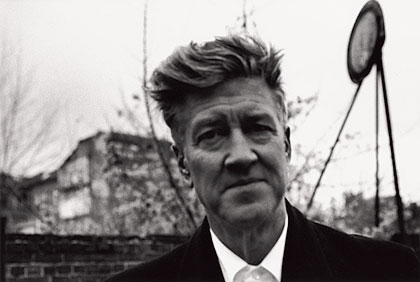
David Lynch

I'm finding that there are dozens of facts about Beckett's life that I identify with very strongly, from similar personal experiences to shared opinions and outlooks. And these small details accumulate to form a satisfying feeling. However, before I even finish the book I can tell you that there's something missing. Not only is there a vast wealth of detail that I do not relate to, and on some level choose to overlook or ignore, but the facts ultimately do little more than emphasize Beckett's absence. The biography, after all, is not the man. More shocking still, neither is the work.

It is often tempting to uncover what an artist thinks about their work, to gain a greater appreciation of the qualities that drew you to it in the first place. But it's easy to forget that we might not agree with the author's interpretations of his or her work, and that it might conflict quite strikingly with opinions of our own.

Interviewed by Mark Cousins in the late 1990s, director David Lynch was asked for his interpretation of scenes from some of his films. The releases shown included Blue Velvet, Elephant Man and Fire Walk With Me, a film that accompanies the Twin Peaks television series. Lynch admitted that all of his films have meant something deeply personal, but declined to reveal anything on camera. Instead, he focussed on the importance of the audience becoming involved with the films for themselves, and drawing their own conclusions. 'It's a beautiful thing,' he said.

And I can't help but agree. That's not to say I won't stop reading biographies, mind you. Old habits die hard, after all. But I'm no longer in search of any authoritative answers to my big questions. After all, a biography can only offer us the facts, pure anecdotes and wild speculations. Why settle for someone else's when you can have your own?