19.8.12

Grant Gee on Sebald and Joy Division

An interview with The White Review
A still from Grant Gee's documentary, Patience (After Sebald) (2012)
Evan Harris (The White Review) interviews Grant Gee about his documentaries, Patience (After Sebald) and Joy Division: 'Grant has previously made two feature length documentaries: Joy Division, which chronicles the band’s life; and the ambient Meeting People is Easy, for which Grant was nominated for a Grammy, which follows Radiohead as they tour OK Computer. He has made numerous short films and had a productive period in the 90s making music videos for famous bands, most of which he admits are mediocre, apart from the iconic No Surprises by Radiohead, of which he is justly proud. I meet him in the BFI cafe. The large glass windows are showing a sneak peek of spring: an oceanic sky and the Southbank’s brutalist concrete solar-cast copper. Grant is affable and earnest, thinking carefully about his responses, giving them length and depth. He is modest about his career and apologises several times for rambling, which he does not.' [Read More]

Also at A Piece of Monologue:
2.3.12

Grant Gee, Patience (After Sebald)

'Gee emulates the act of attentive reading.'
A still from Grant Gee's Patience (After Sebald)
Vertigo reviews Grant Gee's recent documentary about W. G. Sebald, Patience (After Sebald) [Read More]

Also at A Piece of Monologue:
24.1.12

The South Bank Show: J. G. Ballard

Documentary first broadcast in 2006


Also at A Piece of Monologue:
17.7.11

The Unmade Films of J. G. Ballard

On the cinematic qualities of Ballard's work
A still from Chris Petit's The Unmade films of JG Ballard (1990)
UBUWeb are hosting a fragment of Chris Petit's The Unmade films of JG Ballard [1990], a film possibly also known as Moving Pictures: JG Ballard. The website describes the film as an 'essay on Ballard's fiction, and its unrealised cinematic potential, with particular reference to David Cronenberg's (yet to be filmed) Crash, featuring an interview with the director, prior to making of his film.' (link via Ballardian) [Watch the Film]

Also at A Piece of Monologue:
24.8.10

Chris Petit, Radio On

Watch Chris Petit's seminal existential road movie online

Radio On
Uploaded by BFIfilms. - Watch feature films and entire TV shows.

Also at A Piece of Monologue:
5.3.10

Chris Petit: Content and Radio On

Sight and Sound profiles the work of the British director

In an online exclusive for Sight and Sound magazine, Mark Fisher explores the Ballardian landscape of Chris Petit's new film, Content, and reflects on it as an 'informal coda' to his hypnotic debut feature, Radio On:
At one point in Chris Petit’s haunting new film Content, we drive through Felixstowe container port. It was an uncanny moment for me, since Felixstowe is only a couple of miles from where I live – what Petit filmed could have been shot from our car window. What made it all the more uncanny was the fact that Petit never mentions that he is in Felixstowe; the hangars and looming cranes are so generic that I began to wonder if this might not be a doppelgänger container port somewhere else in the world. All of this somehow underlined the way Petit’s text describes these “blind buildings” while his camera tracks along them: “non-places”, “prosaic sheds”, “the first buildings of a new age” which render “architecture redundant”.

Content could be classified as an essay film, but it’s less essayistic than aphoristic. This isn’t to say that it’s disconnected or incoherent: Petit himself has called Content a “21st-century road movie, ambient”, and its reflections on ageing and parenthood, terrorism and new media are woven into a consistency that’s non-linear, but certainly not fragmentary. [...]
Radio On, Petit said in a recent interview, “ended with a car ‘stalled on the edge of the future’, which we didn’t know then would be Thatcherism.” Ahead lay a bizarre yet banal mix of the unprecedented and the archaic. Instead of accelerating down Kraftwerk’s autobahn, we found ourselves, as Petit puts it in Content, “reversing into a tomorrow based on a non-existent past”, as the popular modernism Radio On was part of found itself eclipsed by a toxic-addictive confection of consumer-driven populism, heritage kitsch, xenophobia and US corporate culture. In this light, Content stands as a quiet but emphatic reproach to the British cinema of the last 30 years, which in its dominant variants – drab social realism, faux gangster, picture-book costume drama or mid-Atlantic middle-class fantasia – has retreated from modernity. It isn’t only the poor and the non-white who are edited out of Notting Hill, for example – it’s also the Westway, west London’s Ballardian flyover, which now stands as a relic of “the modern city that London never became”.

Yet Content isn’t just a requiem for the lost possibilities of the last 30 years. In its use of stunning but underused locations – the ready-made post-Fordist science-fiction landscapes of Felixstowe container port, the eerie Cold War terrain of nearby Orford Ness – Content demonstrates not only what British cinema overlooks, but what it could still be. [Read the article]

Content shows on More4 on 9 March. Independent cinema screening dates and venue details to be confirmed

Also at A Piece of Monologue:
17.1.10

Disjecta: This week's links


(Image: Woody Allen stands in front of the New Yorker building)

This week has seen a proliferation of William Burroughs on the web, including two wonderful documentaries. In other news, The Guardian reviews Joyce Carol Oates' latest novel, A Fair Maiden, and plans have been made to restore George Orwell's Indian birthplace. Woody Allen contributes a short, humorous piece to the New Yorker magazine, Radio On director Chris Petit announces his new road movie, Content, and Paul Morley interviews music producer Brian Eno.

Literature:

William S. Burroughs: The BBC Arena documentary
William S. Burroughs: Documentary on Burroughs' life and work
William S. Burroughs: Polina Mackay on The Naked Lunch
William S. Burroughs: Sound recording, The Doctor is on the Market
Jorge Luis Borges: The Mirror Man documentary
J. G. Ballard: Hitchens on Ballard
Martin Amis: The Guardian book club reviews Time's Arrow
Will Self: Sebald, the Nobel prize and pets
Mervyn Peake: Book cover designs
Joyce Carol Oates: A review her new novel, A Fair Maiden
George Orwell: Orwell's birthplace in India to be restored
Reading: Natasha Tripney on the unvanquishable book pile
Humanities: Increasingly 'commercialized' university culture

Philosophy & Critical Theory:

Slavoj Žižek: Žižek speaks at the London Society of the Arts
Harold Bloom: Hospitalized
Walter Benjamin: Radio broadcasts for children
Timothy Clark: Robert Eagleston on The Poetics of Singularity
Most Cited Authors, Critics and Philosophers in the Humanities
101 Great Philosophers: The Guardian reviews Madsen Pirie's new book

Music:

Brian Eno: Paul Morley interviews the unique producer

Film:

Woody Allen: A piece in the New Yorker's 'Shouts & Murmurs' column
Werner Herzog: Guernica on the reissued journal Walking on Ice
Werner Herzog: Mark Kermode's memoir recalls Herzog's gunshot wound
Eric Rohmer 1920-2010
Chris Petit: Petit presents his new documentary, Content

Television:

Treme: New Orleans drama from David Simon, creator of The Wire.

Art:

Damien Hirst: Art critic Jonathan Jones is 'finished' with Damien Hirst

Theatre:

Thomas Bernhard: Heldenplatz at London's Arcola Theatre this month

Etc.:

Elsie de Wolfe: Profile of the interior designer at Critical Cookie


Thank you to all link contributors, who can be found on the A Piece of Monologue Twitter page.
3.10.09

Radio On at Chapter Arts Centre

A chance to see Chris Petit's existential road movie
Chris Petit, 'Radio On'
Chris Petit's beautiful existential road movie, Radio On, is playing at Chapter Arts Centre in Cardiff on October 13th. Produced by Wim Wenders in the late 1970s, Radio On includes a soundtrack featuring Kraftwerk, David Bowie, and Robert Fripp. Its barely-existent narrative delineates a quiet protagonist's journey from London to Bristol, to investigate the possible suicide of his brother. It's shot in a wonderfully dark, glossy monochrome, and includes some superb evocations of Ballardian motorways and decaying late-twentieth century Britain. A must see.

More information:

25.4.09

Chris Petit on J. G. Ballard

Filmmaker and novelist on one of his key influences, writer J. G. Ballard
J.G. Ballard and Gabrielle Drake in ‘Crash!’ (1971; dir. Harley Cokliss).
'For Ballard, the key image of the last century was that of a man driving alone down a superhighway.'

The tributes just keep coming. Writer and critic Chris Petit has reflected on the passing of J. G. Ballard, who died earlier this week after a long illness. Petit is best known to me for his late-70s existential road movie Radio On, a downbeat black-and-white masterpiece about 'a man driving alone down a superhighway.' Petit's film is an excellent example of the Ballardian mood that pervades certain elements of British culture.

Incidentally, this isn't the first time the influence of Ballard has been felt in Petit's work. Iain Sinclair's Crash (BFI) draws a number of aesthetic parallels between Ballard and Petit. Chris Petit's debut novel, Robinson, even begins with a quotation from Ballard, taken from his autobiographical sequel to Empire of the Sun: The Kindness of Women. The quote reads: 'Deep assignments run through all our lives; there are no coincidences.'

You can read Petit's article, published in Granta, by clicking here.
20.4.08

Radio On

Chris Petit's seminal philosophical road movie
Radio On (dir. Chris Petit, 1980)
Radio On is a subtle, masterfully understated meditation on late 1970s Britain. It's a journey through underground arthouse cinema from the 40s to the 70s, and an experiment in European forms of cinematic expression. But Radio On is also a journey in itself: a kind of existential road movie. It traces the strangely melancholy story of a protagonist disconnected from his job, his friends, his family and his surrounding environment. Upon hearing of the death of his brother - which may or may not have been a suicide - the leading character decides to make a necessary trip from London to Bristol, perhaps to uncover an unknown truth.

Along the way, the protagonist meets a diverse collection of characters. There is a soldier driven to violence and psychosis by a job he despises. A guitar player (played by Sting) who finds himself nostalgic for an idyllic past, dreaming of a future career in music that's been "lost in the post". There is a German woman disconnected from her homeland, her family, her language and her own sense of identity. And then, of course, there is Robert B., the leading character: an individual of no apparent origin and no apparent destination.
Radio On (dir. Chris Petit, 1980)
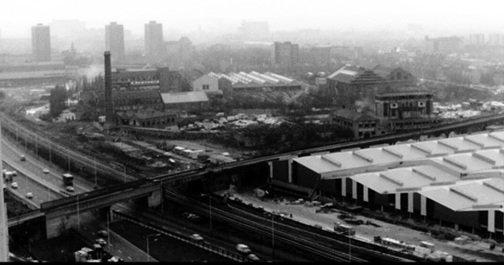
Radio On's loose, barely-existent narrative is told through a rich monochrome print of ghostly whites and glossy blacks, presenting fractured, dehumanising Ballardian urban backdrops alongside gloomy, ethereal rural landscapes. There are resonant panning shots of cityscapes saturated with the detritus of defunct nineteenth century industry alongside boarded-up, dilapidated buildings, abandoned petrol stations and empty hotels. All contribute to a profound and poignant sense of wonder and dread. Beautifully crafted static shots seem to emphasise the empty meaning of modern existence through images of blank, static television screens, monotonous flickering marquees and lurching fuel-pump dials.

The soundtrack that underscores the entire film lends context to the time it was made, but also adds a dreamy, abstracted depth to the cinematography. David Bowie's 'Heroes/Helden' opens the film as a camera slowly pans around an austere apartment; the familiar English lyrics juxtapose with a German rendering of the song that throws all listeners into strange new territory.

The familiar quickly becomes unfamiliar, the natural unnatural, the real strangely unreal. Kraftwerk's contributions offer some strange contradictions: an odd, compelling mixture of the human and the inhuman: nostalgic yet distant: human ghosts lost in the machines. Robert Fripp's otherworldly 'Urban Landscape' plays over shots of a city at night, of sound and light... again, familiar yet somehow intangible. There is a distinct, pensive tone to this waking daydream of a film.

Radio On (dir. Chris Petit, 1980)
Radio On is ultimately a film about a time and a place. There is a sharp, distinct, yet inexplainable mood that saturates every note of every song, and every grain of every shot. The tone of Radio On expresses a time and a place where everything rests on the cusp of inevitable change. The central irony of the film being the final victory of a universal cynicism, as Britain spirals into political turmoil and the unforgiving, authoritarian political agendas of Thatcherism take grip.

There is no final sense of resolution as the film draws to a close. Radio On is an experience to be absorbed rather than a story to be followed; the circumstances that surround Robert's brother are never really made clear. Instead, Radio On dwells on its own thoughtful ambiguities, opening the possibilities not only for the self-discovery of its protagonist, but for the self-discovery of its audience.

Radio On is not a film that espouses truth, or that claims to grant a closure or sense of direction to the lives of its audience. Instead, it is a film situated upon such problems, and choosing to tackle them head-on. Radio On attempts to confront the absurdity and disenchantment of 20th Century living. It is a reflection on existence: a meditation on a time and a place that reflects the circumstances that created it, and that still holds a strong relevance for audiences today. A beautiful, gloomy, melancholy masterpiece, and an absolute must-see.

Watch Radio On free at A Piece of Monologue