7.7.09

Amélie Doistau: French editions of Beckett's work

A wonderful online gallery of Doistau's designs
Amélie Doistau photography on French editions of Samuel Beckett's work
This morning I stumbled upon the work of graphic designer Amélie Doistau, who has contributed photographs for five proposed volumes of Samuel Beckett's work:
  • En attendant Godot (Waiting for Godot)
  • Mal vu Mal dit (Ill Seen Ill Said)
  • Oh, les beaux jours (Happy days)
  • Molloy (Molloy)
  • L'Inommable (The Unnamable)
As far as I can tell, these designs have never been implemented, but were possibly artistic proposals for a prospective publisher. The website displays two separate design concepts for the five editions (above). The first depicts a series of minimalist domestic spaces, while the second focusses on props in an austere, brightly-lit room. One or two of the images seem a little inappropriate for their subject matter, but the photographs are beautiful and nicely conceived. You can click on the images above to see them in a much larger resolution, or visit Amélie Doistau's website.
24.6.09

University of Reading: Beckett Conference 2009

News and developments in the world of Beckett Studies
Samuel Beckett at his apartment in Paris signing a rare Limited Edition copy of The Lost Ones
In the summer of 2008, James and Elizabeth Knowlson contributed a vast collection of Beckett's letters, manuscripts and interviews with his friends to the Beckett International Archive at Reading University. To celebrate the occasion, an academic conference will be taking place in September 2009, and will be attended by some of the leading scholars in contemporary Beckett criticism.

In addition, talks and displays are being organized to coincide with the conference; these aim to explore the historical and cultural significance of the Knowlson collection, and what it means for future academic scholarship.
Reading University is one of the world's leading institutions for Beckett study, and holds an international reputation for its academic research resources. In the first issue of Beckett News, published this month, the university reveals further details of the upcoming conference, the Knowlson collection, and their cooperation with Faber and Faber to enhance and expand recent editions of Beckett's prose, poetry and drama:
Samuel Beckett's hands, signing a manuscript
Beckett – Living Materials:
International Conference and Research Opportunities Symposium
25-26 September 2009
Beckett Conference 2009: Humanity and Animality in Beckett

On Friday 25 and Saturday 26 September, the Beckett International Foundation is organizing a Beckett Symposium to celebrate the acquisition of the Knowlson archive. This will include a conference constituting a preliminary stage to a project on animality in relation to Beckett’s work being prepared by Mary Bryden and entitled A Beckett bestiary. The conference, Humanity and Animality in Beckett, will bring together an international line-up of scholars who will read papers over the two days. Key acquisitions from the Knowlson collection will be on display in the Reading Room and delegates will have the opportunity to handle some of these materials. Mark Nixon and Dirk Van Hulle, University of Antwerp, will present the Beckett Digital Manuscript Project as a ‘work in progress’, and Bill Prosser's doodle drawings will be on display. There will also be a theatrical performance (which is yet to be confirmed) and a round table discussion of the research opportunities arising from the acquisition of the Knowlson collection. Further details of the symposium will be available on the BIF website: www.beckettfoundation.org.uk

Samuel Beckett manuscript

The Beckett Digital Manuscript Project

The Beckett Digital Manuscript Project is an international collaboration under the auspices of the [Beckett International Foundation], the Centre for Manuscript Genetics at the University of Antwerp and the Harry Ransom Center, Austin, Texas, and supported by the Estate of Samuel Beckett and the Bibliothèque Nationale in Paris. Mark Nixon and Dirk Van Hulle are the co-directors. Mark and Dirk are also collaborating on Samuel Beckett’s library, a joint monograph which examines the reading traces in the books held in Beckett’s library at the time of his death. Mark is editing a book on Beckett and publishing (British Library, 2010), with John Pilling, Andrew Nash and Sean Lawlor among the contributors.

New Faber and Faber editions of Samuel Beckett's work

Reading and Faber & Faber

Faber, which has acquired the rights to Beckett's prose, poetry and criticism from Calder, is republishing Beckett's works in uniform ‘Readers’ editions’, intended for the general public, and ‘Critical editions’ addressed to a more academic audience. The Beckett International Foundation is contributing facsimiles from the holdings at Reading, which will be used to illustrate the Readers’ editions. Reading scholars are very much to the fore in providing introductions to the Readers’ editions and lending their erudition to the Critical editions. Ronan McDonald wrote the preface for the new Faber edition of Endgame that was published in May 2009. James Knowlson is writing the preface to Happy days and Mary Bryden to Waiting for Godot. Mark Nixon is editing a Readers' Edition of Samuel Beckett: shorter fiction 1950–1981 and preparing a Critical Edition of the short story Echo's bones, both are due to be published next year. Sean Lawlor and John Pilling are working on the Critical edition of the Collected poems of Samuel Beckett to be published in 2011.

Reading University: Beckett News, June 2009, Issue 1 (PDF format)
Reading University: Beckett News, June 2009, Issue 1 (HTML format)

Leading Ladies: Fiona Shaw in Happy Days

The Guardian offers its list of grand stage roles for women
Fiona Shaw as Winnie in 'Happy Days'
The Guardian has published an online gallery of leading ladies in dramatic on-stage productions, all photographed by Tristram Kenton. Included among them is Fiona Shaw's performance of Winnie in the 2007 production of Samuel Beckett's Happy Days:
Particularly as he aged, Samuel Beckett wrote some extraordinary roles for women – none more so than in this almost-one-woman show, in which a senior performer must enact the human tragicomedy while buried first to her waist, then to her neck in sand.

10.11.08

How Beckett Can Save Your Life

Fiona Shaw as Winnie in Samuel Beckett's 'Happy Days'
"WINNIE: [gazing at zenith] Another heavenly day."

Samuel Beckett, Happy Days
One night last week I sat down to watch Samuel Beckett's Happy Days, a production from the Beckett on Film project. I had been looking forward to it for some time, being a fan of the writer's work, and up until that point had never seen or read the text. Or so I thought. I settled myself into a comfortable position on my bed, pressed the Play button of my remote control, and a strange realization began to dawn on me. I had encountered the text before, and my memories of reading it began to emerge.

A few years ago I had found myself in a hospital bed with a spinal infection. My illness had left me paralyzed from my chest downwards, and without any physical sensation. It had been a terrible distressing time for me, and I can remember using various coping mechanisms to get me through. I was an undergraduate at the time, studying English Literature and Cultural Criticism at Cardiff University. It was the beginning of the Autumn semester, and while my return suddenly seemed unlikely, my parents had brought a neat little box filled with all of my set texts for the weeks and months ahead.

Ever the optimist, I remember reaching down into that box three or four times a day, between meals, check-ups, medication and conversation. Time passes slowly on a hospital ward, and the idea of working was not only a great distraction, but a way of looking to the future instead of dwelling on my sorry predicament. I can remember reading a Postcolonial discourse reader, and annotating several of the articles inside for the sheer hell of it. I really knew how to live back then. I can remember skimming through one of the photocopied handouts that came with some of the modules. And I can even remember looking at a dog-eared paperback of Dan Brown's Da Vinci Code, which my Auntie had contributed to the box. I didn't get around to reading that one. Time doesn't pass that slowly.

But what I couldn't remember, for the life of me, was picking up Samuel Beckett's Happy Days. I can see it now, settled snugly to the left, a slim Faber & Faber paperback edition. It was the set text for an English Literature module on modern drama, but failed to draw my attention in any fantastical way. The cover looked pretty mundane and unassuming, although I remember liking the typeface of the title. Very clean, very simple. But that's for another time.

Watching the Beckett on Film production I suddenly became violently aware of myself in hospital again, reading the text on a ward for serious brain and spine injury/infection. It was beginning to get dark, and I had stretched out to turn on my reading light. I could see the city out through the windows on my left, and to my right the lights of the corridor and the nurse's station. A member of staff would visit each bed in each ward on the hour, every hour, to check on every patient and administer drugs or pain relief.

I lay in wait for a painless injection into the side of my stomach, which to this day I'm still confused about, but I suspect it was to prevent my muscles from wasting. It was at this time that I sat up, as best I could, and read Happy Days in the dark. My first experience of Samuel Beckett's writing, and one I would soon completely forget.

What strikes me now, more than anything, was the apposite nature of the play in relation to my situation at the time. The lead protagonist, Winnie, is trapped up to her waist in earth, completely unable to move from this point down and permanently rooted to the spot. She still has agency, of a sort, and retains a sense of life and independence through language, but there is no denying her physical condition. In the second act it worsens still. 'Still' being the appropriate word. Winnie finds herself buried to her neck, but continues to speak to her mostly unseen companion Willie to the very end of the play.

I suddenly remembered feeling very disturbed by Winnie's position, as it felt so completely close to my own. I had been informed that there was a risk my spinal infection may spread further upward, paralyzing my lungs. But we managed these risks as best we could, and those caring for me took every precaution and every care. They were magnificent, I must say. But despite their reassurances, I still felt a terrible anxiety about my position and began to relate ever more to the absurdity of Winnie's.

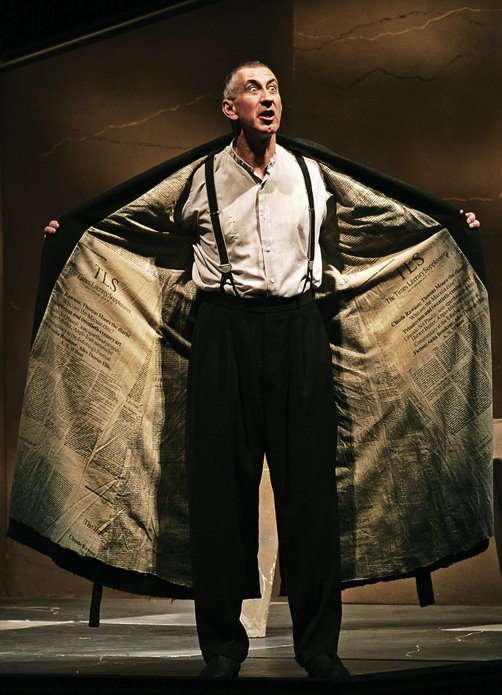
Barry McGovern performing 'I'll Go On', a monologue adapted by Gerry Dukes and Barry McGovern from Samuel Beckett's 'Trilogy'.

Although I forgot my hospital experience of Beckett's play (had I repressed it?), I find it strange to discover that I began reading his work in earnest exactly one year later. I'm always a little depressed around this season when I remember my time on the wards, and perhaps I was looking to regain the comfort I had found back then. But whatever the case, I found it, and continue to find it in Samuel Beckett's work.

The physical similarities between Winnie and myself are, in retrospect, irrelevant. They were simply the hook that drew me in, that enabled me to relate and identify myself with the character. After that, I began to identify with different qualities in different places. Whether I was reading a short dramatic work, or one of Beckett's novels, there is a questioning tone that explores themes running through our lives, and which appealed to me.

I'm not talking about political or ethical or even philosophical types of questioning, but something else. Beckett's work, while doubtlessly relevant to these areas I mention, also represents the quiet times that individuals experience. Whether we call it solitude, or loneliness, or waiting, Beckett has a distinctive knack for representing it: those quiet times we meet with humour, or bitterness, or melancholy, or joy, or the searching out of a friend. For me, Samuel Beckett's work reflects this strange space in a reassuring way. His prose and dramatic work manage to capture those quiet times without the trite sentimentality that creeps into this blog from time to time: it's naked, it's bare and it feels truthful. And I love it.

When I read Happy Days a few years ago, I thought I needed it to relate to and to comfort me. But now that I have fully-recovered, I feel I need it still. Perhaps more than ever.