22.10.12

Brian Eno on Music, Art and Imaginary Landscapes

A 1989 documentary

Open Culture (link via 3:AM Magazine):
In Imaginary Landscapes, documentarians Duncan Ward and Gabriella Cardazzo paint an impressionistic video portrait of Brian Eno: record producer, visual artist, collaborator with the likes of U2 and David Bowie, ambient music-inventing musician, self-proclaimed “synthesist,” early member of Roxy Music, and co-creator of the Oblique Strategies. Even if you’ve never handled an actual deck of Oblique Strategies cards — and few have — you’ve surely heard one or two of the Strategies themselves in the air: “Honor thy error as a hidden intention.” “The most important thing is the most easily forgotten.” “Do something boring.” The idea is to draw a card and follow its edict whenever you hit a creative block. This should, in theory, get you around the block, no matter what you’re trying to create. Eno first published the Oblique Strategies with painter Peter Schmidt in 1975, and here in Imaginary Landscapes, fourteen years later, you can hear him still excited about the cards’ basic premise: if you follow arbitrary rules and theoretical positions, they’ll lead you to creative decisions you never would have otherwise made. [Read More]
Also at A Piece of Monologue:
12.9.12

Brian Eno: 1980 Radio Interview

Brian Eno interviewed on KPFA's Ode to Gravity
Brian Eno
From UbuWeb:
Charles Amirkhanian and Brian Eno discuss Phonetic Poetry, how Brian writes his lyrics, and the spirit of inquisitiveness at KPFA Radio on Saturday February 2, 1980. Listen to some of Brian Enos pieces; After the Heat, Everything Merges With the Night, Another Green World, Spirits Drifting and sections of other pieces. Brian Eno also discusses the artist Peter Schmidt and their work on the Oblique Strategies Cards, being a producer, Process vs Product and looping. Reel I ends with some thoughts on Steve Reich and his music.

Reel II starts with the history of the recording studio as a compositional tool;" and collaboration with David Byrne on album My Life in the Bush of Ghosts. Eno also talks about and listens to Elvis, The Supremes, Sly Stone, Lee Perry and Jimmy Hendrix. Then he offers some unfinished pieces from his upcoming album with David Byrne. [Read More]
Also at A Piece of Monologue:
17.1.10

Disjecta: This week's links


(Image: Woody Allen stands in front of the New Yorker building)

This week has seen a proliferation of William Burroughs on the web, including two wonderful documentaries. In other news, The Guardian reviews Joyce Carol Oates' latest novel, A Fair Maiden, and plans have been made to restore George Orwell's Indian birthplace. Woody Allen contributes a short, humorous piece to the New Yorker magazine, Radio On director Chris Petit announces his new road movie, Content, and Paul Morley interviews music producer Brian Eno.

Literature:

William S. Burroughs: The BBC Arena documentary
William S. Burroughs: Documentary on Burroughs' life and work
William S. Burroughs: Polina Mackay on The Naked Lunch
William S. Burroughs: Sound recording, The Doctor is on the Market
Jorge Luis Borges: The Mirror Man documentary
J. G. Ballard: Hitchens on Ballard
Martin Amis: The Guardian book club reviews Time's Arrow
Will Self: Sebald, the Nobel prize and pets
Mervyn Peake: Book cover designs
Joyce Carol Oates: A review her new novel, A Fair Maiden
George Orwell: Orwell's birthplace in India to be restored
Reading: Natasha Tripney on the unvanquishable book pile
Humanities: Increasingly 'commercialized' university culture

Philosophy & Critical Theory:

Slavoj Žižek: Žižek speaks at the London Society of the Arts
Harold Bloom: Hospitalized
Walter Benjamin: Radio broadcasts for children
Timothy Clark: Robert Eagleston on The Poetics of Singularity
Most Cited Authors, Critics and Philosophers in the Humanities
101 Great Philosophers: The Guardian reviews Madsen Pirie's new book

Music:

Brian Eno: Paul Morley interviews the unique producer

Film:

Woody Allen: A piece in the New Yorker's 'Shouts & Murmurs' column
Werner Herzog: Guernica on the reissued journal Walking on Ice
Werner Herzog: Mark Kermode's memoir recalls Herzog's gunshot wound
Eric Rohmer 1920-2010
Chris Petit: Petit presents his new documentary, Content

Television:

Treme: New Orleans drama from David Simon, creator of The Wire.

Art:

Damien Hirst: Art critic Jonathan Jones is 'finished' with Damien Hirst

Theatre:

Thomas Bernhard: Heldenplatz at London's Arcola Theatre this month

Etc.:

Elsie de Wolfe: Profile of the interior designer at Critical Cookie


Thank you to all link contributors, who can be found on the A Piece of Monologue Twitter page.
14.11.09

David Bowie's Lodger: 30th Anniversary

Third album in the renowned 'Berlin Trilogy'
David Bowie, 'Lodger'

The Quietus celebrates the thirtieth anniversary of David Bowie's Lodger, the third album of the so-called Berlin trilogy (Low, "Heroes", Lodger). Ben Graham elaborates on the significance of Lodger to Bowie's career, and recaps some of the key details of the musician's creative relationship with Brian Eno.

There's also an interesting exploration of Bowie's influences at the time the album was recorded, from the high-strung intellectualism of Talking Heads and the motorik beat of Neu!, to the European paranoia of Polanski's The Tenant.

But in essence, Graham aims to establish once and for all the role that Lodger plays within Bowie's Berlin trilogy. On the one hand, he argues, there are characteristics that hold it in place alongside Low and "Heroes", but the release of Lodger inevitably marks a kind of irreconcilable departure (thank you to 'Z' for drawing my attention to this article):
[...] And responsibility, in the end, is the real theme of Lodger: taking us back to the opening track’s worries over the fate of the entire planet resting in the hands of one flawed, capricious human being, through to ‘Repetition’s’ description of how we pass on our pain to those closest to us, full of self-pitying victimhood yet unaware we’ve become the aggressor. From the crippling banality of ‘DJ’- a man with the ears of millions of believers, yet nothing to say- to the cocooned self-absorption of ‘Boys Keep Swinging,’ and the damp squib of a judgement day portrayed in ‘Look Back in Anger.’ The last words on the album are “Such responsibility- it’s up to you and me.”

It’s this sense of responsibility - both individual and collective - that finally separates Lodger from the so-called Berlin albums. Low was, in Bowie’s own words, “Isn’t it great to be on your own, let’s just pull down the blinds and fuck em all”, a celebration of self-pity. “Heroes” saw the individual begin to fight back, but still from a passive-aggressive, me-against-the-world standpoint. It’s only with Lodger that Bowie realises that to survive in any meaningful sense, he has to engage with society, and with the rest of the human race. [Read More]

More at A Piece of Monologue:
29.10.09

David Bowie: 40 Years

An anniversary retrospective
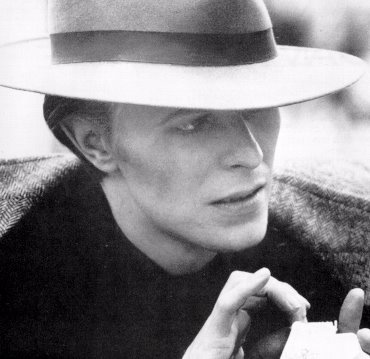
David Bowie as the Thin White Duke, 1976

Graeme Thomson reflects on the musical career of David Bowie, spanning four decades:
In some respects "Space Oddity" was a false dawn, widely regarded as an opportunistic novelty number timed to coincide with the moon shot. Bowie, meanwhile, never felt at ease playing the winsome acoustic troubadour. Bored by the "denim hell" and frayed authenticity of the likes of Led Zeppelin, he eventually hitched his wagon to the overt theatricality of glam rock, creating Ziggy Stardust, the quintessential Bowie construct. Incorporating elements of mime, kabuki and the droogs as portrayed in Stanley Kubrick's [AClockwork Orange, Ziggy was the ultimate representation of pop-star-as-alien, driven by the robust buzz-saw guitar riffs of Mick Ronson. Three years after the first, Bowie's second appearance on Top of the Pops was genuinely iconoclastic, his performance of "Starman" denoting 1972 as Year Zero for a generation of punks, Goths, new wavers and New Romantics.

Having achieved lift-off, Bowie followed through on his promise to make a "wild mutation" as a rock'n'roll star. Only five years passed between 1971's Hunky Dory and the corrupted Aryan beauty of Station to Station, but in that time Bowie bounced from hokey folk to glam to hard rock to frigid Eurodisco, mutating en route into Aladdin Sane, Hallowe'en Jack and the Thin White Duke.

Falling on each emerging trend - disco, Philly soul, electronic minimalism, new wave - as it stole into view, he was a magpie with a priceless knack for pinching ideas from the cultural margins and siphoning them into the mainstream through his own work. One biographer defined him as a "style vampire", a mannequin dressed in a series of beautiful, borrowed clothes. "Some people say Bowie is all surface style and second-hand ideas," said Brian Eno, his on-off collaborator for three decades. "But that sounds like a definition of pop to me."

He certainly looked and acted the part. Sexually voracious - when he met his first wife, Angie, in 1969 they were famously "fucking the same bloke" - he was impossibly thin and vampiric, those fangs and odd, mismatched eyes emitting an unearthly vibe. Like all great pop stars, he contrived to paint the grim grind of sustained drug-taking as a vaguely noble quest, a way of seeking new dimensions rather than making emergency repairs to a fractured psyche. In Bowie's case, mired in cocaine addiction, those dimensions involved dystopian visions where the occult, the Holy Grail and fascism met in some futuristic, Ballardian hell.

Recovering in Berlin from these nightmares in 1976 and 1977, Bowie made the most influential records of his career. Low and "Heroes" were dense, pensive, occasionally hilarious works marrying US R'n'B with the electronic Euro pulse of Neu and Kraftwerk. Lodger (1979) and Scary Monsters (1980) concluded his journey from secluded drug dependency to boisterous commercial rejuvenation, but after that his creativity crumbled. [Read More]

More information:
18.7.09

Brian Eno on the Apollo Moon Landings

Musician, producer and artist speaks about moon landing anniversary
Brian Eno
As part of a retrospective marking the anniversary of the Apollo moon landings, New Scientist magazine has interviewed composer and music producer Brian Eno:
You were 21 when the moon landings took place. What do you recall?

I remember it very, very well. I watched it in the house of my painting tutor at art school, and I remember the very eerie sensation of watching on his little black and white television and then looking up at the moon and being absolutely shocked at the idea of what was happening there at that moment in time. It was one of those strange moments when time closes up on you and something that seems fictional and fantastic suddenly becomes real.

You are credited with inventing ambient music. How do the Apollo moon missions fit in with its development?

Around the time of Apollo I was listening to a lot of film soundtracks. What I liked was that they represented a form of incomplete music, where the missing element was the visual element. I liked making music that somehow allowed the listener to imagine a visual element themselves.
1.7.09

Picador, Beckett and Russell Mills

On Russell Mills' distinctive book designs

John Coulthart on Picador's Samuel Beckett book-sleeves, designed by Russell Mills:
This 1979 Picador edition of The Beckett Trilogy is one of my favourite paperback cover designs. The “illustration” (as it’s described on the back) is a photograph of an artwork by artist/designer Russell Mills and the minimal credit gives no indication as to whether it was Mills who was responsible for the striking type layout. I’ve noted previously the equally striking Picador designs by the Quay Brothers who were responsible for both art and layout on their covers. Mills extended his work into graphic design later with album cover designs (and some book design) for Brian Eno, David Sylvian, David Toop and others so I’ll give him the benefit of the doubt in this case.

21.12.08

Another Green World

Brian Eno, 'Another Green World'
'Well I mean obviously when one’s dealing with words like “real” which are so ambiguous as to be almost meaningless – almost any statement can be true. But what I mean to say is that you can afford to expose yourself to uncertainties in art that you wouldn’t allow yourself in real life. You can allow yourself to get into situations where you are completely lost, and where you are disoriented. You don’t know what’s going on, and you can actually not only allow yourself to do that, you can enjoy it.'
Brian Eno
I took a train to my parents' home in the valleys, and I've secured a small space for myself in what was once my bedroom. When the door is closed, the room feels and looks very quiet; it sounds quiet, too, for that matter. I'm alone with my past. But before I have a chance to get profound about it, I realize that this is not the same room after all. There have been two major renovations in the time since I left, and to some extent the very structure of the room has been altered: wardrobe space has been torn out of the wall, painted, and new bookshelves have been installed in their place.

I have gathered together a pile of unread books, eight clothes hangers, and a bag with my other personal affects. I'm home for the Christmas period, so I am determined to make the place my own. Not in the same way that it was when I was a teenager, when the walls were plastered with images of my favourite personalities or Radiohead posters. But my own in a smaller, more modest way. A few books on the bedside table, and an internet connection on the desk: this is all I need nowadays. I'm not going to stay long, perhaps a week or so; and this room has become a purely functional space for me now.

But, as some things never change, I begin looking for something to listen to while I clear away the old objects. I've heard Brian Eno's name a few times recently, so I thought I'd spin one of his older records, an old favourite, in fact: Another Green World. It was the third solo album since his departure from Roxy Music, and took a new direction from its two predecessors. Gone was the quirky glam pop of Here Come the Warm Jets (a reference to the male orgasm there, if ever there was one) and Taking Tiger Mountain (By Strategy). Another Green World adhered to that tired, dreary idea of the concept album, but managed to energize it with something fresh and exciting - and a little bit strange.

Brian Eno in 1976
I'm always struck by how catchy the songs are. Not that most of them really resemble songs: only five of the fourteen tracks have any lyrics. Another Green World feels like a selection of moods, or atmospheres, that have been constructed in a logical and cohesive way. I can remember listening to the album back in the Cardiff a year or two ago, and how cold everything was. I'm always drawn to the album during the autumn and winter months, if at all, because there is something bleak about the music that seems to suit the scene. What it gives the city is a shimmering soundtrack, and is no less poignant for that.

The music, at times, is very sparse. A few piano notes, a synthesizer, and space to breath. But it's staggering just how affecting the music can become. More than once I've choked up in the middle of 'Becalmed' or 'Zawinul/Lava' or 'Everything Merges with the Night'. There's an instrumental piece entitled 'The Big Ship' which sounds so grand and evocative and romantic that whenever I play it I stop whatever I'm doing and dream off for a few moments. It just sounds so grand and so majestic. And beautiful.

The record feels split between these sparse gestures, atmospheric instrumental pieces such as 'In Dark Trees' and off-hand lyrical ditties like 'I'll Come Running', which I love. There are so many counterpoints in the music, that every time I listen it feels new. But, of course, there is a familiarity there, too. And listening to Another Green World comes complete with an odd kind of welcoming sensation, as though no matter how strange or unsettling the atmosphere of the instrumentals, it's a world you're happy to inhabit. At least for awhile.

I remember reading some time ago that Another Green World was one of the key inspirations for David Bowie's Low album, and formed one of the central reasons for Enos recruitment to the project. It's not difficult to see why, either. 

Another Green World shares some of Low's defining qualities, from its playfulness with the structure and forms of songwriting, to its earnest attempt to create stimulating and compelling musical spaces through the instrumentals. Of course, there are many differences too. But I think it's interesting that whenever I listen to Low, it's never too long before I come back to Another Green World; a record I can happily listen to on repeat all day long, unobtrusively, in the background.

This Charming Man


I've always had a soft spot for Paul Morley. He moved to Manchester in the late 1970s and discovered its rich, tumultuous music scene, becoming both a fan and a reporter for New Musical Express. Now, he is perhaps most associated with his writing on Ian Curtis and Joy Division; Morley found himself a privileged observer of the Factory Records community, and became personally acquainted with all of the members of both Joy Division and New Order. In some ways, he could be considered the band's official archivist. Of sorts.

The catch with Morley, and there's always a catch, it in his delivery. He plays around with the words he uses as he uses them, and he was never afraid to experiment. His stint at the NME came at a time when a number of journalists were playing around with the form, in the same way that the musicians were testing theirs. As far as I remember, Morley's reviews were the first music reviews I encountered that quoted philosophers and contemporary theorists, if only in passing. It was a new writing for a new music.

Morley can be described as eccentric, quirky and offbeat. But at the same time, he's a monument of seriousness. And it can be too much at times. Philip Roth has said that 'sheer playfulness and deadly seriousness are my closest friends', and the words seem to fit snugly around this journalist, sometimes like a noose. But often not. I have a sentimental soft-spot for Paul Morley, whether it is through his writing or his television appearances. And to accusations of pretension or ostentation I can only say that, of course, he is guilty as charged. But it is his pretentious outlook that appeals to me most: it's the appeal of a philosophical Mancunian dandy, always dressed in black.


Single artwork for The Smiths' 'This Charming Man

I've seen him on television a number of times, and it's never a surprise to see him getting carried away. But his heart always seems to be in the right place. In a fantastically strange interview with Brian Eno for 'The Thing Is...' back in 1992, Morley and Eno spend the duration locked in performance games, while searching out what makes Eno tick. You can click here to watch it, incidentally.

But what's drawn my attention today is a more recent clip, teasing out the meaning of This Charming Man by The Smiths. Paul Morley has enrolled Northern poet Simon Armitage to his aid, alongside one of the original band members, drummer Mike Joyce. Once again, the discussion leaps forward into loftiness without a care in the world, in much the same way as Morrissey approaches the song, and investigates the hidden meaning and significance underlying the poetic lyrics.

Of course, ultimately, it's a mystery that will never be solved: there is a magic underlying the drama of This Charming Man which is impossible to capture outside of the song itself. But it's an interesting attempt. And a nice tribute.
16.12.08

David Bowie and the Berlin Period

Bowie moves to Europe to produce a series of seminal recordings
David Bowie, 'Heroes' photoshoot, 1977
'I find that I have to put myself in those situations to produce any reasonable good writing. I've still got that same thing about when I get to a country or a situation and I have to put myself on a dangerous level, whether emotionally or mentally or physically, and it resolves in things like that: living in Berlin leading what is quite a spartan life for a person of my means, and in forcing myself to live according to the restrictions of that city.'

David Bowie speaking with Charles Shaar Murray in 1977.
The first time I lived alone was in my first year as an undergraduate in the city. Friends of mine cast themselves further afield, and in the first months I found myself feeling solitary and depressed. I was never more than eight train stations from someone I knew, but my mindset had changed and I became isolated within myself.

I found a new circle of friends in those first few months, some of whom I'm in touch with to this day. But while I adjusted, I began to realize something very simple and essential about myself. I started to see the ways in which everything I had ever done I had done alone. Up to that point in my life, all of my most treasured experiences, all of my most worthy rewards, were the result of being alone. And it was a thought that made me uncomfortable.

I have always felt myself to be a social person. It's difficult for me to comprehend what it might be like to live alone, or to be by myself for any long stretch of time. But when I moved to the city (a new career in a new town), I began to feel that I had always been somehow alone. It was difficult for me to define at the time, and still is now. But despite my warm and loving family, my fantastic group of friends, and all the others I had loved, I felt a sense of unalterable isolation; it was a sense of absence that placed a gap between me and those around me. As Ian Curtis of Joy Division once said, I felt I was 'touching from a distance, growing further all the time.' I always had the feeling when I was with someone that I was just as much with myself. I was always alone, even in company. And while this wasn't necessarily a bad thing, it was a major adjustment for me.

As a result, I began to read voraciously. I devoured Sartre's La Nausée and Camus' L'Ètranger for clues, followed by some of the major texts of existentialist philosophy. I began to look for a meaning and significance in my life which would somehow explain and justify this feeling of solitude. I read Dostoyevsky, Kafka and Primo Levi for a sense of protagonists cast adrift, attempting to attain something stable for themselves and their identities in confusing and hostile environments. I listened to The Holy Bible by the Manic Street Preachers, an album recorded in the city where I lived, and I found an adolescent solace in its desperate, nihilistic stance. I drew comfort from all of these things. And I still do.

But something special happened when I discovered David Bowie. He felt like an embodiment of so many of my anxieties, but expressed them in a joyous and liberating way. Like myself, Bowie had an enduring fascination with Andy Warhol and the Velvet Underground, together with the American Beat movement of the 1950s. And I felt as though I could strongly relate to his position as an anonymous suburban lad thinking big and getting dramatic about it. It appealed to my inner-extrovert.

David Bowie, Thin White Duke in 'The Man Who Fell to Earth' (1976)'
I found in David Bowie a fantastic empty signifier, floating along as a blank canvas, ready and waiting for me to impose and inscribe my interests, influences and anxieties in one very convenient, stable and tangible space. He became something of an idol to me for awhile. Not simply someone to identify with, but an idea or an image that I would aspire to. What strikes me in retrospect was that the idea, or image, I saw in David Bowie was one of my own creation. In identifying with him I was ultimately identifying with those elements of myself that I wanted to cultivate, strengthen and embody.

But there was more. After listening to those early albums, from Hunky-Dory to Diamond Dogs, I began to relate even more strongly to the albums Bowie recorded in Berlin in and around 1977. Struck down by personal problems, ranging from drug addiction to a crumbling marriage, Bowie left success and celebrity in a paranoid and fractured Los Angeles to recuperate in Europe. The influence of Kraftwerk, Faust, and late-1970s electronica lead Bowie to Germany, where he found a small, modest apartment in its capital city, Berlin.

The intention was striking. Bowie, together with a number of close friends, would live in Berlin and incorporate himself into its culture. There he could walk the streets unrecognized, and frequent the shopfronts and late-night bars without fear of being accosted or surveyed. It was here that Bowie began to kick his cocaine habit and adjust to the newly-found solitude of being single again. He wrote, recorded, and released three albums during this period, commonly named together as the Berlin Trilogy (although Bowie and Brian Eno always preferred 'The Berlin Triptych').

It was these three albums that caught me cold and off-guard. They dragged me into them and re-moulded me as something else. It sounds almost absurd to say it, but after listening to them I can scarcely believe that I was the same person.

David Bowie in 'The Man Who Fell to Earth'
Beginning with the first album, Low, which became my favourite record of all time up to that point, I was completely locked into the music. Split between fragmented, eccentric pop-funk and vast claustrophobic electronica the album became the soundtrack of early-Adulthood. "Heroes" was a boisterous and thundering voice for my inner-existentialist, and allowed me to express an identity to myself that I was often barely aware of. While Lodger managed to contain a manifesto of alienation and confusion in one, sprawling - but surprisingly short - statement.

The Berlin records express closed physical spaces, solitude, and a heightened sense of alienation or even despair. But there is something infectious and exhilarating in the music that made these negative feelings essential and valid. The music provided a rhythm and a melody to a dark period in my life, and allowed me to work through and articulate a whole range of complex emotional feelings. And when I look back or listen to the music now, I vary between periods of finding the music numbing, or finding it new and vital. I think it depends on my mood. But I can always remember a time when this music was everything I had, and the only thing I needed. It was fun, joyous and exciting.

Looking back, I think the music helped me to integrate myself into the larger world. We all fear being alone, isolated from the rest of the world, and it's a thought that can stalk us our entire lives. There is no cure for this feeling of solitude, the feeling of being lonely and cast adrift. But there are ways to alleviate the sensation. For some, there are physical exercises that can be practiced and mastered, to make one feel not simply alone, but at one with oneself. Others find comfort in literature, or music, or a hobby.

Descartes once said 'Conquer yourself rather than the world,' and I can see the man's point. Reconciling differences within myself is an infinite and impossible task. But my awareness of this absurd position had put me in good stead. I now feel far more in touch with myself, and with the chaos and confusion that exists within me. I know that my existence is messy, uneven and often unpredictable, but I don't feel resigned to it - I feel it has given me a new sense of freedom and life. I even feel that I can be more present with other people now, family, friends and loved ones. I think that learning to be present when you are alone is excellent preparation for being present with others. And for this lesson, I have Bowie's Berlin albums to thank.

Thomas Jerome Seabrook, 'Bowie in Berlin: A New Career in a New Town'

A new book has been published: Thomas Jerome Seabrook's Bowie in Berlin: A New Career in a New Town. Aside from the author's startling name, which is almost exactly that of Bowie's protagonist in The Man Who Fell to Earth, Thomas Jerome Newton, the book appears to offer a number of fascinating insights. Beginning with Bowie's troubled time in Los Angeles recording Station to Station, the book traces the influences and motives of Bowie and those around him, and their decision to move to Berlin.

To quote the dust jacket, 'Bowie in Berlin tells the story of that period and those records, exploring Bowie's fascination with the city, unearthing his sources of inspiration, detailing his working methods, and teasing out the elusive meanings of the songs. Painstakingly researched and vividly written, the book casts a new light on the most creative and influential era in David Bowie's career.' You can read more about the book here.

More information:
31.8.08

David Lynch and the Big Fish

Lynch on creativity and meditation
'I used to go to Bob's Big Boy Restaurant just about every day from the mid-seventies until the early eighties. I'd have a milkshake and sit and think.

'There's a safety in thinking in a diner. You can have your coffee or your milkshake, and you can go off into strange dark areas, and always come back to the safety of the diner.'
David Lynch
We all have our heroes, and most of us have more than one. Different people can speak to us at different times in our lives, or all come rushing in to influence us at once. As an undergraduate, I had a fascination with the late 70s David Bowie: his distinctive look and austere philosophy of life appealed to me at the time. As a result, Bowie's collaborators and influences also had an affect: I became interested in Brian Eno, Iggy Pop, NEU! and Kraftwerk all in the same breath. And they were all heroes. (No pun intended.)

I know that these characters have had a lasting impact on my development, and without them I wouldn't be quite the person I am today. But there have been others who held my attention in more subtle ways, and I can imagine that their influence on me has been even greater still.

I've been a fan of the film director David Lynch since I was a teenager. I connected with his films, his television series Twin Peaks, and certain strains in his personality. But although I've never emulated Lynch as such, his interviews and his work have held a strong, if largely unrecognized grip.

I think on some level I've adopted my neat and simple dress sense from Lynch (with a passing nod to Bob Dylan). My love of jazz was partly sparked by music in the soundtrack of Lynch's films. And there's no doubt that through Lynch I discovered an enduring love and adoration for strong black coffee. Black as midnight on a moonless night.

I've recently finished reading Catching the Big Fish, a book where Lynch discusses his preoccupation with transcendental meditation, and his love and enthusiasm for the 'art life'. The book is as close as we are ever likely to get to a discussion of meaning in his work. Lynch is famously evasive about his personal interpretations, and always stresses the importance of an audience finding their own way through. But what drew me to the book was his zest and joy for the magic of cinema, and the charms of entering a fantastic, imaginative world.


David Lynch
What I love most about David Lynch is his willingness to follow an idea, and let it grow and develop into something new. He seems to see the world with a certain childlike wonderment, and it's inspiring to hear the way he sees film, and art, and culture as a way-of-life rather than a passing entertainment. If there is any one influence that David Lynch has held over me, it's this simple and impassioned view.

Of course, I don't agree with everything the man says. There are certain experiences I do not relate to, and I can't say his love for transcendental meditation has rubbed off on me. But nonetheless, there is so much to love and to enjoy. Catching the Big Fish is very short, and comprised more of short asides or observations than sustained discussions. It's more aphorism than autobiography. Here are a few lines that struck me in particular:
[On solitude:] Bushnell Keeler, the father of my friend Toby, always had this expression: 'If you want to get one hour of good painting in, you have to have four hours of uninterrupted time.'
[On the experience of cinema:] It's so magical - I don't know why - to go into a theatre and have the lights go down. It's very quiet, and then the curtains start to open. Maybe they're red. And you go into a world.
[On artistic suffering:] Right here people might bring up Vincent van Gogh as an example of a painter who did great work in spite of - or because of - his suffering. I like to think that van Gogh would have been even more prolific and even greater if he wasn't so restricted by the things tormenting him. I don't think it was the pain that made him so great - I think his painting brought him whatever happiness he had.
[On a sense of place:] A sense of place is so critical in cinema, because you want to go into another world, and its own feel, and its own mood. So you try to put together all these things - these little details - to create that sense of place.
[On Beauty:] When you see an ageing building or a rusted bridge, you are seeing nature and man working together. If you paint over a building, there is no more magic to that building. But if it is allowed to age, then man has built it and nature has added to it - it's so organic.
[On working with wood:] Wood is one of the greatest materials to work with. There are soft woods and hard woods, and they all have their own beauty when you are working with them. When I saw through a piece of freshly cut pine, the smell of it just sends me right to heaven. The same goes even for pine needles. I used to chew Ponderosa pine pitch, which is the sap that oozes out of the tree and dries on the outside of the bark. If you can get a fresh piece of pitch, it is like syrup. It will stick to you and you won't be able to get it off your hands. But sometimes it hardens like old honey. And you can chew this, and the flavour of pine pitch will make you crazy, in a good way.
[On Fire] Sitting in front of a fire is mesmerizing. It's magical. I feel the same way about electricity. And smoke. And flickering lights.
What a guy.