Brad Johnson looks at the distinctive quality of Lispector's prose
 |
| Clarice Lispector |
Also at A Piece of Monologue:


|
| Clarice Lispector |

Why do I claim that calm is the key to Malick's art? To try and tease this out, I would like to turn to the theme of nature, whose massive presence is the constant backdrop to Malick's movies. If calm in the face of mortality is the frame for the human drama of The Thin Red Line, then nature is the frame for this frame, a power that at times completely overshadows the human drama.
The Thin Red Line opens with the image of a huge crocodile slowly submerging into a weed-covered pond -- the crocodile who makes a brief return appearance towards the end of the film, when he is shown captured by some men from Charlie company, who prod it abstractedly with a stick. Against images of jungle trees densely wrapped in suffocating vines, we hear the first words of the movie, presumably spoken by Witt,
'What's this war in the heart of nature? Why does nature vie with itself, the land contend with the sea? Is there an avenging power in nature? Not one power, but two.' [...]

Obviously, the war in the heart of nature has a double meaning, suggesting both a war internal to nature, and the human war that is being fought out amid such immense natural beauty. These two meanings are brought together later in the film by Colonel Tall, when he is in the process of dismissing Starros from his commission and justifying the brutality of war,
'Look at this jungle, look at those vines, the way they twine around the tress, swallowing everything. Nature is cruel, Starros.'
Images of trees wrapped in vines punctuate The Thin Red Line, together with countless images of birds, in particular owls and parrots. These images are combined with the almost constant presence of natural sounds, of birdsong, of the wind in the Kunai grass, of animals moving in the undergrowth and the sound of water, both waves lapping on the beach and the flowing of the river.
Nature might be viewed as a kind of *fatum* for Malick, an ineluctable power, a warring force that both frames human war but is utterly indifferent to human purposes and intentions. This beautiful indifference of nature can be linked to the depiction of nature elsewhere in Malick's work. For example, Badlands is teeming with natural sounds and images: with birds, dogs, flowing water, the vast flatness of South Dakota, and the badlands of Montana, with its mountains in the distance -- and always remaining in the distance. Days of Heaven is also heavily marked with natural sounds and exquisitely photographed images, with flowing river water, the wind moving in fields of ripening wheat and silhouetted human figures working in vast fields. Nature also possesses here an avenging power, when a plague of locusts descend on the fields and Sam Shepherd sets fire to an entire wheat-crop -- Nature is indeed cruel. [...]

Although it is difficult not to grant that nature is playing a symbolic role for Malick, his is not an animistic conception of nature, of the kind that one finds lamented in Coleridge's 1802 'Dejection: An Ode': 'Oh Lady! We receive but what we give/And in our life alone does nature live'. Rather, in my opinion, nature's indifference to human purposes follows on from a broadly naturalistic conception of nature. Things are not enchanted in Malick's universe, they simply *are*, and we are things too. They are remote from us and continue on regardless of our strivings. This is what is suggested by the Wallace Stevens poem cited in epigraph to this essay. A soldier falls in battle, but his death does not invite pomp or transient glory. Rather, death has an absolute character, which Stevens likens to a moment in autumn when the wind stops. Yet, when the wind stops, above in the high heavens the clouds continue on their course, 'nevertheless,/In their direction'. What is central to Malick, I think, is this 'neverthelessness' of nature, of the fact that human death is absorbed into the relentlessness of nature, the eternal war in nature into which the death of a soldier is indifferently ingested. That's where Witt's spark lies.
There is a calm at the heart of Malick's art, a calmness to his cinematic eye, a calmness that is also communicated by his films, that becomes the mood of his audience. As Charlie company leave Guadalcanal and are taken back to their ship on a landing craft, we hear the final voiceover from Witt, this time from beyond the grave,
'Oh my soul, let me be in you now. Look out through my eyes, look out at the things you made, all things shining.' [...]

In each of his movies, one has the sense of things simply being looked at, just being what they are -- trees, water, birds, dogs, crocodiles, or whatever. Things simply are, and are not moulded to a human purpose. We watch things shining calmly, being as they are, in all the intricate evasions of 'as'. The camera can be pointed at those things to try and capture some grain or affluence of their reality. The closing shot of The Thin Red Line presents the viewer with a coconut fallen onto the beach, against which a little water laps, and out of which has sprouted a long green shoot, connoting life, one imagines. The coconut simply is, it merely lies there remote from us and our intentions. This suggests to me Stevens's final poem, 'The Palm at the End of the Mind', the palm that simply persists regardless of the makings of 'human meaning'. Stevens concludes: 'The palm stands on the edge of space. The wind moves slowly in its branches'. In my fancy at least, I see Malick concurring with this sentiment. [Read the essay]Also at A Piece of Monologue:

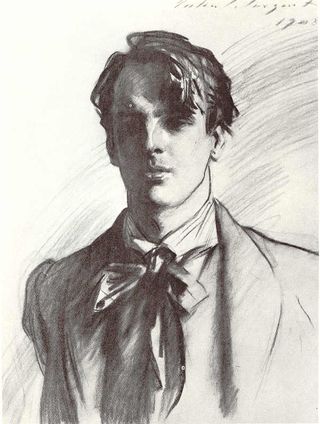 In a review of Calvin Bedient's new book, The Yeats Brothers and Modernism’s Love of Motion, Robert Huddleston takes a look at the significance of William Butler Yeats in relation to twentieth century modernism (via the wonderful 3quarksdaily):
William Butler Yeats has been called the twentieth century’s greatest poet. He may even deserve the title. As Richard Ellmann wrote in his classic study Yeats: The Man and the Masks, “it is not easy to assign him a lower place.” Others may have attempted more; none achieved it. Ezra Pound, T. S. Eliot, Wallace Stevens, and all the other contenders of Yeats’s illustrious generation—none stakes quite the same claim on the imagination, or on the idiom, of our time. “Things fall apart; the centre cannot hold”; “A terrible beauty is born”; “Now days are dragon-ridden, the nightmare / Rides upon sleep.” Even Joyce has his protagonist Stephen Dedalus murmuring lines from Yeats’s early poem “Who Goes with Fergus?” on Sandymount strand: “And no more turn aside and brood / Upon love’s bitter mystery.” Like Shakespeare, Yeats is inescapable.
Yet few critics, including Ellmann, have seemed entirely comfortable with this fact. As a man, Yeats could be personally unappealing, even arrogant and intolerant, although not more so than Eliot and less so than Pound. The problem with casting Yeats as the ne plus ultra of twentieth-century poets stems from the fact that his work defies preconceptions about what a sufficiently modern—and specifically Modernist—poetry should be. Yeats’s ties to the nineteenth century and the legacy of Romanticism were vital and strong. Most importantly, Yeats forsook radical formal innovation and was instead a lifelong advocate of traditional poetic meter and form. [Read More]

'T. S. Eliot worked for a bank. Wallace Stevens and Franz Kafka worked for insurance companies. In their own unique ways Eliot and Stevens and Kafka suffered no less than Poe or Rimbaud. There is no dishonour in electing to follow Eliot and Stevens and Kafka. His choice is to wear a black suit as they did, wear it like a burning shirt, exploiting no one, cheating no one, paying his way. In the Romantic era artists went mad on an extravagant scale. Madness poured out of them in reams of delirious verse of great gouts of paint. That era is over: his own madness, if it is to be his lot to suffer madness, will be otherwise - quiet, discreet. He will sit in a corner, tight and hunched, like the robed man in Dürer's etching, waiting patiently for his season in hell to pass.'
J. M. Coetzee, 'Youth'

'The only answer to the question of the meaning of life has to begin from the fact of our human finitude, of our vulnerability and our fallibility. My personal belief that I’ve tried to argue for in my book Very Little… Almost Nothing—a winning title if ever there was one—is that we have to, in a sense, give up the question of the meaning of life, or at least hear it in a particular way. The formulation that I use in that book is “the acceptance of meaninglessness as the achievement of the everyday or the ordinary.” What I mean by that is that once we’ve accepted that the meaning of life is ours to make, we make meaning. Then we accept that we live in a situation, or, rather, that we inherit a situation of meaninglessness, and out of that meaninglessness we create meaning in relationship to the ordinariness of our common existence. I try to argue for a cultivation of the low, the common and the near—the everyday—as that in relationship to which we can make a meaning out of the meaninglessness of our existence.'


