6.9.14

The Secrets of Leo Tolstoy

Victor Erofeyev on literature, life and ideology
Leo Tolstoy's country estate, Yasnaya Polyana
From Victor Erofeyev (The New York Times) (link via European Graduate School):
I get a physiological pleasure from reading Tolstoy, and the more I read him, the greater the pleasure. His words generate smells, sounds, vibrations of feelings and moods. They are broader than any philosophical doctrine, and more significant even than the author himself, whom his words mercilessly exploit. In all literature, perhaps, there never was so “idea-less” a writer who released into the world writing that fills us with admiration of its power, and fear of its candor.

Tolstoy’s words seem to break away from the writer to reveal the meaning of existence — sometimes surprising the writer himself in the process. Marcel Proust considered Tolstoy to be the almighty lord of his works, controlling all their actions and thoughts. If so it is a generous lord, who is great because he gives freedom to his heroes, and they, on entering our memory, become more alive than the living. Natasha’s first ball, the horse race in “Anna Karenina,” the illness and death of Ivan Ilyich — all these fill the reader with both elemental delight, and also with the horror of confronting the very sources of existence. Sometimes it seems that Tolstoy was born to overturn the rules of literature and to laugh at its pretensions to be a textbook of life.

Tolstoy did not like to discuss “literature,” and did not much like writers like Dante and Shakespeare. He did not regard himself as a professional writer. He was more a serial killer of literary canons. His mind and body raged with such unchecked passions that it was not possible to make ends meet.

He was a monster in his personal behavior; he hated “progress” and the “age of progress”; he hailed freedom for women in a world of stern social convention; he loved the simple peasant, though by blood and habit he was the complete lord. Lenin was unusually accurate when he called Tolstoy a “mirror of the Russian revolution.”

I love to read about Tolstoy’s relationships with his famous contemporaries, so full of misunderstandings and treachery. He hated Turgenev for his “democratic thighs” and love of chatter. He longed to challenge him to a duel with hunting rifles at six paces. He described the horrors of war in his Sevastopol stories, yet his own character was equally belligerent, terrorizing his wife, Sofia Andreevna. His demonstrative vegetarianism and peasant labors became the brunt of jokes (“A muzhik comes before the count and announces, ‘The plow is served”’).

André Gide in an essay on Dostoevsky wrote that Tolstoy obscured the greatness of Dostoevsky. But with time, the prevalent view among intellectuals came to be that Dostoevsky’s mountain was higher than Tolstoy’s. Yes, Dostoevsky has clear goals and defined action. The curtain opens and we watch how a godless existence leads inexorably to sin and evil. Crime becomes punishment. By contrast, when Tolstoy’s Anna Karenina throws herself under a train, what is it? Her punishment? High tragedy? The fate of fallen women? A delirious stream of consciousness? There is no answer. For that, in Tolstoy’s logic, you go to the police, not to the writer. In Dostoevsky, life is subservient to thought. In Tolstoy, thought is in a constant spin, like the grenade that will explode and take the life of Prince Andrei Bolkonsky.

Tolstoy’s novels arise out of the small details of his daily diary; they grow out of social gossip, childhood impressions, family legends. He waters this garden, and there grows a tree with heavenly fruit — delicious, fragrant, juicy, unique. [Read More]

Find Leo Tolstoy on Amazon: US | UK

Also at A Piece of Monologue:
8.8.12

Thomas Bernhard: Graphic Essay

Espen Terjesen's beautifully drawn essay on Bernhard's writing

I'm very excited to share a beautiful and concise 'comic essay' on the work of Austrian writer Thomas Bernhard. The essay was written, drawn and designed by Espen Terjesen, an illustrator, cartoonist, pixel artist, teacher/lecturer and writer working in Bergen, Norway. In addition to the original essay, Terjesen has also been kind enough to provide A Piece of Monologue with an English translation.

Terjesen's work not only presents themes from Bernhard's writing with striking, icy accompaniments, but offers a playful approach to the traditional academic essay. By combining elements of literary criticism with the graphic novel, Terjesen's reading of Bernhard becomes, in itself, a creative act. What we are left with is something both thought-provoking and accessible.

To see the strip in its original format, please find links to Terjesen's essay at the bottom of this post. In its complete form, the essay includes a number of footnotes and recommended reading. You can click any of the images to enlarge them. Enjoy!

The Essay


Page 1
Title: Refutations / The prose of Thomas Bernhard / By Espen Terjesen


Panel 1: An abandoned lime works. / An intellectual. / A disabled woman. / A murder.


Panel 2: A visitor tries to clear up the circumstances surrounding the murder. He collects gossip and rumours in the local tavern, Laska...


Panel 3: The Lime Works (1975) is in many ways a typical Bernhard text...


Panel 4: The narrator and the text's fictitious writer, a nameless insurance salesman, meticulously repeats the reports he gets from his informants, Fro and Wieser...


Panel 5: ...but the information is usually second- to fifth-hand...


Panel 6: The Lime Works seems to linger on in a state of probability and uncertainty. The text is abound with narrators and readers...


Panel 7: ...who construct and reconstruct subjective and incompatible worlds...


Panel 8: Where modernist prose portrays different "psychologies"...


Panel 9: ...and how these face (the same) world...


Page 2
Panel 1: ... Bernhard's prose seems to portray a narrative form of "the whispering game". / ...Author1 creates Text1 (and World1). Reader1 reconstructs World1 - and becomes, therefore, the creator of World2 etc.


Panel 2: [figure demonstrating this process]


Panel 3: The nameless, unreliable insurance salesman is the last in a long line of narrators - and our only entry into the chinese boxes that is The Lime Works... Still, he does not make any attempts in sorting or verifying the information (gossip?) he receives...


Panel 4: With that, the text raises ontological questions: what is literary truth? ...


Panel 5: ... what is the nature of fiction?; what constitutes a world? ...


Panel 6: ... The hypothesis works as a poetic trope in the works of authors like Marcel Proust, Thomas Mann, and André Gide. Best known is perhaps Proust's expansive hypotheses in In Search of Lost Time ...


Panel 7: ... Bernhard's "answer" is contradictions and refutations ... / There's no longer any "reality" that can verify the hypotheses...


Panel 8: ... Reality is nothing but a composition of ...


Panel 9: ... interpretations and fictions...


Page 3
Panel 1: ... Hypothetical thinking's inherent defects, weaknesses and inaccuracies become an obsession for Roithamer - an architect based on Ludwig Wittgenstein - in Bernhard's Corrections (1975)...


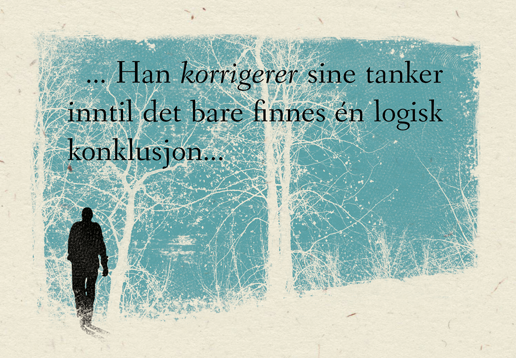
Panel 2: ... He corrects his thoughts until there's only one logical conclusion left...


Panel 3: ... to negate his own existence...


Panel 4: ... Is it at all possible to write truthfully? ... / ... The Lime Works and Correction problematize literary truth-searching in, at least, two ways: 1) by using exceedingly indirect and complicated narrative techniques - which makes first-hand information an impossibility...

 
Panel 5: ... 2) by portraying isolation, resignation and defeat - how persons positively obsessed with truth ...


Panel 6: ... and perfection...


Panel 7: ... go...


Panel 8: ... under...

Esper Terjesen: About the Strip

While working at the University of Bergen, I started thinking about combining my interest in literature and drawing. It was only a few years later, though, that I sat down to draw a graphic essay on Thomas Bernhard, my favourite author. My aim was, first and foremost, to develop a visual language that would suit future essays on academic topics. This essay was, therefore, improvised on the spot. I didn't plan or write anything in advance. I just followed my own train of thoughts while drawing. Needless to say, the result is somewhat unfocused, but I'm still happy with the overall mood and feel of the essay.

When it comes to the contents itself: To me, a lot of Thomas Bernhard Criticism seems to be founded on realistic-mimetic and psychological theories (often of a biographic-affirmative nature) and the idea that Bernhard is a modernist (along the lines of authors like Thomas Mann, James Joyce and Marcel Proust). I would argue that it makes more sense to associate Bernhard with postmodern literature and writers. Modernist literature seems, to me, at least, to raise epistemological questions (what can we know?). We are presented with different "psychologies", and how these view and/or meet the (same) world. Postmodern literature, on the other hand, raises ontological questions (what constitutes a world?). It deals with literary truth (is it at all possible?), the nature of fiction, and how (fictional) worlds relate.

One of the most important literary tropes in Bernhard's prose, is "refutation". Where Proust writes extensive hypotheses, Bernhard's prose seems to consist of nothing but refutations. This is perhaps best viewed in Bernhard's Das Kalkwerk and Korrektur, which I discuss in the essay. The former having up to five levels of narration, muddling up the narrative. The latter describing how an architect "corrects" and adjusts his philosophy until the only logical conclusion is to negate his own soul.

Website

You can see the complete essay, along with photographs of the project's development, on Esper Terjesen's website.

Completed essay:
Development:

Also at A Piece of Monologue:
1.8.12

John Bolin, Beckett and the Modern Novel

This October from Cambridge University Press
John Bolin, Beckett and the Modern Novel
A promising new publication from Cambridge University Press, published this October: 'Samuel Beckett's narrative innovations are among his most important contributions to twentieth-century literature. Yet contemporary Beckett scholarship rarely considers the effect of his literary influences on the evolution of his narrative techniques, focusing instead on Beckett's philosophical implications. In this study, John Bolin challenges the utility of reading Beckett through a narrow philosophical lens, tracing new avenues for understanding Beckett's work – and by extension, the form of the modern novel – by engaging with English, French, German and Russian literature. Presenting new empirical evidence drawn from major archives in the United Kingdom, Ireland and the United States, Bolin demonstrates Beckett's preoccupation with what he termed the 'European novel': a lineage running from Sade to Stendhal, Dostoevsky, Gide, Sartre and Celine. Through close readings of Beckett's manuscripts and novels up to and including The Unnamable, Bolin provides a new account of how Beckett's fiction grew out of his changing compositional practice.' [Read More]

Also at A Piece of Monologue:
8.9.11

Top 11 Existentialist Novels?

Literary classics of angst, ennui and despair
Still from Orson Welles' 1962 adaptation of Franz Kafka's The Trial
Flavorwire lists their top 11 existentialist novels:
  • Paul Bowles, The Sheltering Sky
  • William Faulkner, As I Lay Dying
  • André Gide, The Immoralist
  • Ralph Ellison, Invisible Man
  • Franz Kafka, The Trial
  • William Shakespeare, Hamlet
  • Kobo Abe, The Woman in the Dunes
  • Albert Camus, The Stranger
  • Fyodor Dostoyevsky, Notes from Underground
  • Jean-Paul Sartre, Nausea
  • Margery Williams, The Velveteen rabbit
[Source]

Also at A Piece of Monologue: