19.2.14

The Essays of Schopenhauer: E-book

A selection from Parerga and Paralipomena
Screenshot from essaysofschopenhauer.com
From essaysofschopenhauer.com:
This website presents six essay extracts from Schopenhauer's last work entitled 'Parerga and Paralipomena', a collection of philosophical reflections first published in 1851. A further eighteen essays are available in both paperback and e-book formats at a small cost. This unique and comprehensive curation is a must have for anyone interested in learning more about Schopenhauer's ideas and literary style.

Schopenhauer's depth of insight into the human condition influenced a long list of famous thinkers including Friedrich Nietzsche, Richard Wagner, Ludwig Wittgenstein, Albert Einstein, Sigmund Freud, Otto Rank, Carl Jung, Joseph Campbell, Leo Tolstoy, Thomas Mann, Jorge Luis Borges, Thomas Hardy and Charles Darwin to name just a few. [Read More]

Also at A Piece of Monologue:
28.9.12

Theodor Adorno, Quasi Una Fantasia: Essays on Modern Music

The Guardian reviews a new edition from Verso
Theodor Adorno, Quasi Una Fantasia: Essays on Modern Music
Nicholas Lezard reviews Theodor Adorno's Quasi Una Fantasia: Essays on Modern Music: 'Adorno wrote about everything, really, but what he wrote most about was music. He knew what he was talking about: he had entertained attainable ambitions to compose, and been taught by Alban Berg. When Thomas Mann, in exile, needed to have a serialist composer in Dr Faustus, it was to Adorno he turned, and his contribution to the book was invaluable. Schoenberg, exiled a few miles up the road at the same time, was seriously miffed for years that he hadn't been asked – understandably, since he had invented the atonality of Mann's composer. But there was something Adorno could bring to the table which Schoenberg couldn't. As George Steiner put it, "what Adorno contributed [to Dr Faustus] was not only the hard-edged technicalities of compositional and instrumental processes, but his own radical perceptions of what it is to compose music under pressure of previous musical history and of social crisis."' [Read More]

Also at A Piece of Monologue:
8.8.12

Thomas Bernhard: Graphic Essay

Espen Terjesen's beautifully drawn essay on Bernhard's writing

I'm very excited to share a beautiful and concise 'comic essay' on the work of Austrian writer Thomas Bernhard. The essay was written, drawn and designed by Espen Terjesen, an illustrator, cartoonist, pixel artist, teacher/lecturer and writer working in Bergen, Norway. In addition to the original essay, Terjesen has also been kind enough to provide A Piece of Monologue with an English translation.

Terjesen's work not only presents themes from Bernhard's writing with striking, icy accompaniments, but offers a playful approach to the traditional academic essay. By combining elements of literary criticism with the graphic novel, Terjesen's reading of Bernhard becomes, in itself, a creative act. What we are left with is something both thought-provoking and accessible.

To see the strip in its original format, please find links to Terjesen's essay at the bottom of this post. In its complete form, the essay includes a number of footnotes and recommended reading. You can click any of the images to enlarge them. Enjoy!

The Essay


Page 1
Title: Refutations / The prose of Thomas Bernhard / By Espen Terjesen


Panel 1: An abandoned lime works. / An intellectual. / A disabled woman. / A murder.


Panel 2: A visitor tries to clear up the circumstances surrounding the murder. He collects gossip and rumours in the local tavern, Laska...


Panel 3: The Lime Works (1975) is in many ways a typical Bernhard text...


Panel 4: The narrator and the text's fictitious writer, a nameless insurance salesman, meticulously repeats the reports he gets from his informants, Fro and Wieser...


Panel 5: ...but the information is usually second- to fifth-hand...


Panel 6: The Lime Works seems to linger on in a state of probability and uncertainty. The text is abound with narrators and readers...


Panel 7: ...who construct and reconstruct subjective and incompatible worlds...


Panel 8: Where modernist prose portrays different "psychologies"...


Panel 9: ...and how these face (the same) world...


Page 2
Panel 1: ... Bernhard's prose seems to portray a narrative form of "the whispering game". / ...Author1 creates Text1 (and World1). Reader1 reconstructs World1 - and becomes, therefore, the creator of World2 etc.


Panel 2: [figure demonstrating this process]


Panel 3: The nameless, unreliable insurance salesman is the last in a long line of narrators - and our only entry into the chinese boxes that is The Lime Works... Still, he does not make any attempts in sorting or verifying the information (gossip?) he receives...


Panel 4: With that, the text raises ontological questions: what is literary truth? ...


Panel 5: ... what is the nature of fiction?; what constitutes a world? ...


Panel 6: ... The hypothesis works as a poetic trope in the works of authors like Marcel Proust, Thomas Mann, and André Gide. Best known is perhaps Proust's expansive hypotheses in In Search of Lost Time ...


Panel 7: ... Bernhard's "answer" is contradictions and refutations ... / There's no longer any "reality" that can verify the hypotheses...


Panel 8: ... Reality is nothing but a composition of ...


Panel 9: ... interpretations and fictions...


Page 3
Panel 1: ... Hypothetical thinking's inherent defects, weaknesses and inaccuracies become an obsession for Roithamer - an architect based on Ludwig Wittgenstein - in Bernhard's Corrections (1975)...


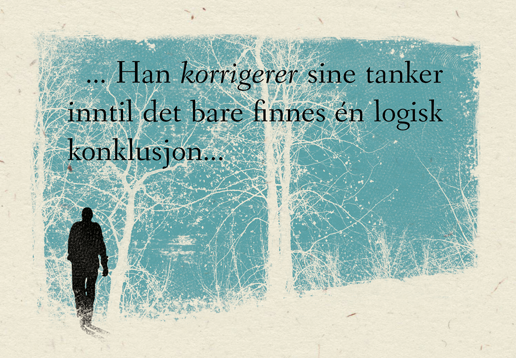
Panel 2: ... He corrects his thoughts until there's only one logical conclusion left...


Panel 3: ... to negate his own existence...


Panel 4: ... Is it at all possible to write truthfully? ... / ... The Lime Works and Correction problematize literary truth-searching in, at least, two ways: 1) by using exceedingly indirect and complicated narrative techniques - which makes first-hand information an impossibility...

 
Panel 5: ... 2) by portraying isolation, resignation and defeat - how persons positively obsessed with truth ...


Panel 6: ... and perfection...


Panel 7: ... go...


Panel 8: ... under...

Esper Terjesen: About the Strip

While working at the University of Bergen, I started thinking about combining my interest in literature and drawing. It was only a few years later, though, that I sat down to draw a graphic essay on Thomas Bernhard, my favourite author. My aim was, first and foremost, to develop a visual language that would suit future essays on academic topics. This essay was, therefore, improvised on the spot. I didn't plan or write anything in advance. I just followed my own train of thoughts while drawing. Needless to say, the result is somewhat unfocused, but I'm still happy with the overall mood and feel of the essay.

When it comes to the contents itself: To me, a lot of Thomas Bernhard Criticism seems to be founded on realistic-mimetic and psychological theories (often of a biographic-affirmative nature) and the idea that Bernhard is a modernist (along the lines of authors like Thomas Mann, James Joyce and Marcel Proust). I would argue that it makes more sense to associate Bernhard with postmodern literature and writers. Modernist literature seems, to me, at least, to raise epistemological questions (what can we know?). We are presented with different "psychologies", and how these view and/or meet the (same) world. Postmodern literature, on the other hand, raises ontological questions (what constitutes a world?). It deals with literary truth (is it at all possible?), the nature of fiction, and how (fictional) worlds relate.

One of the most important literary tropes in Bernhard's prose, is "refutation". Where Proust writes extensive hypotheses, Bernhard's prose seems to consist of nothing but refutations. This is perhaps best viewed in Bernhard's Das Kalkwerk and Korrektur, which I discuss in the essay. The former having up to five levels of narration, muddling up the narrative. The latter describing how an architect "corrects" and adjusts his philosophy until the only logical conclusion is to negate his own soul.

Website

You can see the complete essay, along with photographs of the project's development, on Esper Terjesen's website.

Completed essay:
Development:

Also at A Piece of Monologue:
20.7.12

Robert Walser, Selected Stories

John Self reviews a recent collection of stories from the New York Review of Books (NYRB)
Robert Walser
From the excellent literary blog, Asylum: 'Walser’s Selected Stories must be a high point. Ditto by their exalted design standards: look at that cover, the delicate green and purple like colorizing effects on a black-and-white film. And the composition, or cropping, of the photograph itself: the subject – the author – to one side, as though standing proudly (or tentatively?) by his title; or, not quite in the middle of the road; or, just about to go for a walk.' You'll have to click for more. [Read More]

Also at A Piece of Monologue:
18.7.12

Colm Tóibín on Samuel Beckett and his mother

Dan Barrett on New Ways to Kill Your Mother
Colm Tóibín, New Ways to Kill Your Mother
In Dan Barrett's (Pop Matters) review of Colm Tóibín's recent work, New Ways to Kill Your Mother, he draws attention to the essay on Beckett and the uneasy relationship with his mother, May:
Another character who will stick in my memory is Samuel Beckett. Toibin writes about Beckett when he was in his early adulthood, and suffering under the oppressive influence of a rather provincial, rather narrow-minded mother. What to do with young Samuel Beckett? He was listless, rude, and self-loathing. He spent a great deal of time sleeping and loitering in the National Gallery. He claimed that he struggled to produce a single sentence; he thought of his work as “turds”.

Learning this, it’s gratifying to think about what this young man eventually did with his life, and it’s an inspiring story for any writer in his 20s (or 30s, or even 40s) who is panicking about the struggle to “find a voice”. This struggle is as old as time. Just because you’re taking long naps and feeling desperate today, it doesn’t follow that you won’t one day produce a Happy Days, or a Waiting for Godot. [Read More]
Also at A Piece of Monologue:
15.7.12

Colm Tóibín on Fiction and Reality

A reflection on biography, fiction and writer's lives
Colm Tóibín
An extract from 'What is Real is Imagined', a recent essay by Colm Tóibín published on the The New York Times website:
I have been writing about writers and their families so it is strange that the idea of rights versus responsibilities does not preoccupy me. I feel that I have only rights, and that my sole responsibility is to the reader, and is to make things work for someone I will never meet. I feel just fine about ignoring or bypassing the rights of people I have known and loved to be rendered faithfully, or to be left in peace, and out of novels. It is odd that the right these people have to be left alone, not transformed, seems so ludicrous.

Within a few months of marrying, Thomas Mann wrote a story suggesting that his wife had had an incestuous relationship with her twin brother. Samuel Beckett, in his first book of stories, used a letter from a dead cousin, thus causing offense to her family. Brian Moore’s father, who was a doctor, worked tirelessly during the bombing of Belfast in 1941; in his novel “The Emperor of Ice Cream,” Moore has the father, who is clearly based on his own father, fleeing Belfast for the safety of Dublin during the air raids.

No one suggests that Mann or Beckett or Moore was an especially bad person. Indeed, all three were known for their courtesy and much loved by those close to them and by readers. But when it came to the moment when they were putting their stories together, working out the details, mixing memory and desire, they had no qualms, no problems about appropriating what they pleased. They used what they needed; they changed what they used. Their soft hearts became stony. [Read More]
Colm Tóibín is the author of the recent book, New Ways to Kill Your Mother: Writers and Their Families.

Also at A Piece of Monologue:
24.4.12

On Philosophical Novels

From Tolstoy and Dostoyevsky to Sartre and Bernhard
Leo Tolstoy reading, pencil portrait by Ilya Repin (1891)
Jennie Erdal writes a survey of the philosophical novel in the Financial Times, and Geoff Dyer lists five examples of memorable philosophical fiction:
At St Andrews University in the early 1970s, philosophy was still a required subject for entry into an honours course. To leave the way clear for reading modern languages, I decided that the requirement would best be dispatched in my first year. Before I knew it, I was hooked and ended up dropping one of the languages in favour of a joint degree in moral philosophy and Russian. For me it seemed the dream ticket. Russian literature was awash with existential difficulties and moral disorder, from the problem of free will in Dostoevsky’s The Brothers Karamazov (1880) to the meaning of life itself in Tolstoy’s War and Peace (1869) – not to mention all the ungovernable passions, suicide, murder and suffering humanity encountered along the way. Philosophy on the other hand, with its categorical imperatives and systematic approach to concepts of right and wrong, would provide a disciplined moral analysis. [Read More]
Also at A Piece of Monologue:
10.2.12

Lars Iyer on Literature's Antagonistic Couples

Lars Iyer picks his favourite literary 'frenemies'
Ian McKellen and Roger Rees as Estragon and Vladimir in Samuel Beckett's Waiting for Godot. Photo by Sasha Gusov
Lars Iyer, author of Spurious, Dogma and two books on Maurice Blanchot, names his favourite literary 'frenemies'. He choice picks a number of classic antagonistic couples from the works of Samuel Beckett, Cervantes, Thomas Bernhard, D. H. Lawrence, J. G. Ballard, Thomas Mann, Patricia Highsmith, and Saul Bellow, to name just a few. [Read More]

Also at A Piece of Monologue:
13.10.11

W. G. Sebald as Academic

Academia, literary fame and post-war Germany's culture of silence
W. G. Sebald
Uwe Schütte, director of German studies at Aston University. discusses his acquaintance with W. G. Sebald in the Times Higher Education: 'From the late 1970s, the "angry young academic" underwent quite a transformation, with Sebald now focusing his critical attention on empathetic discussions of writers who had been marginalised or ignored by mainstream German studies. Sebald never wrote an essay - let alone a book - on any of the "biggies" of German literature: Goethe, Thomas Mann, Brecht just don't feature, although Kafka, himself an outsider figure, is a major interest. Rather, he concerned himself with "minor poets" such as the autodidact Herbert Achternbusch, the schizophrenic poet Ernst Herbeck, the Austrian-Jewish Holocaust survivor Jean Améry - writers, who in his view wrote "against" the prevalent conception of culture and/or literature.' [Read More]

Also at A Piece of Monologue:
27.1.11

Can Literature be Philosophical?

James Ryerson on the philosophical novel
David Foster Wallace
In a recent article in The New York Times, James Ryerson asks an age-old question: can literature be philosophical? Recalling examples from Iris Murdoch to David Foster Wallace, Ryerson discusses how we might define the philosophical novel, and explores the gulf that seems to exist between the two disciplines:
Can a novelist write philosophically? Even those novelists most commonly deemed “philosophical” have sometimes answered with an emphatic no. Iris Murdoch, the longtime Oxford philosopher and author of some two dozen novels treating highbrow themes like consciousness and morality, argued that philosophy and literature were contrary pursuits. Philosophy calls on the analytical mind to solve conceptual problems in an “austere, unselfish, candid” prose, she said in a BBC interview broadcast in 1978, while literature looks to the imagination to show us something “mysterious, ambiguous, particular” about the world. Any appearance of philosophical ideas in her own novels was an inconsequential reflection of what she happened to know. “If I knew about sailing ships I would put in sailing ships,” she said. “And in a way, as a novelist, I would rather know about sailing ships than about philosophy.” [Read more]

Also at A Piece of Monologue
29.9.10

WSJ reviews Gabriel Josipovici on Modernism

Eric Ormsby traces the literary revolution at the heart of Josipovici's new study

In the Wall Street Journal this week, Eric Ormsby weighs the strengths and weaknesses of Gabriel Josipovici's recent literary study, What Ever Happened to Modernism? (via Conversational Reading):
With the 20th century and his most cherished authors and artists, Mr. Josipovici comes into his own. Whether discussing a key passage in Thomas Mann's Doktor Faustus or quoting from an interview with the painter Francis Bacon, whether drawing on Rosalind Krauss's studies of Picasso or on Marcel Duchamp's comments on his own work, he is both passionate and lucid. If he is notably perceptive on such authors as Borges and Kafka, he is equally fine on less familiar authors, such as Claude Simon, the Nobel Prize-winning French novelist whom he cites to brilliant effect. Thus, in "The Flanders Road," Simon evokes the German invasion of France in 1940, depicting the "civilians who doggedly went on wandering about in incomprehensible fashion, dragging a battered suitcase after them or pushing one of those children's perambulators filled with vague belongings." In such a scene, the pathos is one with the absurdity, and we feel the force of a difficult truth. [...]

Mr. Josipovici has a gift for sweeping the reader along, but even so, reservations arise. One of the least attractive aspects of literary Modernism has been its penchant for casting what it dislikes into outer darkness. T.S. Eliot and Ezra Pound were especially skilled at such excommunicatory tosses. I've known poets who refuse to read Virgil or Milton because of the belittling judgments of the high modernists; and the judgments are always couched as a polarity: Homer but not Virgil, Marvell but not Milton. Mr. Josipovici betrays something of this doctrinaire tendency; he is scornful of Anthony Powell and V.S. Naipaul, both of whom he dismisses with a quip. But Powell's "Dance to the Music of Time" and Naipaul's "A House for Mr. Biswas" are great 20th-century novels.

Mr. Josipovici faults Philip Roth's fiction for lacking "that sense of density of other worlds suggested but lying beyond words, which we experience when reading Proust or James." Then he imagines his reader objecting that "Roth is an experimental writer!" and "Is that not what Modernism is about?" Here Mr. Josipovici displays a peevish side, remarking: "If that is your reaction you have not really been taking in what I have been saying." Well, maybe. He's baffled by intelligent reviewers, "many of whom have studied the poems of Eliot or the novels of Virginia Woolf," who "betray their calling" by praising what he considers second-rate work—not just Roth but Graham Greene, Toni Morrison, John Updike and Salman Rushdie.

Mr. Josipovici does not countenance the possibility that in the works of the Modernist writers, artists and composers he most admires there lay hidden some dimly willed element that led to their supersession. The caustic self-doubt, and doubt of the world, that drove their genius may have proved corrosive over time, diluting the severe standards they applied to art. He quotes Marcel Duchamp, for example, without acknowledging that his wry and cynical playfulness has led, decades later, to the trivial shenanigans of such poseurs as Damien Hirst and Jeff Koons.
Jorge Luis Borges (left) and Franz Kafka (right)
Perhaps the true question raised by What Ever Happened to Modernism? is about the way in which art grapples with reality. The 19th-century novelists created characters and set them within a narrative; this was an "arbitrary" process: David Copperfield and Père Goriot are as contrived as the marquise who went out at five. Balzac carried a cane inscribed with the motto "I smash all obstacles." Kafka noted that he himself should have a cane inscribed "All obstacles smash me." Kafka knew that, as Mr. Josipovici puts it, "to be modern is to know that some things can no longer be done."

For Mr. Josipovici, Modernism is ultimately an ethical proposition, and a stern one at that. He says that traditional fiction deludes us, encouraging us in the conviction that "we ourselves will never die"; it "actively prevents us from having a realistic attitude to ourselves and the world." This probably isn't Mr. Josipovici's final view—he hedges a bit here—but he does fault the conventional novel for giving the reader "the impression that he or she understands something." [Read more]


Also at A Piece of Monologue:
6.9.10

Gabriel Josipovici: Why Modernism Matters

Is Modernism an antidote to the elitism of British fiction?
Gabriel Josipovici
Gabriel Josipovici has published an article in the New Statesman stressing the importance of modernism to contemporary literature. Encompassing the work of writers as varied and diverse as T. S. Eliot, Franz Kafka, Thomas Bernhard, Samuel Beckett and Marguerite Duras, it offers an antidote to the dominant conventions of British fiction. For Josipovici, the works of authors such as Ian McEwan and Martin Amis depend on outdated ideas of expressive realism and authorial mastery to evoke truth and morality, in ways reminiscent of the nineteenth century novel.

What we discover, looking back on nineteenth century fiction, was that its expression of 'reality' often asserted the cultural and political values of its time. Sympathies for Oliver Twist were won not on his neglected orphan status, but his natural birthright to upper class privilege. While the cultural anxiety of ghost stories, gothic horrors and Sherlock Holmes always seemed to conclude with a return to the way things should be. Or, at least, to the way Victorians thought things should be. Truth and reality were not eternal and timeless, but culturally constructed by the political values of the era.

But while culture has changed, and is forever changing, the work of McEwan, Amis and others seems to proceed as though everything is the same. McEwan's Saturday articulates a post-9/11 culture of middle-class conformity and the ennobling salvation of literature (the 'sweetness and light' of Matthew Arnold). While Amis' evocation of 9/11 in 'The last days of Muhammad Atta' sees reality through a troubling portrayal gender and racial identity. Neither is particularly convincing, but both are politically and ethically problematic. Conventional British realism appears too assured of its claims to truth, of old values and old ideas.

Modernism, aside from its virtuosity and playful approach, offers greater opportunities of inclusion through its questioning of natural distinctions, of language, culture and politics. To return to Josipovici's article, he begins by noting why he wrote What Ever Happened to Modernism? and why, for him, the 'movement' remains relevant today:
I wrote it in the first place to try to make sense of a problem that had long puzzled me: why was it that works of literature such as the poems of T S Eliot, the stories of Kafka and Borges, the novels of Proust, Mann, Claude Simon and Thomas Bernhard seemed worlds apart from those admired by the English literary establishment (works by writers such as Margaret Atwood, John Updike, Martin Amis and Ian McEwan)? The first group touched me to the core, leading me into the depths of myself even as they led me out into worlds I did not know. The latter were well-written narratives that, once I'd read them, I had no wish ever to reread. Was it my fault? Was I in some way unable to enter into the spirit of these works? Or did they belong to a kind of writing that was clearly to the taste of the English public but not to mine?

There was another problem: no composer would dream of writing like Tchaikovsky today, except in an ironic manner; no painter today would dream of painting like Sargent, except in an ironic manner; yet novelists writing in English seemed to want to write like the Victorians and the Edwardians. Others might object that literature is simply different from the other arts and it is absurd to compare them. But then why did I feel that there were profound affinities between Eliot and Picasso, Proust and Bonnard, Simon and Cézanne? Were Eliot and Proust really in thrall to the debilitating idea that they should be modern at all costs? No one who has responded to them could ever imagine this to be the case. Yet critics and reviewers who paid lip-service to Eliot and Proust seemed to fail utterly to see that to take their work seriously meant asking questions about the bulk of current English writing that were simply never asked. Even writers such as William Golding and Muriel Spark, whose work gave me the same thrill as the one I got from Marguerite Duras and Milan Kundera, were treated as the quirky authors of books about children, shipwrecks and eccentric schoolteachers.

It had not always been like that. When I first came to England in the late 1950s, it was a reviewer in the Observer, Philip Toynbee, who alerted me to the novels of Claude Simon. It was in the pages of Encounter that I first came across the stories of Borges. The back pages of the Listener and the New Statesman were alive with critics familiar with European culture and with a wide historical grasp: John Berger, David Drew and Wilfrid Mellers, among others. By the early 1990s, Encounter and the Listener had gone, to be replaced by three-for-the-price-of-two creative writing courses and literary festivals. What had happened to literary modernism in this country? How did it expire like this, without leaving a trace?

To answer this question, it was necessary to show that modernism was not a "movement", like mannerism, or the name of a period. Like Romanticism, it is multifaceted and ambiguous. And it didn't begin in 1880 and end in 1930. Modernism, whenever it began, will always be with us, for it is not primarily a revolution in diction, or a response to indus trialisation or the First World War, but is art coming to a consciousness of its limitations and responsibilities. [Read the article]

Also at A Piece of Monologue:
26.8.10

Thomas Bernhard/Thomas Mann

Stylistic connections between the two writers
Thomas Mann and Thomas Bernhard
Named Tomorrow reflects on similarities in the work of German writer Thomas Mann and Austrian, Thomas Bernhard: 'This is the first of Thomas Mann’s work I’ve read—and I’m only sixty pages in, at that— and I’ve only read a handful of Bernhard, but even this early in Doctor Faustus, it seems that one of Bernhard’s blatant tactics is a reductio ad absurdum of Mann’s style. That may or may not be a product of my limited reading, but I’m finding it impossible to ignore Bernhard as I’m reading Mann.'

Source: 'Bernhard in Mann', Named Tomorrow, 26 August 2010

Also at A Piece of Monologue:
23.2.10

Philip Roth on Kafka and the Holocaust

Jewish novelist discusses the implications of Franz Kafka surviving his early illness
Philip Roth reflects on the elusive writer Franz Kafka, and imagines what of his work would remain had he survived tuberculosis and lived through the Second World War:
I am looking, as I write of Kafka, at the photograph taken of him at the age of forty (my age)—it is 1924, as sweet and hopeful a year as he may ever have known as a man, and the year of his death.His face is sharp and skeletal, a burrower’s face:pronounced cheekbones made even more conspicuous by the absence of sideburns; the ears shaped and angled on his head like angel wings; an intense, creaturely gaze of startled composure—enormous fears, enormous control; a black towel of Levantine hair pulled close around the skull the only sensuous feature; there is a familiar Jewish flare in the bridge of the nose, the nose itself is long and weighted slightly at the tip—the nose of half the Jewish boys who were my friends in high school. Skulls chiseled like this one were shoveled by the thousands from the ovens; had he lived, his would have been among them, along with the skulls of his three younger sisters.

Of course, it is no more horrifying to think of Franz Kafka in Auschwitz than to think of anyone in Auschwitz—it is just horrifying in its own way. But he died too soon for the holocaust. Had he lived, perhaps he would have escaped with his good friend Max Brod, who found refuge in Palestine, a citizen of Israel until his death there in 1968. But Kafka escaping? It seems unlikely for one so fascinated by entrapment and careers that culminate in anguished death. Still, there is Karl Rossmann, his American greenhorn. Having imagined Karl’s escape to America and his mixed luck here, could not Kafka have found a way to execute an escape for himself? The New School for Social Research in New York becoming his Great Nature Theatre of Oklahoma? Or perhaps, through the influence of Thomas Mann, a position in the German department at Princeton … But then, had Kafka lived, it is not at all certain that the books of his which Mann celebrated from his refuge in New Jersey would ever have been published; eventually Kafka might either have destroyed those manuscripts that he had once bid Max Brod to dispose of at his death or, at the least, continued to keep them his secret.The Jewish refugee arriving in America in 1938 would not then have been Mann’s “religious humorist” but a frail and bookish fifty-five-year-old bachelor, formerly a lawyer for a government insurance firm in Prague, retired on a pension in Berlin at the time of Hitler’s rise to power—an author, yes, but of a few eccentric stories, mostly about animals, stories no one in America had ever heard of and only a handful in Europe had read; a homeless K., but without K.’s willfulness and purpose, a homeless Karl, but without Karl’s youthful spirit and resilience; just a Jew lucky enough to have escaped with his life, in his possession a suitcase containing some clothes, some family photos, some Prague mementos, and the manuscripts, still unpublished and in pieces, of Amerika, The Trial, The Castle, and (stranger things happen) three more fragmented novels, no less remarkable than the bizarre masterworks that he keeps to himself out of oedipal timidity, perfectionist madness, and insatiable longings for solitude and spiritual purity.

Philip Roth, '"I Always Wanted You to Admire My Fasting"; or, Looking at Kafka'
in Reading Myself and Others
Also at A Piece of Monologue:
14.9.09

Writers' Autographs

An online signature gallery of some of the world's best known writers
Photograph by Ralph Gibson. Series: Ex Libris. 2001
I have a long-standing fascination with handwriting and typography. The shape of letters and the visual appearance of sentences can contribute just as much meaning to a reader as the words themselves; a fact that the advertising industry is quick to capitalize on.

Writers' signatures hold a particular grip on me, not least for the romantic idea that they bring us closer to the personality of the writers themselves. If we feel close to an author's work, there are times when the printed word can feel like a barrier between us and the original manuscript. A signature offers a stamp of the writer's character and humanity; and in this sense, a signed book can feel like a personal validation of the work.

I've compiled a number of autographs here that, for one reason or another, have caught my attention. Enjoy!


Samuel Beckett


Joyce Carol Oates


Paul Auster


Anthony Burgess


William S. Burroughs


Don DeLillo


Fyodor Dostoyevsky


T. S. Eliot


William Faulkner


Robert Frost


Franz Kafka


Jack Kerouac


Harper Lee

Philip Roth


J. D. Salinger


Jean-Paul Sartre


Jacques Derrida


James Joyce


Susan Sontag


John Steinbeck


Thomas Mann


Leo Tolstoy


Oscar Wilde


Emile Zola
More