11.3.15

Dan Gunn on Finding Time for Literature

Writers and translator Lydia Davis talks to Dann Gunn about Beckett and The Emperor of Ice-Cream
Photograph: Dan Gunn
From Music & Literature:
A very orderly Greek friend visited me recently, and on stepping into my office and seeing the state of my desk, cried out “Dan! What is that?” He was genuinely shocked, perturbed even, at the sight of the books, papers, unopened envelopes, and assorted debris that flows from several piles over my desk, threatening at any moment to spill off the edges (as it regularly does) and onto the floor. My response was not, I hope, unduly defensive: “It’s a sign that I’m being productive.” Indeed, my desk is clear and tidy only ever for a brief moment after some task has just been completed (or at moments when I remember some unopened bill that needs to be paid). I do like to observe something organized emerging from the apparent chaos; and when that chaos threatens to become a liability, I turn to photos of the studios of artists I admire, of Francis Bacon or Alberto Giacometti, and protest: Now their mess really was a mess.

When I was seventeen, I chose to leave Edinburgh, where I was raised, for the University of Sussex, not least because I had read a book by Gabriel Josipovici entitled The World and the Book; it said on the cover that he was teaching there. What I admired (and still admire) about this wonderful critical work was that it dealt openly and freely with different periods and authors, from different cultures and languages, from Dante to Proust to Saul Bellow. Also mentioned on the cover was that Gabriel Josipovici wrote fiction as well as criticism. In some quiet place within me I seized hold of this as a model: a critic who also writes fiction; a novelist who also writes criticism. I had eight fantastic years at Sussex, taught in an ideal setting by the best teachers imaginable. As it happens, on my very first day I was introduced to my “personal tutor” (what in America would be called my “academic advisor”): Gabriel Josipovici. We quickly got to know each other and have remained friends ever since. The Sussex of those days confirmed for me that one did not have to be (only) a specialist, that one could draw inspiration from many sources, refusing to be boxed in to a single discipline or period or language. I still find that the criticism emerging from this openness suits me best. I have recently been rereading with delight Tony Nuttall’s Shakespeare the Thinker—a book by a former Sussex professor that emerges out of precisely what I’d call the “Sussex spirit.”

By multiplying my directions and intellectual investments—this is as true for me of sporting activity (of which I have done a lot)—I tend not to disperse but rather to gain energy. I avoid what I most dread, being bored. I spent a lot of time as a child being bored in classes in which I had absolutely no interest or flair; I vowed to attempt to lead a life in which I would never be bored again. I can honestly say that I’ve virtually achieved that, but only because I’m constantly varying the sort of word-activity I’m doing. Another relevant analogy might be language-learning. There are ways in which learning a new language can interfere with the language(s) one already knows, but in general I’ve found—and I’m surely not the only one—that learning a new language, even if it requires time and energy, pays back doubly, opening a space in the head/brain/sprit that feels and feeds very much like freedom. I am currently learning Bulgarian, and doing this somehow makes the other languages I know vibrate and hum in echo, as if the words of the new language were watering the words grown dry in the languages less practised.

Of course, there are only so many hours in the day, and several of the activities in which I’m involved, such as editing the Cahiers Series or the Letters of Samuel Beckett, are seriously time-consuming. But more important than the time spent is concentration available; and I can only really concentrate when I am excited by what I am doing. Perhaps I am lucky too, in that before I was reading Gabriel Josipovici, my childhood provided earlier models: my mother was always a voracious reader, and though she worked full time (my father having died when I was six years old) and had to raise me and my two older brothers, she would go to the municipal library every week and take out four or five novels; novels which I would then watch her consume. (She is now eighty-six years old, but retains that capacity for concentration that allows her to read a novel in a day.) And though in some ways I loathed my schooling, which was unnecessarily severe, punitive, and even sadistic (I was of the last generation to suffer the full rigours of the British “public school” system, in which being beaten was an everyday reality), it’s blindingly obvious to me, especially since I myself am a teacher, that I learned how to learn at a very young age. The school I attended was intensely academic, and it regularly strikes me how my students are struggling to learn patterns (such as grammar or essay structure) in their early twenties that were being driven into me when I was barely ten years old.

I still haven’t really answered your question, however, about how I allot the time to my various projects. I’m not sure I can do so adequately since this is rather instinctual. Teaching has to come first, since I find it humiliating to teach a class for which I don’t feel thoroughly prepared or to hand back a student’s essay that I have not marked up as completely as I judge to be helpful. (And could it perhaps be that I feel the need, in some barely reachable part of myself, to prove to the ghosts of my own schoolmasters that it is possible to teach in a demanding and informative way without becoming punitive or worse?) After teaching, the other activities somehow find their space and time—though not always simply I must admit. One example: two years ago I was asked by the TLS to review the first two volumes of Marguerite Duras’s Oeuvres complètes which had just come out in the Pléiade edition. I confidently took this on, only to lug these two volumes around with me wherever I went for the following two years, failing completely to get on with the reading, not to speak of the review. I was lucky enough to have an indulgent editor who ceded to my request made earlier this year, to add the final two volumes of the complete works, making up nearly eight thousand pages in total. For some reason this extra load made the task easier for me, and I managed to write my review while we are still in the centenary year of Duras’s birth. I often invoke the wisdom in a remark once made by Muriel Spark, one of my very favourite twentieth-century writers, when in a BBC interview she was asked if she ever had trouble with writer’s block. She said she never did, that she was always delighted to be writing. Her interviewer (John Tusa, I believe) persisted rather incredulously, asking if she really never found herself in trouble when writing her novels. Spark hesitated a moment before admitting that she did occasionally find that her plots became too complex and that as a result she could not find a way forward. “And what do you do then?” asked the interviewer. “Make them more complex.”

At the risk of going on far too long, I have to admit that there is a hierarchy in the writing and editing projects I undertake: not a hierarchy of importance but of difficulty. Here the sporting analogy may be apposite again. For someone who does not train, a run round the block is a challenge, where for one who trains, it is as easy as a stroll. For me, writing fiction is the hardest thing: nobody can indicate how long a story or novel should be, nobody can tell me in what accent or with what tone the characters should speak, nobody can tell me when I’ve written (or edited) enough, and in any case nobody is demanding the novel of me in the first place. Writing fiction is the toughest sort of training. But alongside that, keeping up with Samuel Beckett offers an arduous workout too, for he is surely one of the most intelligent and learned writers, and even to begin to do him justice requires very serious intellectual training, retraining, expansion, investment. If one spends one’s morning trying to write fiction, and one’s afternoon trying to say something about a writer as difficult and important as Beckett, then if one has a few minutes left over in the evening to attend to words in other contexts, one may indeed feel a little like a trained sprinter taking a jog round the block. [Read More]

Also at A Piece of Monologue:
6.9.14

The Secrets of Leo Tolstoy

Victor Erofeyev on literature, life and ideology
Leo Tolstoy's country estate, Yasnaya Polyana
From Victor Erofeyev (The New York Times) (link via European Graduate School):
I get a physiological pleasure from reading Tolstoy, and the more I read him, the greater the pleasure. His words generate smells, sounds, vibrations of feelings and moods. They are broader than any philosophical doctrine, and more significant even than the author himself, whom his words mercilessly exploit. In all literature, perhaps, there never was so “idea-less” a writer who released into the world writing that fills us with admiration of its power, and fear of its candor.

Tolstoy’s words seem to break away from the writer to reveal the meaning of existence — sometimes surprising the writer himself in the process. Marcel Proust considered Tolstoy to be the almighty lord of his works, controlling all their actions and thoughts. If so it is a generous lord, who is great because he gives freedom to his heroes, and they, on entering our memory, become more alive than the living. Natasha’s first ball, the horse race in “Anna Karenina,” the illness and death of Ivan Ilyich — all these fill the reader with both elemental delight, and also with the horror of confronting the very sources of existence. Sometimes it seems that Tolstoy was born to overturn the rules of literature and to laugh at its pretensions to be a textbook of life.

Tolstoy did not like to discuss “literature,” and did not much like writers like Dante and Shakespeare. He did not regard himself as a professional writer. He was more a serial killer of literary canons. His mind and body raged with such unchecked passions that it was not possible to make ends meet.

He was a monster in his personal behavior; he hated “progress” and the “age of progress”; he hailed freedom for women in a world of stern social convention; he loved the simple peasant, though by blood and habit he was the complete lord. Lenin was unusually accurate when he called Tolstoy a “mirror of the Russian revolution.”

I love to read about Tolstoy’s relationships with his famous contemporaries, so full of misunderstandings and treachery. He hated Turgenev for his “democratic thighs” and love of chatter. He longed to challenge him to a duel with hunting rifles at six paces. He described the horrors of war in his Sevastopol stories, yet his own character was equally belligerent, terrorizing his wife, Sofia Andreevna. His demonstrative vegetarianism and peasant labors became the brunt of jokes (“A muzhik comes before the count and announces, ‘The plow is served”’).

André Gide in an essay on Dostoevsky wrote that Tolstoy obscured the greatness of Dostoevsky. But with time, the prevalent view among intellectuals came to be that Dostoevsky’s mountain was higher than Tolstoy’s. Yes, Dostoevsky has clear goals and defined action. The curtain opens and we watch how a godless existence leads inexorably to sin and evil. Crime becomes punishment. By contrast, when Tolstoy’s Anna Karenina throws herself under a train, what is it? Her punishment? High tragedy? The fate of fallen women? A delirious stream of consciousness? There is no answer. For that, in Tolstoy’s logic, you go to the police, not to the writer. In Dostoevsky, life is subservient to thought. In Tolstoy, thought is in a constant spin, like the grenade that will explode and take the life of Prince Andrei Bolkonsky.

Tolstoy’s novels arise out of the small details of his daily diary; they grow out of social gossip, childhood impressions, family legends. He waters this garden, and there grows a tree with heavenly fruit — delicious, fragrant, juicy, unique. [Read More]

Find Leo Tolstoy on Amazon: US | UK

Also at A Piece of Monologue:
4.9.14

The Life and Influence of Walter Benjamin

On the tragic life and enduring influence of the German literary critic
Walter Benjamin
From Ian Penman (City Journal):
Nearly 75 years ago, at the outset of World War Two, stranded between official borderlines, right on the edge of things, the German Jewish philosopher and critic Walter Benjamin slipped out of life. His passing barely registered beyond a small circle of friends and fellow travelers—habitués, like himself, of severe literary journals, fringe politics, esoteric philosophies. Like that of Benjamin’s own literary heroes, Franz Kafka and Marcel Proust, his posthumous career was to prove far more lively. These days, anyone tilling the stony fields of literary or political theory would soon find himself persona non grata if he didn’t pay due obeisance to Benjamin—at least, the version of him now favored: the presiding angel over all that is left-leaning, interdisciplinary, and media-studious.

In the immediate aftermath of the war, though, Benjamin’s work fell into relative obscurity. At the time, only a tiny portion of his rich and varied writing had been translated from German into English or French. What was available was hard to label and difficult to promote. Benjamin was more renowned for what most of us (i.e., those of us not fluent in German) could not read rather than for what we could. Introductory essays by Hannah Arendt, Susan Sontag, and his friend Gershom Scholem filled in some of the background, but back when I first encountered his work, there was little to choose from.

A lifetime on, and things look very different. From out of privation, we now have: four hefty volumes of Benjamin’s Selected Writings and his huge, genre-defying Arcades Project; Momme Brodersen’s exemplary Walter Benjamin: A Biography; countless secondary studies and various memoirs; a gorgeous mocked-up Archive, which reproduces texts, notebooks, and other scraps in eye-straining detail; and two novels dedicated to his shade (Benjamin’s Crossing, by Jay Parini; and The Angel of History, by Bruno Arapaia). Most recently, Howard Eiland and Michael E. Jennings have given us the sturdy Walter Benjamin: A Critical Life, published by Harvard University Press. If the lion’s share of previously untranslated work finally appeared in the last decade, there still isn’t anything like a helpful “Best of Benjamin.” (Arendt’s 1955 selection, Illuminations, remains the best place to begin.) One reason may be that new readers who come to Benjamin end up recasting him in their own image.

Benjamin lived and worked just on the cusp of the current epoch of inescapable popular culture and omnipresent media. “Criticism,” he observed, “is a matter of correct distancing. It was at home in a world where perspectives and prospects counted and where it was still possible to adopt a standpoint. Now things press too urgently on human society.” This could have been written yesterday; it was published in 1928. The deeply cultured Benjamin found himself observing the slow breakdown of the very same high culture on which he depended for his daily bread. Yet he was also a fan of Hollywood films, detective fiction, and other dreamy, mainstream forms. It was one of destiny’s less congenial jokes that she took Benjamin and left us his friend Theodor Adorno, a man uniquely ill-disposed to figuring out anything of value in popular culture.

As an unashamed intellectual, Benjamin spent large portions of his life reading, writing, editing, and researching. But he was also a devoted traveler (he believed in foreign jaunts as a cure-all for most writerly ills); something of a ladies’ man; a loyal aficionado of plush casinos; and an enthusiastic dabbler in drugs. He was, in short, a logjam of contradictions: part Jewish mystic, part Marxist firebrand; skeptical priest, polite libertine. A line that Jean Cocteau devised for Orson Welles could equally apply to Benjamin: “an active loafer, a wise madman, a solitude surrounded by humanity.” [Read More]

Find Walter Benjamin on Amazon: US | UK

Also at A Piece of Monologue:
5.6.14

Byrne on Karl Ove Knausgaard

Danny Byrne reviews the third volume of My Struggle

From Danny Byrne (Music & Literature):
The mental process for which the term “remember” serves as shorthand is something that in everyday life remains necessarily unexamined; a process, like breathing or the act of falling asleep, that becomes problematic as soon as it is exposed to conscious thought. We realize as soon as we attempt to isolate the act of remembering that it is drastically partial and fragmentary, an act of brazen improvisation. Attempting to recall even a simple sequence of events in detail confronts us with a set of narrative problems: we can visualize a series of static images, but animating them into continuous motion—compelling a mnemonic self to walk across a room or sustain a conversation—is a surprisingly difficult act to accomplish.

It is something of a critical cliché to point out, following Proust, that all memory is fictional. Yet the acuity of this insight does not absolve those who use it from applying the relevant considerations of scale. If it were literally the case, we would all be afflicted with the tragicomic amnesia of Beckett’s Vladimir and Estragon, or would exist in a void like the narrator of The Unnamable, forced by some obscure inner compulsion to go on narrating ourselves into existence, if only in order to ward off the darkness and silence of non-being.

Perhaps what memory involves more specifically is a transaction, or even a struggle, between the general and the particular; the reflex of habit and the residue of authentic experience. Images can be stored in the memory, photocopied and filed away for future use; a framework of relevant facts can be established; reserves of intuition can be haphazardly and involuntarily accessed. But we combine these constituent parts into a sequential recollection through a mixture of imagination and habit. We use imagination to flesh out data and intuition, with the ballast of habit always on hand to seal them into rigid form.

Karl Ove Knausgaard’s now-infamous six-volume memoir, of which the third volume has just been published in English, as Boyhood Island in the UK and simply as “Volume 3” in the US, is the monument to his personal struggle with this set of Proustian problematics. Readers of volume one may recall that Knausgaard’s autobiographic odyssey was prompted by his own madeleine moment. In late 2003, the grown-up Knausgaard, then the author of one novel and the beginnings of what would become a strange book about angels, A Time for Everything, is sitting in his office in front of a blank screen. Scanning absently around the room, his eyes half-consciously register a pattern on the parquet floor, which forms “an image of Christ wearing a crown of thorns.” Getting up to make a coffee, he is overcome by a sudden access of involuntary memory, conjuring a long-forgotten scene from his childhood: the narrative beginning of My Struggle. [Read More]

Find Karl Ove Knausgaard on Amazon: US | UK

Also at A Piece of Monologue:
16.5.14

Lydia Davis on Literary Influence

From an interview in The Quarterly Conversation
Lydia Davis
From an interview between Dan Gunn and the writer and translator Lydia Davis, published in The Quarterly Conversation:
Dan Gunn: Proust’s narrator deduces that, to convey the priority of sense-impressions over pre-formulated conclusions, he needs to write à la Dostoevsky. When I read your work I am, in fact, made to think less of Dostoevsky than of Kafka, and of the way in which the familiar becomes strange in his work—his story “Hands” for example, where his narrator’s two hands appear suddenly to be alien and potentially at war with one another. If one may provisionally call such writing “phenomenal,” do you feel that part of your own work which is “phenomenal” to be working within a tradition? Or is it rather something that you developed privately and intuitively?

Lydia Davis: I think influence is a complicated thing. I am influenced by a kind of writing because I am drawn to it, open to it. I am drawn to it because there is already an affinity between my own sensibility and sense of formal structure and those of the author I am reading or studying. I would not be influenced by a writer alien to me. I really see an ongoing process that starts in earliest childhood. The very first picture books and nursery rhymes have their effect, as do songs and the lyrics of songs. My sensibility as a child is affected by these and then my changing sensibility and sense of structure show in my writings, even the stories written as assignments in grade school. And of course the influences of interactions with family and friends and teachers continue to have their effect.

I certainly read Kafka very closely and constantly for a few years—though I was reading many others at the same time, of course, like Hawthorne, Melville, Evelyn Waugh, R.L. Stevenson, Malamud, Dickens, Mary McCarthy, Poe, Emily Dickinson, James, and slews of mysteries. Something drew me to Kafka’s work, and in turn I’m sure I absorbed something of his sensibility and style. Clearly something drew me to Kafka more than to James, for instance—the spareness, the humility (whether assumed or real, or a combination), the bizarre imagination. He was interested in the possibility of two hands suddenly alien to each other; James’s interests lay elsewhere. For years I found James hard to read; I found that his prose left me no breathing room. Now I admire him. But the affinity still is not there. [Read More]

Find on Amazon: US | UK

Also at A Piece of Monologue:
30.1.14

On Reading Proust

Ioanna Kohler talks to Justice Stephen Breyer
Claude Monet, Coquelicots (1873)
From Ioanna Kohler (New York Review of Books):
Ioanna Kohler: In the preface to his translation of John Ruskin’s Sesame and Lilies, Proust talks about the importance of the memories associated with reading, the circumstances and setting in which we read a particular book. When and in what setting did you read À la recherche du temps perdu?

Stephen Breyer: I read the Recherche when I was working as a legal intern at an American law firm in Paris. I was trying to learn French, so I read all seven volumes in French. Every night I drew up vocabulary index cards with lists of the new words that I’d learned from Proust. But luckily I found that the lists became shorter and shorter as I made my way deeper into the book! In any case, it was with Proust’s work that I first began to read authors in the original French. And that was something I continued with other French authors.

Ioanna Kohler: By starting with Proust, you certainly didn’t begin with the easiest author!

Stephen Breyer: Perhaps not, but in that period of my life, I had plenty of time and I could afford to devote myself to that challenging text. I had no final exams to study for, no particular pressure at all. And for that matter, once I reached the end of the Recherche, I immediately reread it. Which is something that happens, I believe, to many readers. In Time Regained, it becomes clear that everything you’ve read up to this point constitutes the inner journey of a man who aspires to become a writer and finally finds his subject, his material: himself and the whole of his life, during which he was convinced that he had lost, or wasted, his time. At that point, you feel the urge to reread the book in order to better understand this inner journey. [Read More]
Find on Amazon: US | UK

Also at A Piece of Monologue:
21.7.13

Christopher Ricks on Lydia Davis

From an article in the Times Literary Supplement
Lydia Davis (Source)
From Christopher Ricks (TLS):
Lydia Davis was born in 1947 in Northampton, Massachusetts. Among her volumes of fiction there is a novel, The End of the Story (1995). The beginning of the story – of the stories – is now taken by her and her publishers to be Break It Down (1986), followed by Almost No Memory (1997), Samuel Johnson Is Indignant (2001), and Varieties of Disturbance (2007). These constitute The Collected Stories of Lydia Davis, more than 700 pages, 200 writings, the shortest a sentence or even less, the longest about forty pages. Writings, because just how to characterize them is to the point (at first, anyway), and has its power to intrigue. They fling their lithe arms wide to embrace many a kind. Should we simply concur with the official title and dub them stories? Or perhaps miniatures? Anecdotes? Essays? Jokes? Parables? Fables? Texts, or in the Beckett idiom, textes? Aphorisms, or even apophthegms? Prayers, or perhaps wisdom literature? Or might we settle for observations? This last, in the double sense of T. S. Eliot’s first book, Prufrock and Other Observations, where “observations” are the claims both of the perceptive eye and of the wise mind, both the remarkings and the remarks. Lydia Davis herself, in an interview: “I am very curious about strangers I observe – as in a bus line”. [Read More]

Also at A Piece of Monologue:

Adam Watt, Marcel Proust

A new title from Reaktion Books
Add caption
From Reaktion Books (via David Houston Jones):

Marcel Proust (1871–1922) spent fourteen years creating A la recherche du temps perdu (In Search of Lost Time), his magnum opus. Only four of its seven volumes had been published by the time Proust died; he did not live to see it become one of the most important literary works of the twentieth century. Today it still attracts widespread critical attention and Proust’s habits, health and sexual preferences continue to absorb and fascinate his commentators and devotees. This book explores the life and work of a writer whose every experience was stored, dissected and redeployed within a vast work of fiction.

Adam Watt considers Proust’s early years of personal and aesthetic experiment and demonstrates how episodes from his childhood and his family life became material for his novel. An engaging account is provided of two central, intertwined processes taking place in Proust’s life against the vibrant backdrop of belle époque Paris and the First World War: the progress of In Search of Lost Time and the simultaneous decline of its author. Proust’s own periods of ill health and isolation nourished his narrator’s thoughts on desire, love and loss, as well as his contemplation of beauty, memory, ageing and the possibility of happiness.

Drawing on Proust’s vast correspondence, the accounts of his contemporaries and the insights of recent scholarship, Marcel Proust offers a rewarding new portrait of the novelist once described as ‘the most complicated man in Paris’. [Read More]

Also at A Piece of Monologue:
24.3.13

Charlotte Mandell on Translating Blanchot

A 2005 interview by Ready Steady Book
Photograph: E. E. Pridgeon
Mark Thwaite of Ready Steady Book talks to Charlotte Mandell about translating the French writer and theorist Maurice Blanchot:
I first came across your name as a translator of the work of Maurice Blanchot. What first got you interested in Blanchot?

Fate. My friend Pierre Joris, who translated Blanchot’s The Unavowable Community, was asked by Helen Tartar (then editor-in-chief at Stanford University Press) to translate La part du feu. He didn’t have the time, so he recommended me. I sent in a sample chapter – I was only 24 then and the only book-length work I’d translated was a book of poems, Le feu l’ombre, by the French poet Jean-Paul Auxeméry. Helen liked the straightforwardness of my translation, the fact that it didn’t use any acadamese – I tried to translate Blanchot as simply and as honestly as I could.

Do you find the close reading required to translate a work has helped you to understand Blanchot more clearly than you would otherwise have done?

Definitely, yes. I feel I’ve never really “read” a work until I’ve translated it. I also make it a rule never to read too far ahead in the book I’m translating – that way everything is fresh and new, and I can’t form any preconceived notions about what will come next. I figure the author never had the luxury of reading his book beforehand, so why should I? (In the case of Blanchot it’s a little different – I’d already read many of his books in French when I was a student in Paris.)

Do you think "the common reader" can get much out of Blanchot or should he be left to academics?

Reading Blanchot is a little like watching someone think. You have to have patience, since his essays move by nuance and suggestion, and come to focus slowly. English readers – Americans especially – are used to being fed information; in the case of an essay, they’re used to the conventional statement-exposition-conclusion format. The nice thing about Blanchot (and the thing a lot of people find exasperating about him) is that he doesn’t follow that formula, or any formula for that matter. Often no conclusion is reached. The subject is examined, and questioned, and looked at from different angles, but never really resolved. I like that a lot – it’s sort of like reading poetry. [Read More]

Also at A Piece of Monologue:
4.3.13

Colm Tóibín on Proust

Tóibín visits the Marcel Proust and Swann’s Way: 100th Anniversary exhibition
Marcel Proust (1871-1922) Cahier 12, 1909, NAF 16652 Bibliotheque nationale de France (BnF), Paris, France, © BnF, Dist. RMN-Grand Palais.
From Colm Tóibín in the New York Review of Books (link via 3:AM Magazine): ‘A specter haunts the exhibition of Proust’s notebooks, manuscripts, and correspondence currently running at the Morgan Library. It is the specter of Proust’s mother. As you move from left to right in the room, the photograph of maman with her two sons, which appears first, sends a shiver down your spine. Mme Proust is seated, looking to the left, while her sons, young men in their twenties, stand on either side of her. They are beautifully dressed and have a look in their eyes that suggests the boulevard and the salon. There is something feline and sleek about the pair of them.’ [Read More]

Marcel Proust and Swann’s Way: 100th Anniversary is on view at The Morgan Library & Museum through 28 April 2013.

Also at A Piece of Monologue:

Walking with Walser

New reviews from The Quarterly Conversation


K. Thomas Kahn reviews Robert Walser's A Little Ramble: In the Spirit of Robert Walser (translated by Christopher Middleton and Susan Bernofsky) and Elfriede Jelinek's Her Not All Her (translated by Damion Searls) in The Quarterly Conversation:
What is “a writer’s writer”? Although the phrase is often used both haphazardly and problematically, there is something inherently useful about it when discussing the enduring legacy of certain authors. The OED attributes the first use of the term “a writer’s writer” to Orwell, who uses this description when writing about Gerard Manley Hopkins. This is particularly fitting, perhaps, as Julian Barnes—in his London Review of Books review of Lydia Davis’s translation of Flaubert’s Madame Bovary—brings Davis’s own discussion of Hopkins’s work to bear on what Barnes refers to as Davis’s status as “a writer’s writer’s writer.”

Recently, too, J. M. Coetzee’s assessment of Gerald Murnane’s work in The New York Review of Books raises this question of inspiration and influence: as Coetzee himself is often described as “a writer’s writer,” does his praise of Murnane’s literary output cast Murnane into the realm of “a writer’s writer’s writer”? To be sure, while the term “a writer’s writer” is often ascribed to “difficult” prose, such as Proust’s and Beckett’s, it’s usually used to emphasize their influence on other writers and artists.

Swiss-born modernist Robert Walser is perhaps the most unsung of these influential “writer’s writers,” and two recent collaborative texts underscore his ability to speak across artistic mediums. A Little Ramble: In the Spirit of Robert Walser, to be published in April by New Directions, includes short microscript pieces by Walser himself, as well as essays, creative writing, and art objects ranging from installation pieces to etchings, all of which speak to Walser’s own microscripts. This collection stems from a series of exhibitions curated by the late Donald Young in Chicago from December 2011 to October 2012, who, in his introduction, explains how he “became more and more interested in the connection between [Walser’s] writings and certain contemporary artists.” Another text, Austrian writer and Nobel laureate Elfriede Jelinek’s dramatic monologue Her Not All Her, with intercalated images by Thomas Newbolt, is collaborative in that Jelinek asserts in her subtitle that she is writing the piece “On/With Robert Walser.” In his afterward, Reto Sorg notes how Jelinek’s own text mixes with those of Walser: “It is almost impossible to tell when any given utterance has Jelinek speaking directly or when she is quoting texts by or about Walser, since the voices and languages intertwine, overlap, and blend together.” Indeed, the very title of Jelinek’s piece (in German, er nicht als er) is itself “formed out of the sounds of Robert Walser’s name.”

Texts like these demonstrate not only Walser’s effect on the literary and aesthetic work in world literature half a century after his death but also his status as a niche author, a seeming prerequisite for any “writer’s writer.” Although Hermann Hesse has famously remarked that if Walser “had a hundred thousand readers, the world would be a better place,” his continued status as a marginal “writer’s writer” also causes a sense of protection and adoration to be aroused in his admirers; as one of Walser’s major English-language translators, Christopher Middleton, puts it: “Robert Walser was known only to a happy few, and his writing has a resistant purity which will keep any larger public, I hope, at bay forever.” Similar strains of idolizing homage and protective insulation are found in both A Little Ramble and Her Not All Her. [Read More]

Also at A Piece of Monologue:
19.2.13

Marcel Proust and Swann's Way Exhibition

‘Marcel Proust and Swann’s Way’ at the Morgan Library
Marcel Proust standing to the left of his mother, Jeanne, and brother, Robert.
Edward Rothstein (New York Times):
A cosmos is compressed into cryptic hieroglyphs in the Clare Eddy Thaw Gallery of the Morgan Library & Museum. Here is an exhibition so condensed, so distilled and in some ways so abstract and well suited to the gallery’s geometric space (which is a perfect cube), that unless you arrive properly prepared, you might leave as bewildered as prospective French publishers were when they rejected Marcel Proust’s “Du Côté de Chez Swann” (“Swann’s Way”), more than a century ago.

“Perhaps I am as thick as two short planks,” reads one of those evaluations, “but I cannot understand how a man can take 30 pages to describe how he turns round in his bed before he finally falls asleep.”

But anyone who reads that first volume of “À la Recherche du Temps Perdu” (translated into English as “Remembrance of Things Past”) has no problem understanding how 30 pages might be required to capture the turnings of self-consciousness and their cascades of recollection. Or even, perhaps, how 3,000 more pages might be needed to scrutinize how sexual compulsion, aesthetic refinement and social perversity find expression in a cast of characters who can be as brilliant, creepy, climbing and compelling as their creator. [Read More]
Also at A Piece of Monologue:
8.10.12

Marcel Proust: In Search of the Present

Daniel Hartley on Proust's In Search of Lost Time
Marcel Proust. Painting by Richard Lindner.
Daniel Hartley (Thinking Blue Guitars):
I noted long ago a common misconception about Proust’s À la Recherche du Temps Perdu. Put simply, people seem to think that the “lost time” of the title denotes the past, but in fact it denotes the present. More specifically, it implies a present that is present to itself in all its plenitude. So why, you might ask, was there all this talk of involuntary memory? Why care so much about memory if what you really want is a full present? It is my thesis that it was not involuntary memory as such that interested Proust, but rather the problem of narrating the atemporal plenitude which that memory implied. In short, Proust raised to the level of a literary phenomenology the split between Erzählzeit (time of narrating) and erzählte Zeit (narrated time). [Read More]
Also at A Piece of Monologue:
6.10.12

Sebald and Proust: Failure to Recover the Past

Vertigo reviews an essay from a new academic collection
(Source)
Vertigo reviews Ofra Amihay and Lauren Walsh's edited collection, The Future of Text and Image, starting with Walsh's essay 'The Madeleine Revisualized: Proustian Memory and Sebaldian Visuality':
Walsh ultimately concludes that Sebald’s work is a modern, post-Holocaust revision of Proust. “Sebald offers no such promise of recapture [through memory]. In fact, to believe the past is recoverable in a re-experiential way is, he suggests, dangerous in settings where the stakes have risen so high – in the post-Holocaust setting. Memory…is always a limited representation, not a true past regained.” In fact, Walsh believes Sebald is suggesting that photographs work to block the act of memory and that he set out to challenge the “very belief in a documentary authority” for photographs. [Read More]
Also at A Piece of Monologue:
27.9.12

Miklós Szentkuthy, Marginalia on Casanova

A new title from Contra Mundum Press
Miklós Szentkuthy, Marginalia on Casanova
From Contra Mundum Press:

Translated by Tim Wilkinson for the very first time into English from the original Hungarian, this publication, which has already received an award from the Petofi Literary Museum, may prove to be one of the most momentous releases of the decade.

Szentkuthy is hailed by many as the Hungarian equivalent of Joyce, Proust, and Musil and, to date, his works have been translated into French, Portuguese, Romanian, Slovakian, and Spanish. Marginalia on Casanova is the first book of Szentkuthy’s epic ten volume St. Orpheus Breviary which, as Csaba Sík noted, “represents the greatest enterprise in scope, in worth? – undertaken in the Hungarian novel.”

Marginalia on Casanova is the first volume of the St. Orpheus Breviary, Miklós Szentkuthy’s synthesis of 2,000 years of European culture. As Szentkuthy’s Virgil, St. Orpheus is an omniscient poet who guides us not through hell, but through all of recorded history, myth, religion, and literature, albeit reimagined as St. Orpheus metamorphosizes himself into kings, popes, saints, tyrants, and artists. At once pagan and Christian, Greek and Hebrew, Asian and European, St. Orpheus is a mosaic of history and mankind in one supra-person and veil, an endless series of masks and personae, humanity in its protean, futural shape, an always changing function of discourse, text, myth, and mentalité.

Through St. Orpheus’s method, disparate moments of history become synchronic, are juggled to reveal, paradoxically, mutual difference and essential similarity. “Orpheus wandering in the infernal regions,” says Szentkuthy, “is the perennial symbol of the mind lost amid the enigmas of reality. The aim of the work is, on the one hand, to represent the reality of history with the utmost possible precision, and on the other, to show, through the mutations of the European spirit, all the uncertainties of contemplative man, the transiency of emotions and the sterility of philosophical systems.”

Marginalia on Casanova relives the spiritualization of the main protagonist’s sensual adventures, though it is less his sex life and more his intellectual mission, the sole determinant of his being, which is the focus of this mesmeric book. Through his own glittering associations and broadly spanning array of metaphors, Szentkuthy analyses and views the 18th century and its notion of homogeneity from the vantage point of the 20th century, with the full armor of someone who was, perhaps, one of the last Hungarian Europeans. While a commentary on Casanova’s memoirs, it is also Szentkuthy’s very own philosophy of love.

Passion, playfulness, irony, and a whole gamut of protean metamorphoses are what characterize Marginalia on Casanova, a work in which readers will experience both profundity and a taking to wing of essay-writing that is intellectually radiant and as sensual and provocative as a gondola ride with Casanova.

Featuring an introduction by Zéno Bianu , an afterword by Maria Tompa, the literary executor of the Szentkuthy Estate, and an original cover design by noted Hungarian artist István Orosz.

About the Author & Translator

Miklós Szentkuthy (1908-1988) is the author of masterpieces such as Prae, the St. Orpheus Breviary, Testament of the Muses, and Towards the One and Only Metaphor, and is recognized as one of the most significant and prolific Hungarian writers of the 20th century. Szentkuthy composed an oeuvre both imposing and complex, centered on the conflict between art and life, or the aspiration for holiness and eroticism. In addition to his many novels, essays, short stories, and memoire-interviews, he also translated numerous texts into Hungarian including Joyce’s Ulysses, Swift’s Gulliver’s Travels, Dickens’ Oliver Twist, and works by Twain, Poe, and many others.

Tim Wilkinson has translated a number of substantial works on Hungarian history and culture including Éva Balázs, Hungary and the Habsburgs 1765-1800 (1997), Domokos Kosáry, Hungary and International Politics in 1848-1849 (2003), and others. In the literary field, he has translated works by Imre Kertész and many other contemporary prose writers. The US edition of his tr. of Fatelessness was awarded the PEN American Center’s PEN/Book-of-the-Month Club Translation Prize (2005). His tr. of Kertesz’s Fiasco is a finalist for Three Percent’s Best Translated Book Award (2012).

Excerpts and Information:

Miklós Szentkuthy, Marginalia on Casanova (New York: Contra Mundum Press, 2012).
ISBN 9780983697244.
20 USD, 16 GBP, 14 €.
Bookstores can order through Ingram. Otherwise, copies can be acquired through local retailers or via Amazon and similar sites worldwide.

For a review, desk copy, or interview request, write to: info@contramundum.net

Website

Contra Mundum Press

Also at A Piece of Monologue:
12.8.12

Will Self: Modernism and Me

An autobiographical essay for The Guardian
Will Self. Photograph: David A. Selby
Will Self reflects on his connection to literary modernism: 'As a bookish adolescent I sopped up texts as if I were blotting paper and they were fluid. My unstructured absorption of the European canon was only intensified by my refusal to submit to the strictures of a conventional English literature degree course: I never took in the historicist perspective that leads ineluctably from Sweet's Anglo-Saxon Primer, through Spenser and Shakespeare to the robust, door-stopping certainties of Victorian triple-decker novels. Instead, already by the time I lay in that Jericho aquarium, I was a devotee of those works marked by an inability to suspend disbelief in their own formal properties. Rabelais's Gargantua and Pantagruel, Cervantes's Don Quixote, Sterne's Tristram Shandy, Melville's Moby-Dick and Lermontov's A Hero of Our Time – these works spoke paradoxically directly to me in their very sense of indirection. I understood intuitively rather than systematically that all these works were examples of a form we might call "pre-modernism", insofar as they anticipated the same existential problems that afflicted Joyce, Woolf, Djuna Barnes, Eliot and other literary modernists to come. That the novel in its inchoate state was more capable of self-questioning experimentation is unsurprising for all sorts of social, cultural and historical reasons, but we can equally ascribe to the writers themselves a sensitivity to what Gabriel Josipovici, in his book What Ever Happened to Modernism?, characterises as an essentially timeless awareness: the simple impossibility of going on, if to go on is to continue with well-established ways of depicting the world in art.' [Read More]

Also at A Piece of Monologue:
10.8.12

Will Self, Kafka's Wound: A Digital Literary Essay

An interactive online essay with digital footnotes
Will Self, 'Kafka's Wound: A Digital Essay'
Wow. What a fascinating idea. Interactive cultural hub "The Space" has just posted Will Self's interactive online essay, 'Kafka's Wound: A Digital Essay'.  Written on commission from the London Review of Books (LRB), the project outlines Self's interest in Kafka's short story, 'A Country Doctor'. His preparation for the essay has been the source of some reflection, recounted in a blog he kept before the piece was published [Read More].

What is remarkable about the essay is the extent to which it utilises multimedia to tell its story. Self's digital footnotes can be accessed as one reads, and to some degree they recall the fiction of W. G. Sebald (to say nothing of Self's recent work). Among the extras is a complete English translation of the Kafka story itself, along with academic commentaries on the work; there are a number of musical works, complete with analysis; there is documentary footage (including a one-hour film of Self's recent trip to Prague); a fascinating panel discussion with two leading translators; not to mention archival photographs, clips of recent Kafka debates, and even an online game! [Read More]

Also at A Piece of Monologue:
8.8.12

Thomas Bernhard: Graphic Essay

Espen Terjesen's beautifully drawn essay on Bernhard's writing

I'm very excited to share a beautiful and concise 'comic essay' on the work of Austrian writer Thomas Bernhard. The essay was written, drawn and designed by Espen Terjesen, an illustrator, cartoonist, pixel artist, teacher/lecturer and writer working in Bergen, Norway. In addition to the original essay, Terjesen has also been kind enough to provide A Piece of Monologue with an English translation.

Terjesen's work not only presents themes from Bernhard's writing with striking, icy accompaniments, but offers a playful approach to the traditional academic essay. By combining elements of literary criticism with the graphic novel, Terjesen's reading of Bernhard becomes, in itself, a creative act. What we are left with is something both thought-provoking and accessible.

To see the strip in its original format, please find links to Terjesen's essay at the bottom of this post. In its complete form, the essay includes a number of footnotes and recommended reading. You can click any of the images to enlarge them. Enjoy!

The Essay


Page 1
Title: Refutations / The prose of Thomas Bernhard / By Espen Terjesen


Panel 1: An abandoned lime works. / An intellectual. / A disabled woman. / A murder.


Panel 2: A visitor tries to clear up the circumstances surrounding the murder. He collects gossip and rumours in the local tavern, Laska...


Panel 3: The Lime Works (1975) is in many ways a typical Bernhard text...


Panel 4: The narrator and the text's fictitious writer, a nameless insurance salesman, meticulously repeats the reports he gets from his informants, Fro and Wieser...


Panel 5: ...but the information is usually second- to fifth-hand...


Panel 6: The Lime Works seems to linger on in a state of probability and uncertainty. The text is abound with narrators and readers...


Panel 7: ...who construct and reconstruct subjective and incompatible worlds...


Panel 8: Where modernist prose portrays different "psychologies"...


Panel 9: ...and how these face (the same) world...


Page 2
Panel 1: ... Bernhard's prose seems to portray a narrative form of "the whispering game". / ...Author1 creates Text1 (and World1). Reader1 reconstructs World1 - and becomes, therefore, the creator of World2 etc.


Panel 2: [figure demonstrating this process]


Panel 3: The nameless, unreliable insurance salesman is the last in a long line of narrators - and our only entry into the chinese boxes that is The Lime Works... Still, he does not make any attempts in sorting or verifying the information (gossip?) he receives...


Panel 4: With that, the text raises ontological questions: what is literary truth? ...


Panel 5: ... what is the nature of fiction?; what constitutes a world? ...


Panel 6: ... The hypothesis works as a poetic trope in the works of authors like Marcel Proust, Thomas Mann, and André Gide. Best known is perhaps Proust's expansive hypotheses in In Search of Lost Time ...


Panel 7: ... Bernhard's "answer" is contradictions and refutations ... / There's no longer any "reality" that can verify the hypotheses...


Panel 8: ... Reality is nothing but a composition of ...


Panel 9: ... interpretations and fictions...


Page 3
Panel 1: ... Hypothetical thinking's inherent defects, weaknesses and inaccuracies become an obsession for Roithamer - an architect based on Ludwig Wittgenstein - in Bernhard's Corrections (1975)...


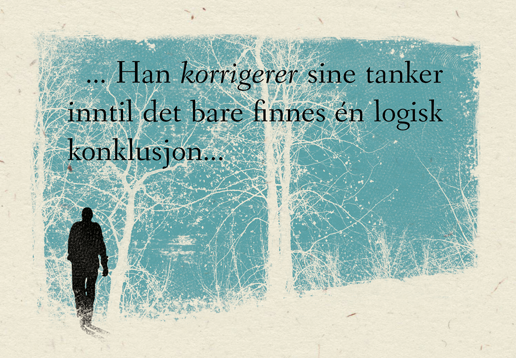
Panel 2: ... He corrects his thoughts until there's only one logical conclusion left...


Panel 3: ... to negate his own existence...


Panel 4: ... Is it at all possible to write truthfully? ... / ... The Lime Works and Correction problematize literary truth-searching in, at least, two ways: 1) by using exceedingly indirect and complicated narrative techniques - which makes first-hand information an impossibility...

 
Panel 5: ... 2) by portraying isolation, resignation and defeat - how persons positively obsessed with truth ...


Panel 6: ... and perfection...


Panel 7: ... go...


Panel 8: ... under...

Esper Terjesen: About the Strip

While working at the University of Bergen, I started thinking about combining my interest in literature and drawing. It was only a few years later, though, that I sat down to draw a graphic essay on Thomas Bernhard, my favourite author. My aim was, first and foremost, to develop a visual language that would suit future essays on academic topics. This essay was, therefore, improvised on the spot. I didn't plan or write anything in advance. I just followed my own train of thoughts while drawing. Needless to say, the result is somewhat unfocused, but I'm still happy with the overall mood and feel of the essay.

When it comes to the contents itself: To me, a lot of Thomas Bernhard Criticism seems to be founded on realistic-mimetic and psychological theories (often of a biographic-affirmative nature) and the idea that Bernhard is a modernist (along the lines of authors like Thomas Mann, James Joyce and Marcel Proust). I would argue that it makes more sense to associate Bernhard with postmodern literature and writers. Modernist literature seems, to me, at least, to raise epistemological questions (what can we know?). We are presented with different "psychologies", and how these view and/or meet the (same) world. Postmodern literature, on the other hand, raises ontological questions (what constitutes a world?). It deals with literary truth (is it at all possible?), the nature of fiction, and how (fictional) worlds relate.

One of the most important literary tropes in Bernhard's prose, is "refutation". Where Proust writes extensive hypotheses, Bernhard's prose seems to consist of nothing but refutations. This is perhaps best viewed in Bernhard's Das Kalkwerk and Korrektur, which I discuss in the essay. The former having up to five levels of narration, muddling up the narrative. The latter describing how an architect "corrects" and adjusts his philosophy until the only logical conclusion is to negate his own soul.

Website

You can see the complete essay, along with photographs of the project's development, on Esper Terjesen's website.

Completed essay:
Development:

Also at A Piece of Monologue: