16.6.14

Richard Marshall on Béla Tarr's The Turin Horse

A reflective essay published in 3:AM Magazine
A still from Béla Tarr's The Turin Horse (2011)
From Richard Marshall (3:AM Magazine):
“In Turin on 3rd January, 1889, Friedrich Nietzsche steps out of the doorway of number six, Via Carlo Alberto. Not far from him, the driver of a hansom cab is having trouble with a stubborn horse. Despite all his urging, the horse refuses to move, whereupon the driver loses his patience and takes his whip to it. Nietzsche comes up to the throng and puts an end to the brutal scene, throwing his arms around the horse’s neck, sobbing. His landlord takes him home, he lies motionless and silent for two days on a divan until he mutters the obligatory last words, and lives for another ten years, silent and demented, cared for by his mother and sisters. We do not know what happened to the horse.”

Some catastrophes are unknown. Some are unknowable.

Knowledge of catastrophe is limited by our imagination which is not limitless. For Nietzsche we think only in the form of language and are trapped by prejudices inherited from this to believe that distinctions of subject/predicate, cause/effect, noun/verb and so on are ontologically grounded, that they are in some tight isomorphic relationship with reality. Not only do these prejudices isolate us from knowing the world, we are isolated from ourselves too. The practices and conventions that give us practical guidance to make sense of our own linguistic meaning, sans Wittgenstein’s over-optimistic assumption that such meanings must be shared, all those personal idiolects, adjusted vocabularies and syntax that detach us from any default convention in order to respond to local circumstance leave us with fragile, lonely and private worlds.

Tarr’s film dwells for as long as it can with two characters whose isolation is stripped down to an abject extreme. The regularities of their trapped behaviours – feeding the horse, being dressed and dressing, eating squalid potatoes, drawing water from the well, these are repetitive sequences of primitive solutions to the universal problem of how to coordinate and communicate beliefs and actions. And the catastrophe that unfolds, the storm blowing like the ash of a burning universe, is a dark matter that dissolves each grim uniformity, every regularity, and in so doing wrecks any scantily dressed default understanding of reality, self and communication. Tarr portrays this as an event that occurs across an extreme boundary. It is a catastrophe that remains beyond them. It dissolves the world into pitch.

History goes on only to the limit of our comprehension because it is about us. A history that wasn’t our history would be incomprehensible. The world that isn’t our world too. Physics is included in this, for physics is guided by the overweening belief in truth as its ultimate value. And all values come from us. If not, where else? This philosophical position is historicist, archeological, anthropological and genealogical. It is the soul of Nietzsche’s nihilism. Husserl similarly was a nihilist when he declares geometry a human device linked to our practical needs and activities. So too was Marx a nihilist when he said that to understand science we had to understand its social genesis. Nihilism isn’t a belief but is rather the default process of modernity.

Our measurement of value is the life. Where catastrophe strikes the values we live by become disorientated, blind, and stupid. Nothing survives the transvaluation of values because the catastrophe strikes at the very heart of the life that is identical with its values. Here is an example of Nietzsche’s thought that we are trapped by linguistic form. Language makes it seem that there is a life and attached some values. But this is wrong, according to Nietzsche. Life and values are one and the same thing. In a boring sense, the relationship is analytic.

Tarr produces the sense of dread that accompanies the catastrophe. It covers the land – which is always the land as you know it, the land as it used to be, the land in which there was hope of its future spreading out. The momentous opening of the film, the extended shot of the horse as will, powering along through the landscape, dominating the world in a freedom of movement that asserts the ‘this is this’ identity of noun and verb, this is the affirmation of life asserting its own continuation and on its own terms no matter how disorganized, incoherent and crazy. Here is a life and its world and in its furious energy and movement everything is going one way – this way, not that way. And if that includes waste, degeneration, decay and death, well, in the vast momentum of the film’s opening there’s no hint of fear that we are not free to remain young, that no institution can abolish age, nor vice nor disease nor any sense that to do so would be to abolish us. Every value is there in that impressive object, its gigantic shape and process so aligned to establish what infernal will has imposed and made. [Read More]

Find on Amazon: US | UK

Also at A Piece of Monologue:
9.3.14

Ludwig Wittgenstein and Religious Belief

A short video documentary produced by the BBC

[Source]

Find Ludwig Wittgenstein on Amazon: US | UK

Also at A Piece of Monologue:
19.2.14

The Essays of Schopenhauer: E-book

A selection from Parerga and Paralipomena
Screenshot from essaysofschopenhauer.com
From essaysofschopenhauer.com:
This website presents six essay extracts from Schopenhauer's last work entitled 'Parerga and Paralipomena', a collection of philosophical reflections first published in 1851. A further eighteen essays are available in both paperback and e-book formats at a small cost. This unique and comprehensive curation is a must have for anyone interested in learning more about Schopenhauer's ideas and literary style.

Schopenhauer's depth of insight into the human condition influenced a long list of famous thinkers including Friedrich Nietzsche, Richard Wagner, Ludwig Wittgenstein, Albert Einstein, Sigmund Freud, Otto Rank, Carl Jung, Joseph Campbell, Leo Tolstoy, Thomas Mann, Jorge Luis Borges, Thomas Hardy and Charles Darwin to name just a few. [Read More]

Also at A Piece of Monologue:
30.10.13

Homes of German Philosophers

An online gallery of photographs by Patrick Lakey
Friedrich Schiller's workspace
Ludwig Wittgenstein's study in Cambridge
Ludwig Wittgenstein's desk in Cambridge
Arthur Schopenhaer's book collection
Martin Heidegger's rural hut
Los Angeles home of Theodor W. Adorno and Max Horkheimer
A selection of images from Patrick Lakey's German Photographs Collection, chronicling German philosophers' homes throughout the world. [See More]

Also at A Piece of Monologue:
11.7.13

Samuel Beckett's Book Collection

George Hunka on a recent survey of Samuel Beckett's reading habits
Samuel Beckett reading in his Paris apartment
From George Hunka (The Theatre Bar):
The books with which a writer chooses to surround himself may be a far more interesting clue to his own writings than the biography — what he read is more germane to the work than what he ate, what clothes he wore, whom he slept with. And perhaps it’s not necessary that he read all of the books on those shelves: he found them, at one time or another, of interest to himself or of relevance to his own creative endeavor.

So now we have Samuel Beckett’s Library, published late last month by Cambridge University Press, a census and study of the books that remained in Beckett’s library at his death, by Dirk Van Hulle and Mark Nixon. For those more interested in the work than the life, the book is an essential text, and even partakes of an intellectual biography itself. Along with the continuing series of letters (two volumes published, two more to follow), one can trace Beckett’s growth and maturity as an artist through the various marginalia (and even non-marginalia; see below) that he leaves along his reading trail. “As Maryanne Wolf argues, ‘the experience of reading is not so much an end in itself as it is our best vehicle to a transformed mind,’” Van Hulle and Nixon write in their introduction. “It is impossible to look ‘inside’ a reader’s or a writer’s mind with hindsight, but its transformations are partially retraceable on the basis of reading notes.”

A census — a simple list of the books in Beckett’s library — is included as an appendix, but they tell us only as much as a simple list can tell us. Van Hulle and Nixon differentiate between different kinds of reading traces — marginalia, dog-eared pages, non-marginalia (phrases and references that occur in Beckett’s work but are not marked), and extractions (passages copied verbatim from a printed text into a notebook). Among these non-marginalia in Beckett’s work are phrases and passages from Charles Darwin and William Shakespeare, phrases and passages that struck Beckett so sharply that their marking was unnecessary and testimony to his excellent memory.

There are both recognitions and surprises to be found. Dante, Shakespeare, and Schopenhauer are obviously present — and so is a single volume of Nietzsche, The Gay Science, “showing several dog-ears” but no written marginalia. (There is none of Ionesco’s plays in the library, only a single novel; Artaud’s The Theatre and Its Double is present, but unmarked.) Darwin, as mentioned above, was read and re-read. So were several volumes of secondary literature — surveys of literary and philosophical history provided Beckett with the starting points for his own individual explorations. Van Hulle and Nixon are particularly good on Beckett’s indebtedness to Mauthner and Wittgenstein and managed to unearth “one of the most surprising books in the extant library: Olga Plümacher’s Der Pessimismus,” a book from one of the writers in Frank Wedekind’s circle and now likely to become the basis for a master’s thesis or doctoral dissertation or two. [Read More]

Also at A Piece of Monologue:
23.3.13

Wittgenstein Day-to-Day

Wealth of biographical material leads to online Facebook account
Ludwig Wittgenstein
From the University of Reading:
As part of his research into the life and work of philosopher Ludwig Wittgenstein, Dr John Preston, Senior Lecturer in and Head of the Department of Philosophy has collected a large amount of biographical material. So much material that he realised that he could recount the events that happened in Wittgenstein's life day-by-day as they occurred one hundred years ago on a Facebook account.

Since its creation, Wittgenstein day-by-day has had thousands of visits - mostly from 23-24 year olds - a significant number for an academic profile, thus proving that this is an excellent way to engage with a younger audience. [Read More]
Visit the Wittgenstein Day-by-Day Facebook page.

Also at A Piece of Monologue:
24.2.13

Thomas Pynchon, Philosophy, Ethics

3:AM Magazine publishes an essay by Martin Paul Eve

From Martin Paul Eve (3:AM Magazine):
Thomas Pynchon ranks among the most critically acclaimed American authors of the past fifty years; certainly so when viewed in terms of academic scholarship. He has two academic journals devoted solely to his work and influence (Pynchon Notes and Orbit: Writing Around Pynchon), over twenty monographs exploring his writing and, since 1978, there have been 23 doctorates awarded in the United Kingdom alone on, or in major part concerning, his fiction. This trend shows no sign of stopping; with apologies to the well-known formulation of James Joyce, almost a century ago, it seems as though Thomas Pynchon will continue to keep the professors busy.

The reasons for this critical proliferation are not hard to fathom. Pynchon is a man of mystery, refusing to be photographed or interviewed, who has published some of the finest works of post-war literature, particularly V., Gravity’s Rainbow, The Crying of Lot 49 and Mason & Dixon. His novels have most frequently been type-cast as exemplary of the postmodern – saturated as they are with paranoia, indeterminacy and failed quest-narratives – but this seriously underplays the scale of Pynchon’s writing. Consider that Pynchon is also a writer of enormous historical scope. V. spans the defining moments of crisis in the twentieth century, Gravity’s Rainbow re-casts the sixties in terms of World War II and the history of Calvinism (including a flashback to a Mauritian Dodo hunt) while Mason & Dixon explores the interrelation of its eponymous protagonists with the Age of Reason and slavery in America. If this weren’t enough, his novels are interdisciplinary, incorporating metaphors from science and technology, cartography, popular culture, cartoons, aural puns, mathematical in-jokes, outrageous character names (and sexual practices) and sublime prose poetry.

More important than any of these preceding aspects, though, is the fact that Pynchon is a politically engaged, ethical writer. Gravity’s Rainbow is not just a dense, postmodern sprawl, but instead makes one of its central observations on the fact that the evil of mankind, parallel to nature, “does not know extinction; all it knows is transformation”, a spatio-temporal transposition to a new setting, persisting Beyond the Zero of any Pavlovian deconditioning, and always collecting around centres of power, embodied by the novel’s final, America-bound, transatlantic V-2/ICBM. Through this impossible moment, Pynchon highlights that behind twentieth-century America’s technological and economic supremacy lies the dark negotiations of Operation Paperclip and a re-embodiment of the right-wing politics supposedly vanquished in the Second World War. How many of us notice, inscribed upon our antibiotics, the second label, permanently hidden beneath the surface-level, reading “sulfonamide” and “I.G. Farben”? How many of us see, when we watch satellite television, the German technician crying: “Vergeltungswaffe”? [Read More]

Also at A Piece of Monologue:
19.2.13

The Unread and the Unreadable

From Andrew Gallix's 'In Theory' column
Monument of James Joyce in Trieste. (Source.)
Andrew Gallix (The Guardian) (thanks to Lucy Menon for the link):
There was a time when a learned fellow (literally, a Renaissance man) could read all the major extant works published in the western world. Information overload soon put paid to that. Since there is "no end" to "making many books" – as the Old Testament book Ecclesiastes prophesied, anticipating our digital age – the realm of the unread has spread like a spilt bottle of correction fluid. The librarian in Robert Musil's The Man Without Qualities only scans titles and tables of contents: his library symbolises the impossibility of reading everything today. The proliferation of lists of novels that you must, allegedly, have perused in your lifetime, reflects this problem while compounding it. On a recent visit to a high street bookshop, I ogled a well-stacked display table devoted to "great" novels "you always meant to read". We measure out our lives with unread books, as well as coffee spoons. [Read More]
Also at A Piece of Monologue:
26.11.12

Ludwig Wittgenstein's Photography

Unseen photographs by the Austrian philosopher
Ludwig Wittgenstein with his three sisters
From Open Culture: 'For the unsentimentally cerebral Wittgenstein, a photograph is not a memorial, but a “probability.” The philosopher’s archive at the University of Cambridge includes the photograph above, a true “probability” in that it does not represent any one person but is a composite image of his face and the faces of his three sisters, made in collaboration with the “founding father of eugenics,” Francis Galton.' [Read More]

Also at A Piece of Monologue:
26.9.12

Ludwig Wittgenstein on Writing

From Culture and Value
Photograph: Ralph Gibson
From Ludwig Wittgenstein, Culture and Value, edited by G. H. Von Wright and translated by Peter Winch:
Each of the sentences I write is trying to say the whole thing, i.e. the same thing over and over again; it is as though they were all simply views of one object seen from different angles.
Also at A Piece of Monologue:
12.9.12

Ludwig Wittgenstein: Looking not Thinking

Ray Monk on Wittgenstein's propensity towards visual thinking
From the New Statesman:
“Thinking in pictures,” Sigmund Freud once wrote, “stands nearer to unconscious processes than does thinking in words, and is unquestionably older than the latter both ontogenetically and phylogenetically.” There is, in other words, something primordial, something foundational, about thinking visually.

Such a view is anathema to many philoso- phers, a good many of whom believe that all thought is propositional, that to think is to use words. For some of the most distinguished philosophers in history, thinking and verbalis- ing were practically the same thing. Bertrand Russell sometimes to his great frustration, was hopeless at visualising and was more or less indifferent to the visual arts. His mental life seemed almost entirely made up of words rather than images. When his friend Rupert Crawshay-Williams once gave him an intelligence test that involved matching increasingly complicated geometrical shapes, Russell did extremely well up to a certain point and then exceptionally badly after that. “What happened?” Crawshay-Williams asked. “I hadn’t got any names for the shapes,” Russell replied.

In this, as in many other respects, Ludwig Wittgenstein was Russell’s opposite. For Wittgenstein, to think, to understand, was first and foremost to picture. In conversation with his friends, he several times referred to himself as a “disciple” or “follower” of Freud and many people since have been extremely puzzled what he might have meant by this. I think Freud’s remark quoted above might provide the key here, that it might have something to do with the emphasis one finds in Freud on the primordiality of “thinking in pictures”.[Read More]
Also at A Piece of Monologue:
26.8.12

Ludwig Wittgenstein and Architecture

Pier Paolo Tamburelli reviews a book on the house Wittgenstein built for his sister
Daniele Pisani L'architettura è un gesto. Ludwig Wittgenstein architetto [Architecture is a Gesture: Ludwig Wittgenstein, architect]
Pier Paolo Tamburelli (Domus) reviews Daniele Pisani's Italian language publication L'architettura è un gesto. Ludwig Wittgenstein architetto [Architecture is a Gesture: Ludwig Wittgenstein, architect]: 'With great earnestness, Daniele Pisani tells the story of the Kundmanngasse house, designed by Paul Engelmann and Ludwig Wittgenstein, and built by Wittgenstein in the period from 1926 to 1928. Pisani quietly puts together all the pieces necessary for understanding the house and its role in the evolution of Wittgenstein's thought. He accurately describes the philosopher's biography as well as that of his sisters who were involved in the project (Margaret, but also Hermine), providing us with information about the Wittgenstein family and the political and cultural situation in Vienna at the time. He reconstructs the era's architectural debate in which the story of the house is (reluctantly) placed. The quiet tone and the accuracy of the story help eliminate the many legends that have accumulated over time about the house. The Kundmanngasse house is in fact a favourite subject for architects' philosophical dilettantism (second to this is only the exegesis, "Building, Dwelling, Thinking" by Martin Heidegger) as well as for philosphers' architectural dilettantism (think of the crazy interpretations that see in the house a petrified philosophy, a logic transformed into a house—hausgewordene Logik' [Read More]

Also at A Piece of Monologue:
25.8.12

W. G. Sebald on Writing, Memory and Modern Culture

An interview with amazon.co.uk
W. G. Sebald
Toby Green (amazon.co.uk) talks to W. G. Sebald about 'memory, modern culture and the truth of writing':
Beginning with Vertigo, what was it that made you actually start the writing when you did?

I was in my mid-forties when I produced my first scribblings which were non-academic. I went down to London. Completely randomly, I had picked out a book by an Austrian writer, Konrad Baier, which I had not looked at for some time. The book had a footnote about a botanist who had been on Bering's Alaskan expedition. When I got to London, I went to the British Museum on a complete whim and read about it. I could not see how I could possibly write an essay or a monograph on this, but it so fascinated me that I just wrote it down in a longhand prose poem. I had no intentions to publish it. It was very liberating at the time, because it was so intensely private.

At the beginning of Vertigo, you follow the young Stendhal in Napoleon's army and introduce the central theme of the book: the unknowability of the past and memory's unreliability. As a writer you must draw on memory--do you feel that all the stories we tell are fictions, or do some stories have more truth than others?

Seen from the outside, some stories have more truth than others, but the truth value of the story does not depend on its actual truth content. The truth value depends on how it is framed and phrased. If a story is aesthetically right, then it is probably also morally right. You cannot really translate one to one from reality. If you try to do that, in order to get at a truth value through writing, you have to falsify and lie. And that is one of the moral quandaries of the whole business.

That's a theme that is evident in your books, what you term in The Emigrants "the questionable business of writing"--why do people write?

One doesn't know why one does it. You have no idea. If someone asks, you have to own up and say that you have no idea what your motives are. It could be a compulsive habit with neurotic dimensions. Or it could be vanity.

Do you think that exhibitionism comes into it?

Oh yes--that is the less savoury side, along with the mercenary considerations.

So how do you find that you are viewed, as a writer?

Usually with a mixture of admiration and contempt! But there are of course some noble motives--trying to say something that is true, and being analytical about oneself. That's all very laudable, but even these are mixed up with less savoury motives, and the commodification of literature has just made the whole thing worse.

Is that a contemporary phenomenon?

Chateaubriand was as vain and ambitious in the eighteenth century as anyone today. And there have always been exceptions, people like Kafka--every line in his diary is so straight and sincere. [Read More]
Also at A Piece of Monologue:
22.8.12

Norman Malcolm, Ludwig Wittgenstein: A Memoir

'It is a small book [...] but its influence would be hard to overstate'
Ludwig Wittgenstein, photographed in Swansea.
Carl Elliott (The Chronicle of Higher Education) reviews Ludwig Wittgenstein: A Memoir, by Norman Malcolm: 'It is a small book, published over half a century ago, but its influence would be hard to overstate. Not many philosophical books have created as many disciples. If philosophers were evangelists (and some are), Malcolm’s memoir would be the Gospel of John, a strange, beautiful little book that you leave in hotel rooms and hand out door to door. I read it again this week for the first time in many years, and it was still as gripping as I remembered it. What accounts for its lasting appeal?' [Read More]

Also at A Piece of Monologue:
8.8.12

Thomas Bernhard: Graphic Essay

Espen Terjesen's beautifully drawn essay on Bernhard's writing

I'm very excited to share a beautiful and concise 'comic essay' on the work of Austrian writer Thomas Bernhard. The essay was written, drawn and designed by Espen Terjesen, an illustrator, cartoonist, pixel artist, teacher/lecturer and writer working in Bergen, Norway. In addition to the original essay, Terjesen has also been kind enough to provide A Piece of Monologue with an English translation.

Terjesen's work not only presents themes from Bernhard's writing with striking, icy accompaniments, but offers a playful approach to the traditional academic essay. By combining elements of literary criticism with the graphic novel, Terjesen's reading of Bernhard becomes, in itself, a creative act. What we are left with is something both thought-provoking and accessible.

To see the strip in its original format, please find links to Terjesen's essay at the bottom of this post. In its complete form, the essay includes a number of footnotes and recommended reading. You can click any of the images to enlarge them. Enjoy!

The Essay


Page 1
Title: Refutations / The prose of Thomas Bernhard / By Espen Terjesen


Panel 1: An abandoned lime works. / An intellectual. / A disabled woman. / A murder.


Panel 2: A visitor tries to clear up the circumstances surrounding the murder. He collects gossip and rumours in the local tavern, Laska...


Panel 3: The Lime Works (1975) is in many ways a typical Bernhard text...


Panel 4: The narrator and the text's fictitious writer, a nameless insurance salesman, meticulously repeats the reports he gets from his informants, Fro and Wieser...


Panel 5: ...but the information is usually second- to fifth-hand...


Panel 6: The Lime Works seems to linger on in a state of probability and uncertainty. The text is abound with narrators and readers...


Panel 7: ...who construct and reconstruct subjective and incompatible worlds...


Panel 8: Where modernist prose portrays different "psychologies"...


Panel 9: ...and how these face (the same) world...


Page 2
Panel 1: ... Bernhard's prose seems to portray a narrative form of "the whispering game". / ...Author1 creates Text1 (and World1). Reader1 reconstructs World1 - and becomes, therefore, the creator of World2 etc.


Panel 2: [figure demonstrating this process]


Panel 3: The nameless, unreliable insurance salesman is the last in a long line of narrators - and our only entry into the chinese boxes that is The Lime Works... Still, he does not make any attempts in sorting or verifying the information (gossip?) he receives...


Panel 4: With that, the text raises ontological questions: what is literary truth? ...


Panel 5: ... what is the nature of fiction?; what constitutes a world? ...


Panel 6: ... The hypothesis works as a poetic trope in the works of authors like Marcel Proust, Thomas Mann, and André Gide. Best known is perhaps Proust's expansive hypotheses in In Search of Lost Time ...


Panel 7: ... Bernhard's "answer" is contradictions and refutations ... / There's no longer any "reality" that can verify the hypotheses...


Panel 8: ... Reality is nothing but a composition of ...


Panel 9: ... interpretations and fictions...


Page 3
Panel 1: ... Hypothetical thinking's inherent defects, weaknesses and inaccuracies become an obsession for Roithamer - an architect based on Ludwig Wittgenstein - in Bernhard's Corrections (1975)...


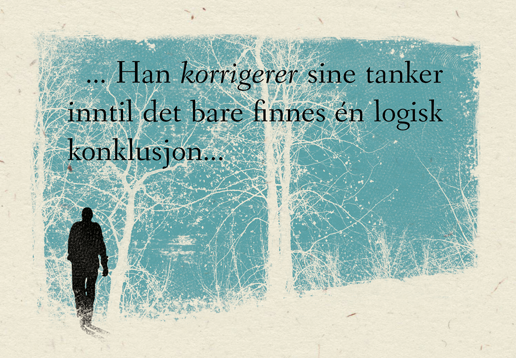
Panel 2: ... He corrects his thoughts until there's only one logical conclusion left...


Panel 3: ... to negate his own existence...


Panel 4: ... Is it at all possible to write truthfully? ... / ... The Lime Works and Correction problematize literary truth-searching in, at least, two ways: 1) by using exceedingly indirect and complicated narrative techniques - which makes first-hand information an impossibility...

 
Panel 5: ... 2) by portraying isolation, resignation and defeat - how persons positively obsessed with truth ...


Panel 6: ... and perfection...


Panel 7: ... go...


Panel 8: ... under...

Esper Terjesen: About the Strip

While working at the University of Bergen, I started thinking about combining my interest in literature and drawing. It was only a few years later, though, that I sat down to draw a graphic essay on Thomas Bernhard, my favourite author. My aim was, first and foremost, to develop a visual language that would suit future essays on academic topics. This essay was, therefore, improvised on the spot. I didn't plan or write anything in advance. I just followed my own train of thoughts while drawing. Needless to say, the result is somewhat unfocused, but I'm still happy with the overall mood and feel of the essay.

When it comes to the contents itself: To me, a lot of Thomas Bernhard Criticism seems to be founded on realistic-mimetic and psychological theories (often of a biographic-affirmative nature) and the idea that Bernhard is a modernist (along the lines of authors like Thomas Mann, James Joyce and Marcel Proust). I would argue that it makes more sense to associate Bernhard with postmodern literature and writers. Modernist literature seems, to me, at least, to raise epistemological questions (what can we know?). We are presented with different "psychologies", and how these view and/or meet the (same) world. Postmodern literature, on the other hand, raises ontological questions (what constitutes a world?). It deals with literary truth (is it at all possible?), the nature of fiction, and how (fictional) worlds relate.

One of the most important literary tropes in Bernhard's prose, is "refutation". Where Proust writes extensive hypotheses, Bernhard's prose seems to consist of nothing but refutations. This is perhaps best viewed in Bernhard's Das Kalkwerk and Korrektur, which I discuss in the essay. The former having up to five levels of narration, muddling up the narrative. The latter describing how an architect "corrects" and adjusts his philosophy until the only logical conclusion is to negate his own soul.

Website

You can see the complete essay, along with photographs of the project's development, on Esper Terjesen's website.

Completed essay:
Development:

Also at A Piece of Monologue: