24.6.09

University of Reading: Beckett Conference 2009

News and developments in the world of Beckett Studies
Samuel Beckett at his apartment in Paris signing a rare Limited Edition copy of The Lost Ones
In the summer of 2008, James and Elizabeth Knowlson contributed a vast collection of Beckett's letters, manuscripts and interviews with his friends to the Beckett International Archive at Reading University. To celebrate the occasion, an academic conference will be taking place in September 2009, and will be attended by some of the leading scholars in contemporary Beckett criticism.

In addition, talks and displays are being organized to coincide with the conference; these aim to explore the historical and cultural significance of the Knowlson collection, and what it means for future academic scholarship.
Reading University is one of the world's leading institutions for Beckett study, and holds an international reputation for its academic research resources. In the first issue of Beckett News, published this month, the university reveals further details of the upcoming conference, the Knowlson collection, and their cooperation with Faber and Faber to enhance and expand recent editions of Beckett's prose, poetry and drama:
Samuel Beckett's hands, signing a manuscript
Beckett – Living Materials:
International Conference and Research Opportunities Symposium
25-26 September 2009
Beckett Conference 2009: Humanity and Animality in Beckett

On Friday 25 and Saturday 26 September, the Beckett International Foundation is organizing a Beckett Symposium to celebrate the acquisition of the Knowlson archive. This will include a conference constituting a preliminary stage to a project on animality in relation to Beckett’s work being prepared by Mary Bryden and entitled A Beckett bestiary. The conference, Humanity and Animality in Beckett, will bring together an international line-up of scholars who will read papers over the two days. Key acquisitions from the Knowlson collection will be on display in the Reading Room and delegates will have the opportunity to handle some of these materials. Mark Nixon and Dirk Van Hulle, University of Antwerp, will present the Beckett Digital Manuscript Project as a ‘work in progress’, and Bill Prosser's doodle drawings will be on display. There will also be a theatrical performance (which is yet to be confirmed) and a round table discussion of the research opportunities arising from the acquisition of the Knowlson collection. Further details of the symposium will be available on the BIF website: www.beckettfoundation.org.uk

Samuel Beckett manuscript

The Beckett Digital Manuscript Project

The Beckett Digital Manuscript Project is an international collaboration under the auspices of the [Beckett International Foundation], the Centre for Manuscript Genetics at the University of Antwerp and the Harry Ransom Center, Austin, Texas, and supported by the Estate of Samuel Beckett and the Bibliothèque Nationale in Paris. Mark Nixon and Dirk Van Hulle are the co-directors. Mark and Dirk are also collaborating on Samuel Beckett’s library, a joint monograph which examines the reading traces in the books held in Beckett’s library at the time of his death. Mark is editing a book on Beckett and publishing (British Library, 2010), with John Pilling, Andrew Nash and Sean Lawlor among the contributors.

New Faber and Faber editions of Samuel Beckett's work

Reading and Faber & Faber

Faber, which has acquired the rights to Beckett's prose, poetry and criticism from Calder, is republishing Beckett's works in uniform ‘Readers’ editions’, intended for the general public, and ‘Critical editions’ addressed to a more academic audience. The Beckett International Foundation is contributing facsimiles from the holdings at Reading, which will be used to illustrate the Readers’ editions. Reading scholars are very much to the fore in providing introductions to the Readers’ editions and lending their erudition to the Critical editions. Ronan McDonald wrote the preface for the new Faber edition of Endgame that was published in May 2009. James Knowlson is writing the preface to Happy days and Mary Bryden to Waiting for Godot. Mark Nixon is editing a Readers' Edition of Samuel Beckett: shorter fiction 1950–1981 and preparing a Critical Edition of the short story Echo's bones, both are due to be published next year. Sean Lawlor and John Pilling are working on the Critical edition of the Collected poems of Samuel Beckett to be published in 2011.

Reading University: Beckett News, June 2009, Issue 1 (PDF format)
Reading University: Beckett News, June 2009, Issue 1 (HTML format)
8.2.09

'As The Wind Takes Me': Beckett in Hamburg, 1936

A retrospective of Beckett's travels in Germany
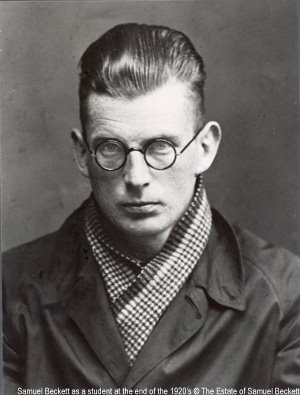
Photograph of a young Samuel Beckett.
'Beckett had already planned his own departure. By 19 September, he could write that 'The prospect of getting away is a great relief', although he had no specific plans except to travel to Germany and then 'selon le vent' (as the wind takes me).'


James Knowlson, 'Damned to Fame: The Life of Samuel Beckett'.
One of the things that distinguishes James Knowlson's biography of Samuel Beckett from its predecessors is the unprecedented access it had to the writer's so-called 'lost years'. And they were lost in more ways than one: it was a period of wandering and of solitude for Beckett, as he toured the art galleries and cultural sights of the major European cities. It was also a period 'lost' in the sense that no documentation appeared to remain from this time in his life. Knowlson's biography was written and published upon the discovery of a series of notebooks, previously hidden away from view, that Beckett wrote while traveling.

Often referred to by Beckett scholars as 'The Unknown Diaries', the notebooks detail the author's experience of Germany between 1936 and 1937, shortly before he finally settled permanently in Paris. The diaries offer a snapshot not just of the development of a great writer, but of Europe at a time of tumultuous political struggle, artistic censorship and the inexorable rise of National Socialism.

Samuel Beckett's Hamburg Diaries, 1936

There is a website online that offers readers a glimpse at Samuel Beckett's diaries during this period, and publishes highlights from his nine-week stay in Hamburg in 1936. The website originates from 'the research done by Roswitha Quadflieg around the Hamburg chapter of Samuel Beckett's German Diaries [and] was first shown in the winter of 2003 at the Freie Akademie der Künste in Hamburg [...] as an homage on occasion of Samuel Beckett's 100th birthday.'

The online exhibition of Beckett in Hamburg 1936 comes complete with a partial transcription of the writer's diaries over the entire period of his stay, and an interactive calendar with quotes, photographs and explanatory notes. It's beautifully designed and fun to browse. Available in German or English translation, you can see it for yourself by clicking here.
15.1.09

Beckett and Schopenhauer

Gottfried Büttner on an enduring philosophical influence
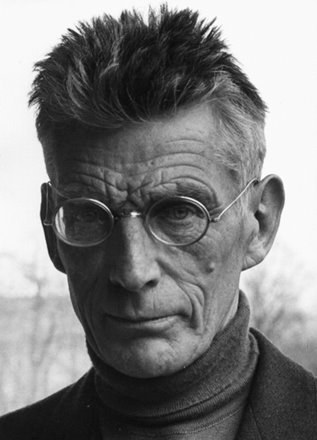
Samuel Beckett
'As a young man, Beckett read Schopenhauer again and again, and not only because of his beautiful style, despite his claims to the contrary. Schopenhauer's pessimism was very close to Beckett's own, and he was to heed the three ways of enduring the misery of existence that Schopenhauer recommended: art, or aesthetic contemplation, compassion, and resignation.'

Gottfried Büttner
With the exception of an hour here and there, I've spent the day in bed negotiating with my lungs, the old dust bags. I thought I'd brush up on my European philosophy, and given my state of mind it wasn't long before Schopenhauer appeared on the scene. Arthur Schopenhauer, a philosopher of the grand pessimistic tradition of misanthropy and resignation. In short: perfect bedtime reading - especially for someone who's annotating Malone Dies in between.

One of the key draws to Schopenhauer has been his influence on Samuel Beckett, an influence that cannot be overstated. The philosopher not only had an impact on Beckett's academic development, and interest in philosophy, but later a more profound effect on the way the writer lived his life. Schopenhauer had a large effect on Beckett's outlook on the world, and the influence is recounted time and again in biographies of the writer, notably James Knowlson's Damned to Fame. When suffering from an illness, Beckett once confided to a friend:
'[...] the only thing I could read was Schopenhauer. Everything else I tried only confirmed the feeling of sickness. [...] I always knew he was one of the ones that mattered most to me, and it is a pleasure more real than any pleasure for a long time to begin to understand now why it is so. And it is a pleasure also to find a philosopher that can be read like a poet.'

quoted in James Knowlson, Damned to Fame
Gottfried Büttner has written a short article tracing the influence of Schopenhauer's pessimistic philosophy on Samuel Beckett's life and work. 'Schopenhauer's Recommendations to Beckett', first published in Samuel Beckett Today, draws upon Beckett's novels and theatrical work, but seems particularly interested in anecdotes from the writer's life - notably, from James Knowlson's acclaimed biography. It's a concise overview, but for all its brevity it's still worth a look. The essay is freely available online, and you can read it by clicking here.
5.1.09

Samuel Beckett in Paris

A walk through Samuel Beckett's neighbourhood
Allée Samuel Beckett, Paris. Photograph by Rhys Tranter
'Hand in hand from the top of the Eiffel Tower, among the first. We were respectable in those days. Now it's too late. They wouldn't even let us up.'

Samuel Beckett, Waiting for Godot
'Paris: The crucible in which Samuel Beckett's reading turned into writing [...] In 1936 Samuel Beckett moved into the Hotel Libéria. After a stabbing incident, he remet Suzanne Deschevaux-Dumesnil. In 1937 they moved to a seventh-floor studo at 6 Rue des Favorites, in the 15th arrondissement. They lived there until 1961, when SB moved to his final address, a purpose-built flat in the 14th at 38 Boulevard St. Jacques, near the "Falstaff" and "hygienic anonymity" of the Bar Américain in the Hŏtel PLM, where he often met visitors.'

C. J. Ackerley and Stanley Gontarski
On New Year's Day I woke up in a beautiful hotel room in Paris, the city of lights. And as bright morning sunshine streamed through a window overlooking a courtyard, I sat at the edge of the bed collecting my things together. I had an old paperback copy of Samuel Beckett's Endgame, a series of photographs taken by John Minihan, and a list of addresses carefully written onto several slips of paper. Jennifer and I were going in search of Samuel Beckett, a writer who had died in the city almost exactly nineteen years before.

I've been interested in Samuel Beckett's writing for a long time. His poems, plays, novels and short stories hold a strong grip on my imagination, and seem to offer something inescapable that I'm am constantly returning to. I came to Paris to celebrate the coming of the New Year, but the city's strong links with Beckett's writing and his personal life were too powerful to resist.

One of the most memorable moments of the trip was stumbling across the Boulevard St. Jacques, where Beckett lived from the early 1960s until the final year of his life in 1989. The architecture seemed to vary between classic French apartment buildings, with balconies at each of the windows, and modest residential quarters built in the latter-half of the twentieth century. As Jennifer and I passed along the street, I could barely contain my excitement, recalling scenes from James Knowlson's biography of Beckett, and the recollections of personal friends.

We passed where some of Beckett's key social haunts once stood, but found that many of them were as absent as the man himself. I had hoped that we could enter Le Petit Cafe at the PLM Hŏtel - it had been an inconspicuous place for Beckett to meet with friends and acquaintances in relative anonymity. But the writer's social haunt on the Boulevard St. Jacques was nowhere to be found.

On the Boulevard St Jacque, Paris, 1985. Photograph by John Minihan.
One of the knock-out moments of the trip was the sudden recognition of the Metro railway line running down the middle of the Boulevard St. Jacques. In the centre of the pavement, with streetlamps to our left and right, and trees planted in parallel lines down the entire length of the street, I had a sudden uncanny experience. My perspective, while standing on a particular spot, felt very familiar to me, although I had never been there before. Standing stock-still on the spot, I had a jubilant eureka moment, when everything finally clicked into place: the photographer John Minihan had been standing in that very spot in 1986, with Samuel Beckett right in front of him.

We took a left at the end of Beckett's street, and walked along the Avenue Coty. A pathway down the middle of the road had been built to accommodate pedestrians and tourists, and a sign had been erected to mark the Allée Samuel Beckett.

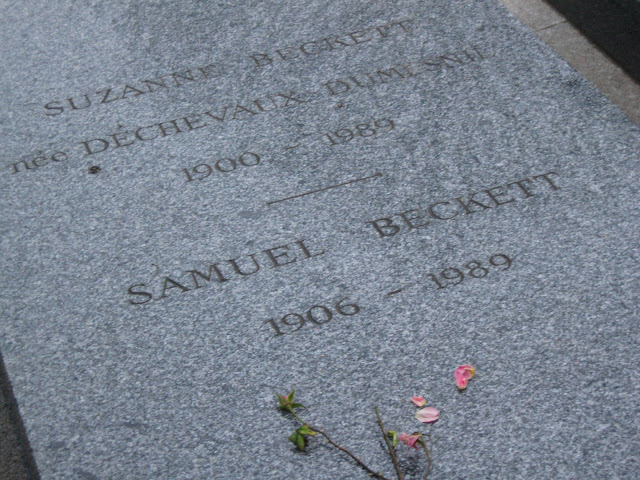
The gravestone of Samuel Beckett, at the Cimitière de Montparnasse, Paris. Photograph by Rhys Tranter.
'Paris had finally claimed him as its own. Samuel Beckett's last resting place, beside his wife Suzanne, was in the Cimitière de Montparnasse, in the heart of the city that had shaped his world as Dublin had, and was now his permanent home.'

C. J. Ackerley and Stanley Gontarski
The trip culminated with a visit to the site of his grave in the Cimitière de Montparnasse. It was already dark when we arrived, and the whole place had a distinctive feel about it. We walked along the path in search of the gravesite, huddled together in the cold. The place seemed shrouded in mist, but in retrospect I'm not sure whether it was really there, or a trick of my memory.

Jennifer and I left the cemetery together, and I was awe-struck. I still am, actually. I thought of all the thousands of words I had read, both by him and about him, and about how strange it feels to have an obsession. I was glad to have paid my respects, and shared an absurd moment with Jennifer. A unique tribute. But we did not stay long. It was dark all around, and the cemetery gates were beginning to close.

In the quiet of the cemetery, the only thing that could be heard was the tolling of the closing bells. Thinking back on it now, I'm reminded of the end of Beckett's novel Murphy, as Celia and Mr. Kelly leave the park at closing time:
'The wail of the rangers came faintly out of the east against the wind. All out. All out. All out. (...) Celia toiled along the narrow path into the teeth of the wind, then faced north up the wide hill. There was no shorter way home. The yellow hair fell across her face. The yachting-cap clung like a clam to the skull. The levers were the tired heart. She closed her eyes.

'All out.'
28.8.08

Samuel Beckett's 'Ping'

On Beckett's late, experimental short story
"White ceiling shining white one square yard never seen ping perhaps way out there one second ping silence. Traces alone unover given black grey signs no meaning light grey almost white always the same. Ping perhaps not alone one second with image always the same time a little less that much memory almost never ping silence."

Samuel Beckett, 'Ping'
I don't know whether it's the caffeine, or simply my nature, but I've always been a night owl. Thinking it over, it's probably a handsome blend of the two: nature and nurture working together. But whatever the cause, the symptom is always the same: insomnia. And for better or for worse, I'm constantly searching out ways to occupy my time.

Tonight I found myself skipping through some of Samuel Beckett's shorter works, rereading First Love and discovering Dante and the Lobster for the first time. The latter story, composed early in Beckett's writing career, recounts the first adventure of one of the writer's recurring characters, Belacqua. Drawn from incidents in Beckett's own life, the Belacqua stories were published together in the More Pricks Than Kicks collection.

Dante and the Lobster has a certain playfulness about it, and is written in a third-person narrative that allows us to identify with its protagonist while being aware of his pretensions and shortcomings. It offers a glimpse of the young Beckett as an exuberant and ostentatious writer, keen to display his wit and erudition with stylistic wordplay and knowing references. But while his knowledge can be daunting, the prose still feels warm and approachable, in its way.

At the end, I thought I would skip a few hundred pages and peruse some of Samuel Beckett's later prose work. Short prose. Nothing that would take too much time; I was looking for something easy on the early-morning eye.

In the end I settled for Ping, weighing it at just two and a half-pages. From the first few sentences I was completely hooked. Its style is completely at odds with More Pricks Than Kicks, with all ornamentation stripped away. Instead of the security of knowledge, we have a cold, bare image of a bright white room. There is, perhaps, a protagonist, perhaps another, and perhaps a narrator. But nothing is certain. We have little more than a hint of a consciousness, precarious at best. And it expresses a something so close to nothing it's scarcely anything at all.

I love it! The text refuses to give the reader anything concrete to sink their teeth into, and there is a struggle to comprehend both the scene, the central character, and the narrator. We are given no easy answers, and barely two clues to rub together, but there is something compelling about it. It reads like the expression of a mind barely aware of itself, but expressed in a beautiful and poetic way - even if it is impossible to grasp, or to understand. There is something imploring the reader to take time over it. To think it over. To quote a line from Dante and the Lobster:
'Still he pored over the enigma, he would not concede himself conquered, he would understand at least the meaning of the words, the order in which they were spoken and the nature of the satisfaction that they conferred on the misinformed poet, so that when they were ended he was refreshed and could raise his heavy head, intending to return thanks and make formal retraction of his old opinion.'

Ping is impenetrable, but it is beautiful. David Lodge has attempted to summarize it as 'the rendering of consciousness of a person confined in a small, bare, white room, a person who is evidently under extreme duress, and probably at the last gasp of life.' Typically, Beckett's short piece asks far more questions than it answers, but for me that is what is so compelling about it. And, perhaps bizarrely for some, I do not feel impelled to seek the answers out. Probably because I don't think the text conceals them. To draw on a line from Beckett's Molloy: 'this is something I can study all my life and never understand.'

In Frescoes of the Skull, James Knowlson and John Pilling define the 'telegrammatic briskness' of Ping as a reflection of the 'impotence and ignorance that Beckett has always carefully distinguished from Joyce's omniscience and omnipotence.' Even for those familiar with Beckett's characteristic motifs, and literary style, there is a 'strangeness and opaqueness that prevent it, like [Finnegans Wake], from ever being perfectly apprehensible'. For me, this is precisely the charm and beauty (that word again) that draws me to Ping in the first place.

But, for those who are drawn to the riddle wrapped in the enigma, there are some key questions to be answered. Stanley Gontarski and C. J. Ackerley pose just a few of them, with a description of the scene: 'Although the story lines of the late tales are simple, narratologically they are complex. The reader focusses not only on a figure in a closed space, but on another figure and a narrator imagining them. There is not just the psychologically complex image of a self imagining itself, but a self imagining itself imagining itself, often suspecting that it, too, is being imagined.'

It doesn't get much better than that!
22.8.08

Samuel Beckett's 'Breath'

Beckett's shortest play

In case you were wondering, this isn't a discussion of Samuel Beckett's oral hygiene. Instead, it's a brief look at Beckett's briefest and perhaps most willfully perverse play: Breath. For those who are new to it, the play is almost absurdly straightforward. It begins with a faint light illuminating the stage, 'littered with miscellaneous rubbish'. As the light increases in intensity, a 'faint brief cry' is heard. 'Silence and hold for about five seconds'. Then the light falls gradually to darkness, and the cry is heard one final time. The end.

The Beckett on Film project, celebrating the one hundredth anniversary of the writer's birth, set about putting all of Beckett's dramatic work on screen. In the case of Breath, contemporary artist Damien Hirst was selected to direct; a suitable choice, not least for the controversy his career has prompted over some of his conceptual work. Actor and friend of Hirst, Keith Allen, was selected as the breath itself (or faint cry), and the artist got to work on creating a landscape of trash for the play.

I can still remember the first time I caught the play on DVD, having no previous knowledge of Breath's strangeness or its brevity. I laughed, completely bewildered, and watched it again. I could see Hirst's obsession with pharmaceuticals and medical paraphernalia all over the stage, but couldn't quite understand how it had been coupled with a human breathing in and out.

One way of looking at it was straightforward enough. In Beckett's text the cry is described as an 'instant of recorded vagitus', a Latin word describing the cry of a newborn infant. And although this part of the text doesn't carry through to Hirst's adaptation, there is a suggestion that the breath and the few brief moments of light could be seen to represent life itself - its shortness, and its desolation. To take a line from Waiting for Godot, we 'give birth astride of a grave'.

But what's the real story behind this bizarre little play? While the idea might look interesting on paper, less than one page of text(!), why would anyone go through the effort of arranging and directing such a production? James Knowlson and John Pilling have suggested that 'Breath has either been treated too reverentially, surprising though this may seem, or has been considered a rather weak joke.' Both interpretations sound inadequate, and perhaps both miss the point. While one can see Breath as a signal of the kind of direction Samuel Beckett's theatre was to take - short, essential and to-the-point - I think the play has received a little too much critical attention over the years: long, rambling and diffuse.

Breath was a play written on the request of Kenneth Tynan, for a series of dramatic work produced for his long-standing avant-garde revue Oh! Calcutta! Beckett wrote that his 'contribution to the Tynan circus is a forty second piece entitled BREATH... It is simply light coming up and going down on a stage littered with miscellaneous unidentifiable muck, synchronized with sound of breath, once in and out, the whole (ha!) begun and ended by the same tiny vagitus-rattle.' (From Knowlson's Damned to Fame, p.565.)

Oh! Calcutta! - a pun on the French 'O que cul t'as'! (Oh, what an ass you have!) - consisted largely of sexually based productions and erotic sketches. Beckett wrote that if '[Breath] fails to titillate I hand in my aprob.' Knowlson has suggested that Beckett's play was intended as an 'ironic comment on what was to follow in the show [...] funny simply because of its deliberate failure to live up to audience's expectations.' But the text, as written, did fail to live up to expectations, and to great surprise of its writer was modified: 'including naked people' in its first production.

According to C. J. Acklerley and S. E. Gontarski the play ran through 1,314 performances and was seen by 85 million people, 'making it easily SB's most viewed SB play.' I can't help but smile at the idea of so many people watching Breath among a packed audience, not knowing what to expect or whether to take what they see seriously. In one sense, a play implying the waste and desolation of a short human life is both tragic and poignant; but it's the shortness of the play that makes it so absurd, and ridiculous, and most of all funny.

Breath has ultimately proved to be a popular success, and rightly or wrongly has garnered critical attention for its themes and its length. But to me the play's strength is in its sense of humour. It's baffled audience expectations, dumbfounded critics, and offered us a valid portrait of human life: nasty, brutish and short. And absurd, funny, strange and bewildering.
19.8.08

Samuel Beckett's 'Not I'

On Beckett's groundbreaking short play
Billie Whitelaw in Samuel Beckett's 'Not I'
"when suddenly she felt . . . gradually she felt . . . her lips moving . . . imagine! . . her lips moving! . . as of course till then she had not . . . and not alone the lips . . . the cheeks . . . the jaws . . . the whole face . . . all those- . . what?. . the tongue? . . yes . . . the tongue in the mouth . . . all those contortions without which . . . no speech possible . . ."

Samuel Beckett, Not I
I've spent the last few days reading James Knowlson's Beckett Remembering Remembering Beckett, a collection of uncollected interviews published for the centenary of Beckett's birth in 2006. Knowlson, the authorized and acclaimed biographer of Beckett's life, publishes many accounts of the evasive writer here for the first time, including memories and anecdotes from colleagues, friends, family members and even Beckett himself.

What struck me as particularly interesting were passages relating to Samuel Beckett's role as a theatre director. A writer by trade, Beckett had no previous experience of working with actors, but adopted a hands-on approach to adaptations of his work from the 1950s up until three years before his death in 1989.

Actors recounting their experiences sometimes felt frustration at Beckett's reluctance to develop back-stories for his characters; for Beckett, each character existed on the stage, and on the stage alone. Rick Cluchey of the San Quentin Drama Workshop, a friend and collaborator of the writer, puts it plainly enough: 'They went nowhere but backstage. They ceased to exist."

And Beckett was similarly reticent about the meanings and interpretations of his character's actions, often shrugging that 'it is of no consequence'. Actors sometimes struggled to relate to the characters they portrayed when so little information was offered them. All that existed was the text: alienated characters in austere circumstances, often completely divorced from any kind of realist representation. But for Samuel Beckett the text was enough, and he refused exegesis or explanation on what he saw as self-contained and self-explanatory. Speaking of Waiting for Godot in an interview, Beckett was definitive:
"I don't know who Godot is. I don't even know (above all don't know) if he exists. And I don't know if they believe in him or not - those two who are waiting for him. [...] All that I knew I showed. It's not much, but it's enough for me, by a wide margin. I'll even say I would have been satisfied with less. [...] Estragon, Vladimir, Pozzo, Lucky, their time and their space, I was able to know them a little, but far from the need to understand. Maybe they owe you explanations. Let them supply it. Without me. They and I are through with each other."
But there were a number of actors with whom Samuel Beckett felt a strong and lasting affinity. A fondness existed for French actors Jean Martin and Roger Blin, who acted in the premiere of Waiting for Godot (En attendant Godot) back in 1953. The aforementioned Rick Cluchey became a long-standing friend of Beckett, and performed to acclaim as many of his characters. Jack MacGowran and Patrick Magee served to prompt and inspire him. And actress Billie Whitelaw not only became a close friend of Beckett's, but a favourite interpreter of his work.

Billie Whitelaw not only occupied prominent roles in plays such as Come and Go and Happy Days, but was directed by Beckett in his production of Footfalls (a play that according to Knowlson was written with her in mind). They both appeared to find an immediate rapport, informed by a mutual understanding and Whitelaw's seemingly selfless dedication to her particularly challenging roles. As though being buried up to the neck in Happy Days wasn't enough, Whitelaw played Mouth in the British premiere of Not I under Beckett's specific guidance.

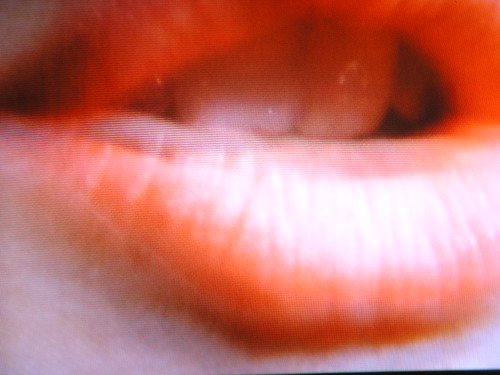
For those not familiar with the play, Not I is essentially a monologue for female voice, depicting a troubled and often silent mouth that has erupted into an uncontrollable speech. For the duration, only a mouth is illuminated on stage, and the lines are delivered in a voice close to monotone; in fact, when Whitelaw would veer close to a sensitive or emotive delivery, Beckett would shake his head and complain 'Too much colour! Too much colour!'

Aside from the challenges inherent in remembering the character's speech, Billie Whitelaw was also placed in an uncomfortable position. To quote James Knowlson, 'Whitelaw was covered in a hood, except for her mouth, shrouded in black and placed high up in a chair on a podium.' While firing out lines to the audience, Whitelaw was blindfolded and restricted, breathing more and more rapidly within her confined space. The result, although Whitelaw does not attribute it to Beckett's supervision or to the play itself, initiated hyperventilation and prompted her collapse at a rehearsal:
"It was nothing to do with Sam, nothing to do with Not I; it was all to do with sensory deprivation. If you are blindfolded and have a hood over your face, you hyperventilate, you suffer from sensory deprivation. It will happen to you. And I hung on and hung on until I couldn't any longer. I just went to pieces because I was convinced I was like an astronaut tumbling out into space. And I thought I can't be tumbling out into space, but I am tumbling out in space and that's when I fell down; I couldn't go on."
But, in typical Beckettian style Whitelaw eventually insisted that she would go on after all. Adjustments were made to her hood that gave her a sense of space and stability, and she continued with her performance. In fact, Billie Whitelaw also performed Not I for a television adaptation in 1973 - the first performance of Not I that I saw.

Julianne Moore in Samuel Beckett's 'Not I'

What strikes me most is the simplicity of the image. Not I is in some ways ideally suited for the film medium, as it allows the audience an extreme close-up of its subject. The image of Mouth is not only a powerfully simple one, but disconcerting and disturbing. It belongs to a universe where nothing else seems to exist at all. Nothing but a constant stream of words. And Whitelaw's performance is easily the best that I've seen so far.

Another prominent interpretation came from Julianne Moore for the Beckett on Film centenary project. But there is something about Moore's performance that has always left me cold. Neil Jordan's direction feels too bright and colourful to me, even sensual, and takes something away from the light and dark contrasts of the previous production.

What bothers me most about centenary adaptation is the decision to include more of Julianne Moore's face on-camera, which seems to miss one of the central points of the play. The audience is no longer aware of Mouth simply as what it is: a mouth. Instead it becomes the mouth of a famous Hollywood actress.

There are also numerous cuts made to the film to present different angles and perspectives, perhaps to keep the audience interested. But these cuts, while self-consciously disorientating, give the impression that the speech has been patched together with different takes - rather than offering a single, unbroken and unrelenting speech.

If Not I is a play about a mouth that speaks alone, utterly divorced from the character of its subject, then this dimension is absent in the Jordon production. We not only lose the sense of a Mouth as a character in and of itself, removed from all other context, but we also lose the strange and abstracted image of a human mouth struggling to express itself.

If you're curious to find out more, you can see Billie Whitelaw's 1973 performance of Not I by clicking here. As you can imagine, Not I probably isn't everybody's cup of tea... but for me there is a strange power in Whitelaw's constant and unrelenting delivery. It's theatre of the most extreme kind.
5.8.08

Pure Anecdote

On my fascination with biography
Samuel Beckett

French philosopher Jacques Derrida once introduced a seminar on autobiography with a quote by Martin Heidegger; speaking on the life of Aristotle, Heidegger had said, 'he was born, he thought, and he died. The rest is pure anecdote.' And it's an interesting point to make. Regardless of what Aristotle may or may not have done during his lifetime, all that is relevant to us is the work he left behind.

Aristotle's ideas form some of the central touchstones of Western philosophy, and continue to influence our understanding of who we are and where we are going. Do we really need to know what the man ate for breakfast?

While visiting art galleries in Berlin during his youth, Samuel Beckett made a point regarding conjecture and speculation in history books. He wrote in one of his travel diaries:
"I am not interested in a 'unification' of the historical chaos any more than I am in the 'clarification' of the individual chaos, and still less in the anthropomorphisation of the inhuman necessities that provoke the chaos. What I want is the straws, flotsam, etc., names, dates, births and deaths, because that is all I can know."
The rest, as Heidegger suggests, is at best pure anecdote; at worst, wild speculation. The lives of historical figures will always remain a mystery to us, despite our best efforts to uncover hope for the contrary. I can read a biography of Franz Kafka. I can read two, or three. I can read Kafka's private journal. If I was so disposed, I could even read letters to his friends, family and loved ones. But all the details I would accumulate, and all the facts I could list, would still read cold off the page. They don't bring me any closer.

But what is it that makes me scurry off in search of these biographies, authorized and unauthorized alike? Is it my attempt to get to the heart of a man or a woman that has held my attention so closely, and do I really think I'll succeed? Does it really make a difference if there's a selection of black-and-white photographs from someone's personal archive on the central pages? Will I know them any better? Do I really want to?

I suspect that I track down autobiographies when I feel an affinity for someone's art. That's where it all begins. I might listen to a Miles Davis or a John Coltrane record, and hear something that speaks to me in some way. I wonder what this sensation is, this sense of recognition, and hope that knowing the artist in more depth might reveal something more. Perhaps it will explain something to me about myself, and why I am drawn to it.

I often I feel I can identify with the people I read about, and it gives me a sense of comfort and satisfaction to find a kindred spirit with similar preoccupations. But the end result is always the same: at the end of the book I become at least partly disillusioned with the life and return to the original work. What is it people say about meeting your heroes? Ultimately, it's not Miles Davis that holds my interest, but his music.

I'm currently reading James Knowlson's biography of Samuel Beckett, Damned to Fame, and I'm repeating the same process all over again. I'm a huge fan of the writer's plays, novels, poetry and short stories, and for years I've been interested to know more about the creator. His work has, like Kafka's, always felt close to me, so I was keen to discover whether I would form a similar impression of the man himself.

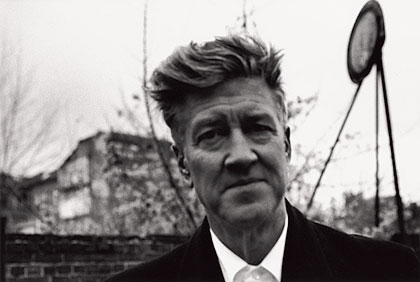
David Lynch

I'm finding that there are dozens of facts about Beckett's life that I identify with very strongly, from similar personal experiences to shared opinions and outlooks. And these small details accumulate to form a satisfying feeling. However, before I even finish the book I can tell you that there's something missing. Not only is there a vast wealth of detail that I do not relate to, and on some level choose to overlook or ignore, but the facts ultimately do little more than emphasize Beckett's absence. The biography, after all, is not the man. More shocking still, neither is the work.

It is often tempting to uncover what an artist thinks about their work, to gain a greater appreciation of the qualities that drew you to it in the first place. But it's easy to forget that we might not agree with the author's interpretations of his or her work, and that it might conflict quite strikingly with opinions of our own.

Interviewed by Mark Cousins in the late 1990s, director David Lynch was asked for his interpretation of scenes from some of his films. The releases shown included Blue Velvet, Elephant Man and Fire Walk With Me, a film that accompanies the Twin Peaks television series. Lynch admitted that all of his films have meant something deeply personal, but declined to reveal anything on camera. Instead, he focussed on the importance of the audience becoming involved with the films for themselves, and drawing their own conclusions. 'It's a beautiful thing,' he said.

And I can't help but agree. That's not to say I won't stop reading biographies, mind you. Old habits die hard, after all. But I'm no longer in search of any authoritative answers to my big questions. After all, a biography can only offer us the facts, pure anecdotes and wild speculations. Why settle for someone else's when you can have your own?
3.8.08

Die Brücke

One of the great artistic movements of the 20th Century
Die Brücke

A few years back a friend and I decided to spend a week in Berlin. We followed the tourist handbooks and navigated our way through the city. After a few days, with growing confidence, we even began to explore with the guidebooks tucked away in our pockets, and gradually started to establish our bearings. I loved the experience, and to this day I feel that Berlin is one of the greatest places I've ever visited.

I found it amazing to see the way Berlin accepts and adapts to its own history: a history that shaped much of twentieth-century Europe, and which manifests itself in every street and every square of the city. There are so many signifiers of a dark and troubling past, amid so much optimism and urban development. The collision of the present with the past, light with dark, was often more than a little on the uncanny side.

We saw bars and restaurants located around Checkpoint Charlie, where tourists can sip a cold beer and contemplate the divide; fragments of the Berlin wall outside shopping malls and train stations; and memorials and high-rise buildings constructed over underground caverns of Nazi administration. Walking through the city was, at times, awe-inspiring, and at others it was frightening.

It was in Berlin that I first came across the work of Ernst Ludvig Kircher, Ernst Heckel and Karl Schmidt-Rottluff, painters of the Die Brücke expressionist movement. Their name, literally meaning 'the bridge', derives from a desire to merge traditional artistic techniques with the evolving avant garde movement. I was initially drawn to investigate the group while reading about David Bowie, who emulates the pose of Heckel's Roquairol on the cover of his Berlin album "Heroes". Iggy Pop strikes a similar pose on the cover of his album, The Idiot, released the same year.


Despite their expressionist techniques, I always saw a certain realism in their work that always appealed to me. I was drawn to the lone figures, that seemed to be trying to comprehend their surroundings. At times I was reminded of some of Kafka's short stories, at others I thought of Edward Hopper's anonymous city dwellers, but sometimes I didn't think of anything specific. I just daydreamed. That was what I loved about them.

I was reminded of Die Brücke again just recently, while reading James Knowlson's fantastic biography of Samuel Beckett, Damned to Fame. In the mid-1930s, as national socialism began to gain momentum, Beckett embarked on a kind of cultural pilgrimage, touring the museums and art galleries of Germany.

Ironically, many of the modern pieces that interested Beckett most, including those of Kirchner, Heckel and Schmidt-Rottluff had recently been declared decadent by the Third Reich and were taken out of the public eye - either to be stored, bought by private collectors or destroyed. Beckett witnessed the censorship first-hand, and was appalled to meet painters and artists who were suffering from the new policies. But despite this, Beckett did find numerous opportunities to see the works he had been looking for, and retained an interest in the Die Brücke movement, and painting in general, all of his life.

Lying in bed this morning, I spent some time in a dreamless haze, watching the sun move gradually up the wall. I was contemplating the morning coffee, but couldn't quite find the motivation to get up and do something about it. It was at this point that I noticed some of the postcards that have been tacked about the place, here and there, to give my room a bit of colour. Two such postcards were bought from an art gallery gift shop in Berlin: two paintings by Kirchner. I decided to make myself a fresh pot of coffee and go in search of some more paintings online.

And I found them. The Museum of Modern Art in New York is currently holding an exhibition of Ernst Ludwig Kirchner's work. There is a website filled with great examples of his painting, and plenty of information about his life and that of the Bridge movement. You can see it for yourself by clicking here.