23.9.09

New Faber editions of Beckett's work

An exciting new collection of novels, poetry and plays edited by Beckett scholars
Detail from earlier Faber edition of Samuel Beckett, 'The Complete Dramatic Works'
Tim Martin on the new editions of Samuel Beckett's work, presented by Faber & Faber:
[...] Faber & Faber celebrates its own 80th anniversary, and marks the 20th year since Beckett’s death with a wholesale republication of his plays and prose.
The history here is complicated. For many years, the British rights to Beckett’s prose works were held by the London publisher John Calder, one of the last great independent publishers in Britain. Calder befriended Beckett in the Fifties, and after the success of Waiting for Godot in London, he added him to what reads like a VIP list of mid-century European or Europhile talent. Among Calder’s writers were Eugène Ionesco, Heinrich Böll, William Burroughs, Alexander Trocchi, Fernando Arrabal, Henry Miller, Hubert Selby, Jr and Marguerite Duras.

When Calder retired in 2007, he passed almost his entire catalogue to Oneworld Publications. But after much negotiation, Faber obtained the rights to Beckett’s poetry and prose. Adding them to the plays it already publishes, Faber, for the first time, brought all Beckett’s English work under the same roof and salved its conscience for having turned down the non-dramatic work in the first place. It also provided the opportunity to address several of the editing errors and textual corruptions in the Calder texts, especially those published after Beckett’s death. (“There is little that is new here, either as to poems or to the publisher’s incompetence,” wrote Christopher Ricks in a review of the latest Calder edition of Beckett’s poems, advising readers to “take the book with more than a grain of salt, since the whole thing is peppered with errors”.)

Faber’s new editions have no scholarly apparatus – a treat, one imagines, reserved for future years – but each boasts a cleaned-up text and a perceptive new introduction from a Beckett scholar. Appearing in bursts from now to next year, they offer affordable and correct editions of one of the deepest and strangest talents of modern literature.

[...]

Faber’s excellent new edition of the late novellas also collects several pieces of the late prose that have been impossible to find between covers: a short piece called The Way, written at the same time as Beckett’s bewildering stage piece Quad, and a vignette called Ceiling, a chilling and minimal evocation of waking up wordless in hospital: “No knowledge of where gone from. Nor of how. Nor of whom. Nor of whence come to. Partly to.” The reissue of this peerless and haunting body of work in rigorous editions is long overdue. With luck, if the famously protective Beckett estate wills it, the next step will be an annotated complete edition. [Read More]


Further information:
22.9.09

Samuel Beckett's Doodles

Artist Bill Prosser on the sketches that fill Beckett's manuscripts
Doodles from the 'Watt' notebooks by Samuel Beckett. Copyright © 2009 by the Estate of Samuel Beckett.
In the Fall 2009 issue of the Ransom Edition, Bill Prosser writes on the sketches and doodles that pepper Samuel Beckett's manuscripts:
Although popularly thought of as a rather dour and ascetic writer, there is a wonderfully playful aspect to Samuel Beckett's creative output: the pictorial array of raggle-taggle characters and baroque broidery that scampers through his notebooks and manuscripts. Continuously—from decorating 1930s exercise books to embellishing the scraps of paper bearing his 1970s "Mirlitonnades"—doodling provided an amiable outlet when, yet again, he found himself up against the obduracy of words.

Beckett's interest in the visual arts is well known. During his exhaustive travels around Germany in the 1930s he kept notes detailing his responses to the Old Master and more modern paintings that he had seen. More communally, throughout his life he formed close friendships with a number of artists, including Jack B. Yeats, Bram Van Velde, Henri Hayden, and Avigdor Arikha. However, his appreciation of fine art seems to have had no discernibly direct effect on his own spontaneous drawings, which repeatedly appear to have earthier, and more mixed, antecedents.

Although Caspar David Friedrich's Two Men Contemplating the Moon may have given rise to the setting for Waiting For Godot, Beckett also warmed to music hall routines and the silent cinema. He once wrote to Sergei Eisenstein asking for a job, and one of his favorite comedians, Buster Keaton, appeared as the central character in his 1964 film, Film. He enjoyed the German cabaret comic Karl Valentin, and borrowed the Marx Brothers' "three hats for two heads" muddle to use in Godot. This varied visual diet gave him an ingested feeling for caricature that flourished as absent-minded glosses to his written texts. [Read More]

3.9.09

Simon Critchley on Krapp's Last Tape

British philosopher shares his thoughts on the Samuel Beckett play
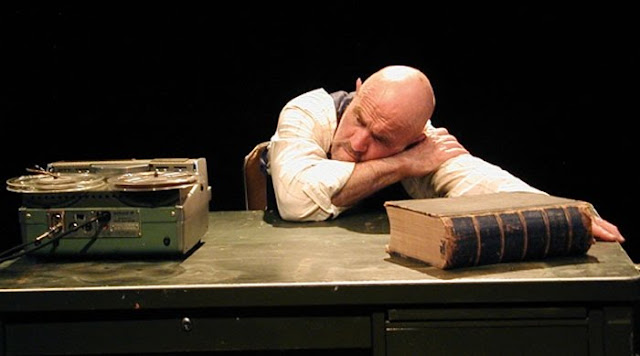
Krapp (played by Paul Gerrior) in Samuel Beckett's 1958 work 'Krapp's Last Tape.' Photograph by Rob MelroseWell, I'm back in the United Kingdom after a month in California. I arrived at Heathrow Airport's Terminal 5 early yesterday morning, and jetlag has prevented me from snatching more than five or six hours of sleep. As a result, I'm spending my early morning hours drinking plenty of water and catching up on a spot of reading.

Just a little earlier on I spotted an interesting blog from British philosopher Simon Critchley, writing online for the New York Times. His article, published back in May, is a response to readers' comments on a previous post, discussing life, the pursuit of happiness, and Samuel Beckett:
[...] I was delighted that one reader recalled Beckett’s Krapp’s Last Tape, which is a hugely important play to my mind, much more so than Waiting for Godot. The wizened, elderly Krapp listens obsessively to the recorded voice of a younger version of himself, who is both more hopeful and more idiotic. The portion of tape to which he listens repeatedly is an epiphanal moment with a lover while punting on a lake:

'I lay down across her with my face in her breasts and my hand on her. We lay there without moving. But under us all moved, and moved us, gently, up and down, and from side to side.'

This passage from raises two points that came up in some of the comments: firstly, Krapp’s experience of bliss is shared with another, with a former lover. This addresses the criticism that Rousseau’s picture of happiness was solitary, indeed selfish and narcissistic. Well, narcissism is a complicated matter and we should not forget that after obsessively contemplating his image in water, Narcissus drowned himself. But the point is well-taken and I tried to acknowledge it at the end of the piece: the feeling for existence can be had with others. Perhaps it is best had with others in the experience of love, whether it is love of another person, as for Krapp, or one’s cats and dogs, as came up more than once in the comments, or indeed in being face to face with a tiger, as one reader wrote.

Secondly, the passage from Beckett reminds us that this transient experience of bliss is a recollected experience, a work of memory. This is the lost time that we go in search of. It is one thing to experience happiness in the moment; it is another to recall such memories months, years or even decades later. This is one of the reasons why we feel compelled to write at all. [Read More.]
20.7.09

Whatever happened to the literary avant garde?

Robert McCrum on the decline of an artistic movement
1950s French couple kissing in Paris.
Robert McCrum has written a short article for The Guardian's online website, mourning the loss of the literary avant garde:
Half a century ago, when Waiting for Godot was the succès d'estime of 1950s Paris and London, Beckett was certainly avant garde, as was his disciple, Harold Pinter. In the UK, next to these innovators, there was the translated work of Alain Robbe-Grillet, and Fernando Arrabal, author of The Burial of the Sardine. And from the US there was William Burroughs, and the heirs to the Beat generation. You never had to go far in a bookshop to bump into the avant garde, and some publishers – Calder & Boyars, for instance – even made a living out of it (though the less said about their methods the better). From roughly 1950 to 1980, the avant garde was alive and well.

But now what? Nothing to speak of, really. The most surreal news from the world of books is the trade press report that The Lost Symbol, Dan Brown's follow-up to The Da Vinci Code, is going to be launched in September from Random House with the biggest ever global first print run (some 6.5m copies) in the publisher's history.

7.7.09

Amélie Doistau: French editions of Beckett's work

A wonderful online gallery of Doistau's designs
Amélie Doistau photography on French editions of Samuel Beckett's work
This morning I stumbled upon the work of graphic designer Amélie Doistau, who has contributed photographs for five proposed volumes of Samuel Beckett's work:
  • En attendant Godot (Waiting for Godot)
  • Mal vu Mal dit (Ill Seen Ill Said)
  • Oh, les beaux jours (Happy days)
  • Molloy (Molloy)
  • L'Inommable (The Unnamable)
As far as I can tell, these designs have never been implemented, but were possibly artistic proposals for a prospective publisher. The website displays two separate design concepts for the five editions (above). The first depicts a series of minimalist domestic spaces, while the second focusses on props in an austere, brightly-lit room. One or two of the images seem a little inappropriate for their subject matter, but the photographs are beautiful and nicely conceived. You can click on the images above to see them in a much larger resolution, or visit Amélie Doistau's website.
24.6.09

University of Reading: Beckett Conference 2009

News and developments in the world of Beckett Studies
Samuel Beckett at his apartment in Paris signing a rare Limited Edition copy of The Lost Ones
In the summer of 2008, James and Elizabeth Knowlson contributed a vast collection of Beckett's letters, manuscripts and interviews with his friends to the Beckett International Archive at Reading University. To celebrate the occasion, an academic conference will be taking place in September 2009, and will be attended by some of the leading scholars in contemporary Beckett criticism.

In addition, talks and displays are being organized to coincide with the conference; these aim to explore the historical and cultural significance of the Knowlson collection, and what it means for future academic scholarship.
Reading University is one of the world's leading institutions for Beckett study, and holds an international reputation for its academic research resources. In the first issue of Beckett News, published this month, the university reveals further details of the upcoming conference, the Knowlson collection, and their cooperation with Faber and Faber to enhance and expand recent editions of Beckett's prose, poetry and drama:
Samuel Beckett's hands, signing a manuscript
Beckett – Living Materials:
International Conference and Research Opportunities Symposium
25-26 September 2009
Beckett Conference 2009: Humanity and Animality in Beckett

On Friday 25 and Saturday 26 September, the Beckett International Foundation is organizing a Beckett Symposium to celebrate the acquisition of the Knowlson archive. This will include a conference constituting a preliminary stage to a project on animality in relation to Beckett’s work being prepared by Mary Bryden and entitled A Beckett bestiary. The conference, Humanity and Animality in Beckett, will bring together an international line-up of scholars who will read papers over the two days. Key acquisitions from the Knowlson collection will be on display in the Reading Room and delegates will have the opportunity to handle some of these materials. Mark Nixon and Dirk Van Hulle, University of Antwerp, will present the Beckett Digital Manuscript Project as a ‘work in progress’, and Bill Prosser's doodle drawings will be on display. There will also be a theatrical performance (which is yet to be confirmed) and a round table discussion of the research opportunities arising from the acquisition of the Knowlson collection. Further details of the symposium will be available on the BIF website: www.beckettfoundation.org.uk

Samuel Beckett manuscript

The Beckett Digital Manuscript Project

The Beckett Digital Manuscript Project is an international collaboration under the auspices of the [Beckett International Foundation], the Centre for Manuscript Genetics at the University of Antwerp and the Harry Ransom Center, Austin, Texas, and supported by the Estate of Samuel Beckett and the Bibliothèque Nationale in Paris. Mark Nixon and Dirk Van Hulle are the co-directors. Mark and Dirk are also collaborating on Samuel Beckett’s library, a joint monograph which examines the reading traces in the books held in Beckett’s library at the time of his death. Mark is editing a book on Beckett and publishing (British Library, 2010), with John Pilling, Andrew Nash and Sean Lawlor among the contributors.

New Faber and Faber editions of Samuel Beckett's work

Reading and Faber & Faber

Faber, which has acquired the rights to Beckett's prose, poetry and criticism from Calder, is republishing Beckett's works in uniform ‘Readers’ editions’, intended for the general public, and ‘Critical editions’ addressed to a more academic audience. The Beckett International Foundation is contributing facsimiles from the holdings at Reading, which will be used to illustrate the Readers’ editions. Reading scholars are very much to the fore in providing introductions to the Readers’ editions and lending their erudition to the Critical editions. Ronan McDonald wrote the preface for the new Faber edition of Endgame that was published in May 2009. James Knowlson is writing the preface to Happy days and Mary Bryden to Waiting for Godot. Mark Nixon is editing a Readers' Edition of Samuel Beckett: shorter fiction 1950–1981 and preparing a Critical Edition of the short story Echo's bones, both are due to be published next year. Sean Lawlor and John Pilling are working on the Critical edition of the Collected poems of Samuel Beckett to be published in 2011.

Reading University: Beckett News, June 2009, Issue 1 (PDF format)
Reading University: Beckett News, June 2009, Issue 1 (HTML format)
8.6.09

Samuel Beckett's Postmodern Fictions

Brian Finney on Beckett's place in Postmodern literature
Bram van Velde, 'Sans Titre' (1970)
From Brian Finney, 'Samuel Beckett's Postmodern Fictions' (courtesy of LitBlog):
'After completing The Unnamable, Beckett felt that he had exhausted his vein of self-immersive narration. The nineteen fifties were the years in which Beckett established his reputation as a dramatist with Waiting for Godot, Endgame and Krapp's Last Tape. In 1950 he did begin writing a series of linked short prose texts in French that he reluctantly released for publication in 1955 as Textes pour rien (Texts for Nothing ). In 1956 he claimed that the trilogy brought him to the point where subsequently he felt he was repeating himself: "In the last book--L'Innommable--there's complete disintegration...There's no way to go on." He adds that Texts pour rien "was an attempt to get out of the attitude of disintegration, but it failed." Apart from being wary of Beckett's constant put-downs of his own work, failure, as he wrote, is in his view the modern artist's world. As the voice remarks in the first text, "nothing like breathing your last to put new life in you." Texts for Nothing certainly does not match the virtuoso performance of The Unnamable. Yet it points forward to Beckett's last full-length novel, How It Is, by looking to form for a way out of the dead end reached at the close of The Unnamable.'
21.5.09

"What's not to get?": Michael Billington on Waiting for Godot

The Guardian theatre critic reviews new Samuel Beckett production
Iain McKellen as Estragon in the UK revival of Samuel Beckett's 'Waiting for Godot'
'I have no problem with the fact that [Waiting for Godot] stars two big box-office names in Ian McKellen and Patrick Stewart. But Sean Mathias's production not only includes superfluous Goon Show-type sound effects but also permits its two lead actors to get away with a good deal of showbiz shtick. At times I felt the evening was closer to Neil Simon's The Sunshine Boys, about the reunion of two old vaudevillians, than to Beckett's tragic vision of humanity.'

Michael Billington has written once again on the UK revival of Samuel Beckett's Waiting for Godot. At first glance, his observations celebrate the newfound public acceptance of open-ended theatre; plays that have for so long played to critics and academics are now becoming popular with the public at large. Wonderful! you might say: it's about time! And so it is. But that's not where the article ends, and it's not the happy ending we were hoping for. What Billington gives with one hand, he takes with the other, and it begins to appear that his well-meaning assessment conceals some not-so-well-meaning conservative reservations.

While Billington is willing to accept and venerate the public's interest in 'freedom of choice' concerning the theatre, and the way Waiting for Godot is being embraced by audiences at London's Haymarket, he appears to resist the productions themselves. His article is structured around a surreptitious contradiction. In the case of the Beckett revival, Billington appears to accuse Sean Mathias' direction of pandering to the masses, resorting to 'Goon Show-type sound effects' and wallowing in crass 'showbiz shtick'. Billington resists these aspects of the production by stressing the importance of the text, as written, and of upholding Samuel Beckett's authorial vision.

I think that his review makes an interesting case, but I am also a little bemused that he would feel this way. To begin with, the Beckett Estate, for all their limitations, are the first to admit that there is no definitive reading of Beckett's work. Each production is a kind of rejuvenation, or reinvention, that builds on the reputation of previous productions, and so adds to the richness of the play's long-term cultural significance. Each successive treading of the boards brings something new to the table, emphasizing a different theme or image or idea for the audience to take away with them. There is no right or wrong interpretation, strictly speaking, and to suggest so misses one of the fundamental points of Beckett's ouevre.

Waiting for Godot
is a play that somehow manages to grasp at a 'tragic vision of humanity', but infuses that vision with humour, irony and slapstick. I can relate to Billington's point that there is a 'joy of not getting it' when it comes to open-ended narratives and profound questions, but it's the joyfulness that Billington doesn't seem to get: the joyfulness of getting what's not to get.
13.5.09

Beckett and Painting: Caspar David Friedrich

On the influence of Friedrich on Samuel Beckett's work
Caspar David Friedrich, 'Two Men Contemplating the Moon 1819-20'
Excerpted from William Vaughan, 'Friedrich':
'Perhaps the most surprising and intriguing of connections of that time is that of Friedrich to the Irish existential playwright Samuel Beckett. Beckett toured Germany in 1936, where he was greatly impressed with the works by Friedrich that he saw on view.

'In this way this is ironic since the prominence of Friedrich in German galleries at this time was for the purpose of promoting Nazi ideology. But Beckett could respond - as Kleist had before him - to the searing loneliness conveyed by Friedrich, to the anxiety that lay behind all that staring into the distance. When in Dresden, Beckett was particularly struck by 'Two Men Contemplating the Moon'. He confessed 'a pleasant predilection for two tiny languid men in his landscapes, as in the little moon landscape, that is the only kind of romantic still tolerable, the bémolisé [in a minor key]. Later he made clear that it was this image that formed the visual source for his most famous play, 'Waiting for Godot' (1953). He specifically drew attention to this fact when in Berlin in the 1050s, arranging for a performance of the work. The situation in Beckett's play, that of two tramps holding a half-slapstick dialogue in a barren landscape beneath a dead tree, can certainly be seen as having a parodic connection to Friedrich's pair of contemplative dissidents.'
12.5.09

Bluffer's Guide to Godot

What to say about Samuel Beckett's most famous play
Patrick Stewart as Vladimir, Simon Callow as Pozzo and Ian McKellen as Estragon in Waiting for Godot at London's Theatre Royal Haymarket. Photograph: Tristram Kenton
'Bluffing your way through a witty conversation about Waiting for Godot is difficult when everybody claims to be an expert. If you haven't scored a ticket yet, let us (and the rest of the critics) help'

The Guardian is offering its readers a bluffer's guide to the current UK revival of Beckett's Waiting for Godot. The production is currently playing the Haymarket Theatre in London, and has attracted a number of warm critical reviews, with even the occasional celebrity guest. You can read Leo Benedictus's bluffer's guide online by clicking here. Alternatively, you can read Michael Billington's review of the show here, or Susannah Clapp's review here.

Billington's article explores the use of slapstick and music hall comedy in the latest run, which sometimes serves to weaken the overall impact of the play; nonetheless, Billington still finds something profound and emotionally-involving in the performances. Clapp is similarly aware of the production's weaknesses, but spends more time conveying its strengths. She summarizes by declaring that the familiar 'Beckettian' formula offers, in this case, ideal ingredients for a West-end success. Interesting stuff!
6.5.09

New York Times on Broadway's Waiting for Godot

Review of new production of Samuel Beckett's signature work
'Waiting for Godot,' with Nathan Lane, left, as Estragon, and Bill Irwin as Vladimir, at the Roundabout Theater Company.
'“I’ve been better entertained,” says Vladimir dismissively, when asked his opinion of one of Pozzo’s perorations. But if, as this play contends, all life is nothing but passing time that would have passed anyway, I can think of few more invigorating ways of both doing and acknowledging exactly that.'

In contrast to Alexis Soloski's lukewarm review in The Guardian (see previous posting), the New York Times offers an enthusiastic take on Broadway's revival of Beckett's Waiting for Godot. You can read the article online by clicking here.

Waiting for Godot on Broadway

Is Samuel Beckett's return to Broadway worth the wait?
Nathan Lane as Estragon, John Goodman as Pozzo and Bill Irwin as Vladimir. Photograph: Joan Marcus
'It's all very nice, but with occasional exceptions courtesy of Goodman, none of it feels particularly necessary. Beckett labelled his play a tragicomedy. Ideally, Waiting for Godot should participate in both parts of that word; this production is neither as funny as it ought to be, nor as horrifying. It's pleasant to watch Irwin and Lane play their scenes, but never does one feel that one shares in their condition, that the play might function as a sort of metaphor for life, each of us waiting, wanting, existing without hope of reward. Oh well: it may provide gimmicky cocktails, but at least the theatre doesn't label the show, as did the play's original American producer Michael Myerberg, "the laugh hit of two continents".'


Alexis Soloski of The Guardian is somewhat unenthusiastic about the revival of Beckett's Waiting for Godot on Broadway. On the one hand, the New York production boasts the acting talents of Nathan Lane and Bill Irwin, and early signs suggest that it is John Goodman's bold and theatrical Pozzo that is winning everyone's attention. But aside from a fairly positive assessment of the lead performances, Soloski labels the show as little more than a 'beautifully lit' but disappointingly 'lukewarm revival'. You can read the article in full by clicking here.

Michel Foucault on Beckett's 'Waiting for Godot'

French cultural theorist and historian on the influence of Samuel Beckett's work
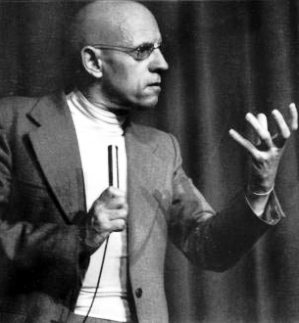
Michel Foucault
Excerpted from James Miller, The Passion of Michel Foucault:
Foucault's own youthful epiphany was not nearly so sudden. It all began, as he later recalled, in a darkened theater one night in the winter of 1953.


The curtain went up, and revealed a barren set. Just the skeleton of a tree. On stage appeared two tramps. "Nothing to be done," says one. "I'm beginning to come round to that opinion," says the other.


Of no discernible age or calling, the tramps chatter idly.


"What about hanging ourselves," says one.


"Hmmm. It'd give us an erection," says the other.


"An erection! ... Let's hang ourselves immediately.'


But this exchange, like every other, comes to nothing.


Off stage, a whip cracks. A man appears, leading a slave tethered to a rope tied around his neck. "I present myself," the master says with pompous grandiloquence: "Pozzo"


A play-within-theplay unfolds. The slave will perform. Pozzo jerks the rope: "Think, pig!" The otherwise mute man abruptly lurhces into a shouted soliloquy: "Given the existence as uttered forth in the public works of Puncher and Wattmann of a personal God quaquaquaqua with white beard quaquaquaqua outside time without extension who from the heights of divine apathia divine athambia divine aphasia loves us dearly with some exceptions for reasons unknown but time will tell..."


This explosion of words is doubtless the most exciting single moment in a nearly three-hour performance. For the rest, it is a matter of endless waiting - waiting for someone called Godot.


Samuel Beckett's play was the intellectual event of that season in Paris. It rocked the intelligentsia, such as Sartre's lecture on existentialism had eight years before. Night after night, audiences sat solemnly, as if watching a dramatization of Heidegger's philosophy - which is precisely what the young novelist Alain Robbe-Grillet declared the play to be. A farce with the air of tragedy, its vagrant heroes had nothing to do and little to say, their hyponotically boring patter broken only by the slave's mad parody of scholasticism. Offered as a kind of philosophical parable, the play seduced Parisian audiences with its irresistible hints of a deep and important mystery just waiting to be unravelled.


It is obvious, Robbe-Grillet declared in his influential review, that Godot is God: "After all, why not? Godot - why not, just as well? - is the earthly ideal of a better social order. Do we not aspire to a better life, better food, better clothes, as well as the possibility of no longer being beaten? And this Pozzo, who is precisely not Godot - is he not the man who keeps thought enslaved? Or else Godot is death: tomorrow we will hang ourselves, if it does not come all by itself. Godot is silence; we must speak while waiting for it: in order to have the right, ultimately, to keep still. Godot is that inaccessible self Beckett pursues through his entire oeuvre, with this constant hope, 'This time, perhaps, it will be me at last.'"


Shortly before his death, Foucault summed up his intellectual odyssey in these years. "I belong to that generation who, as students, had before their eyes, and were limited by, a horizon consisting of Marxism, phenomenology, and existentialism," he said. "For me the break was first Beckett's Waiting for Godot, a breathtaking performance."


That this drama of futility, folly, and aborted metaphysics should have suggested the best way yet to escape from Sartre's "terrorism" is not accidental. The world of Godot is a world where the very ideas of freedom and responsiobility have been dramatically emptied of any lingering moral significance. "Moral values are not accessible," Beckett would later declare. "It is not even possible to talk about truth, that's part of the anguish. Paradoxically, through form, by giving form to what is formless, the artist can find a possible way out."


In the winter of 1953, Foucault had yet to invent his own "possible way out." But that would come soon enough. For this time, perhaps, it was himself, at last, that he was finding.
27.4.09

A Godot Worth Waiting For

On a new production of Samuel Beckett's Waiting for Godot
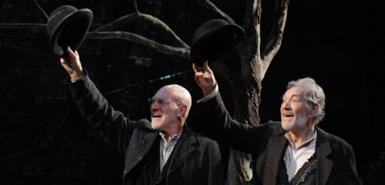
Patrick Stewart and Ian McKellen in Samuel Beckett's 'Waiting for Godot' 2009
'McKellen and Stewart play Gogo and Didi, essentially as old, damaged thespians. “They don't live together,” he points out. “They meet once a day, in the evening, and when night comes, they separate. Godot seems to be an employer of some sort. He has the prospect of work. Well, any actor or washed-up comic knows about an agent, or somebody who they met in a pub, or something.”'

Ian McKellen has spoken to The Times regarding his role in the UK revival of Samuel Beckett's Waiting for Godot. I'm beginning to feel the excitement now, as Jennifer has acquired tickets to an upcoming production at London's Haymarket Theatre. It will be the first time I've seen a Beckett play performed on the stage, which seems almost absurd considering how much I admire the man and his work. Needless to say, I can barely keep still.

McKellen reflects upon his stage and screen career, before offering some observations on his performance alongside Patrick Stewart. You can read the article in full by clicking here.
17.4.09

Waiting for Godot: Stewart argues with a fan at UK revival

Not amused... Patrick Stewart and Ian McKellen in rehearsal for Waiting for Godot, screengrab from BBC2's Culture Show Photograph: BBC
'Actor Patrick Stewart apparently lost his rag with an autograph hunter outside the stage door of the King's theatre in Edinburgh, after a performance of Waiting for Godot. "Are you the arsehole who was sitting in the front tonight?" was his introductory comment, before bellowing "You know, what I really want to know is how you can sleep at night? I really hope you're pleased with yourself."'


As the UK revival of Samuel Beckett's Waiting for Godot continues, Patrick Stewart is reported to have had an angry altercation with a member of the audience. This week the news just keeps rolling in. You can read the Daily Record report by clicking here, or The Guardian's commentary here. Nothing to be done.
16.4.09

Super Tramps: Star productions of Waiting for Godot

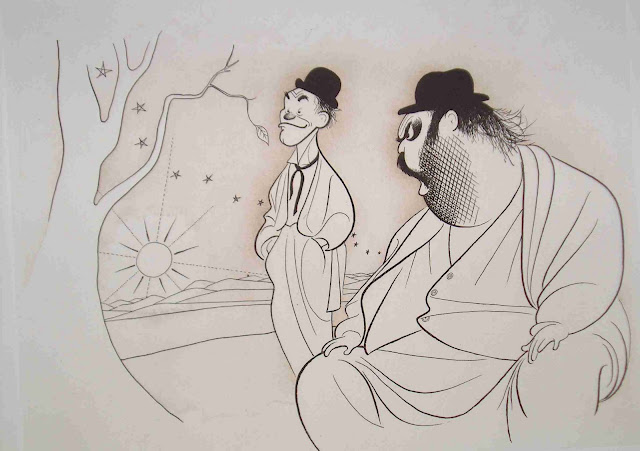
Zero Mostel and Burgess Meredith in Samuel Beckett's 'Waiting for Godot'. By George J. Goodstadt
'The playwright was Samuel Beckett. The play was Waiting for Godot. Fifteen years later, Gielgud urged Richardson to do Home, says Storey, “because of this terrible mistake he’d foisted on Ralph”. Thus began, in its English incarnation, the long and colourful casting history of the play widely regarded as the 20th century’s greatest. (En Attendant Godot had already taken its first bow at the Théâtre de Babylone in Paris in 1953. Lucien Raimbourg and Pierre Latour were Vladimir and Estragon.) In the intervening decades, an enduring question has tormented actors and audiences alike: who exactly is Godot? But before that, a director has to ask an altogether more pressing question: who are Vladimir and Estragon?'
The Sunday Times has hit the ground running with a series of Samuel Beckett articles and retrospectives this week. No doubt this is the result of Patrick Stewart and Ian McKellan's current UK revival of Waiting for Godot on the stage. In addition to a series of interviews with comedians influenced by his work (see previous post, 'Sam's A Laugh'), there is a short piece reviewing notable stars that have been attracted to Waiting for Godot over the years. 

Actors discussed include Alan Howard and Ben Kingsley, who co-starred in a production of Beckett's play at the Old Vic in 1997; and there is reflection on the Mike Nichols production of 1988, where comedic film stars Steve Martin and Robin Williams played the central parts:
'On occasion, too much advantage has been taken of the play's vaudevillian roots. In Mike Nichol's Lincoln Center production in 1988, Robin Williams played Estragon to Steve Martin's Vladimir. Williams predictably lacked the discipline to adhere to the sacred text, ad-libbing contemporary gags and breaking the fourth wall to sit among the audience.'
The stars of this particular article, however, are Ian McKellen and Patrick Stewart. There is ample space devoted to the duo, as they travel the UK with their current revival. You can read the article in full by clicking here.
11.4.09

Waiting for Elmo

Today, we are proud to present a modern masterpiece. A play so modern and so brilliant it makes absolutely no sense to anybody...

Alistair Cookie, 'Monsterpiece Theatre'
'Monsterpiece Theatre', a popular skit on American children's television show Sesame Street, offers its own profound take on Samuel Beckett's Waiting for Godot. Sesame Street presents 'the puzzling story of two monsters waiting for their friend': Waiting for Elmo.
21.3.09

Godot Has Arrived

Ian McKellen (Estragon) and Patrick Stewart (Vladimir) starring in the new UK Production of Samuel Beckett's 'Waiting for Godot'
'[Ronald Pickup:] I was lucky enough to work with Beckett, first at the Royal Court, when I was in Play with Anna Massey and Penelope Wilton in 1976, and then in 1977 on Ghost Trio and ... but the clouds..., two short pieces for television, which Beckett and Donald McWhinnie directed together. Meeting him was an overwhelming experience. He was obsessed with rhythm, and to watch him with the text in front of him was like seeing a composer conducting their own work.'


Danny Rosenthal, 'Godot Has Arrived'
The Independent, 19 March 2009
As Ian McKellen and Patrick Stewart play Estragon and Vladimir in the new UK Production of Samuel Beckett's Waiting for Godot, the Independent newspaper managed to catch up with them for an interview. Their co-stars join the discussion, to answer questions on their experience of Beckett's work, the relationships between characters in the play, critical interpretations, and the playwright's meticulous stage directions. You can read the article in full by clicking here.
16.3.09

In Godot We Trust

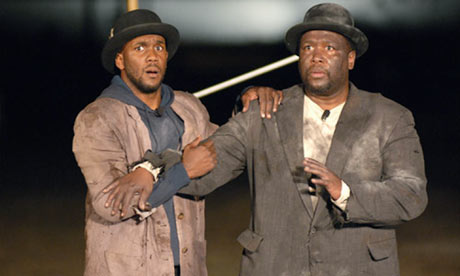
Kyle Manzay, left, and Wendell Pierce perform Waiting for Godot in New Orleans
'As major new productions of Samuel Beckett's masterpiece Waiting for Godot open in Britain and on Broadway, David Smith argues that the playwright's genius lay in creating a work that, more than half a century on, still speaks to audiences, particularly in troubled times.'


David Smith, Imogen Carter and Ally Carnwath,
'In Godot We Trust'
The Observer newspaper is getting excited about Samuel Beckett: specifically the theatrical revival of Waiting for Godot in the UK and New York's Broadway. The article briefly summarizes the critical reception the play received on its original opening, before focussing on its lasting significance to audiences through various traumatic historical moments. There is a general avoidance of general interpretation, and instead an emphasis on the meanings that theatre-goers have brought to the production.

Waiting for Godot, then, becomes something of an empty signifier on which people can project their emotions and their anxieties in a cathartic way; 'Like Shakespeare, Godot is a receptacle into which audiences can pour their preoccupations.' Sir Peter Hall, renowned theatre director and no stranger to Beckett's work, is quoted as saying:
'It's fairly obvious Godot can be anything you want. The great thing Beckett did was to say there is such a thing as metaphorical theatre. Godot's a metaphor for religions, philosophy, belief, every kind of thing you can think of, but it never arrives. We do die, however - this we know. But Sam didn't talk about death, he didn't give lectures about what his play meant.'
The article touches upon the audiences in New Orleans, who found catharsis in a production of Waiting for Godot in light of huge cultural tragedy and incomprehensible disaster. The Observer concludes its history with a series of summaries of recollections of some of the most memorable productions.

First, there is a description of Susan Sontag's Waiting for Godot in Sarajevo, 1993. Wendell Pearce talks about his role in Waiting for Godot in New Orleans, in the context of Hurricane Katrina. Bruno Boussagol shares his thoughts on an all-female staging of the play directed in France in 1991, two years after Beckett's death. Benjy Francis is interviewed about an all-black production of the play. And Rick Cluchey, personal friend of Samuel Beckett, talks about his experiences founding the San Quentin Drama Workshop, an amateur dramatic theatre company based at San Quentin Penitentiary.

You can read the article in full by clicking here.
3.3.09

Waiting for Godot on BBC's The Culture Show

Patrick Stewart and Ian McKellen in UK production of Samuel Beckett's 'Waiting for Godot'
'At 30 minutes, The Culture Show (BBC Two, Tuesday 10pm) is too long. Mark Kermode's hair continues to amaze. A heavy sculpture on top of his head. If it collapses, he will be crushed to death. Mark handed out Kermodes, little statues in the shape of himself, to scriptwriters, directors and actors that Hollywood had overlooked but he had not. It was all very postmodern.

'The presenter, Lauren Laverne, showed Ian McKellen and Patrick Stewart, both soon to appear in Waiting for Godot, Beckett's original notebooks. They were surprisingly full for one who dealt in emptiness. Lauren, dressed as Estragon or perhaps Vladimir, asked, "Can Godot engage with the credit crunch?" Apparently, the play might prompt theatregoers to be more aware of the problem of homelessness. Yeah, right.'

Gary Day, 'Good Works'
Times Higher Educational Supplement, 26th February 2009
While paging through a recent edition of the TLS, I came across a summary of some of the recently aired TV shows broadcast across the UK. Among the shows under review was BBC Two's Culture Show, a hip/indie outlook on all that's new and upcoming in the world of music, literature, art and film. I happen to be a big supporter of the show, not least for the presence of film critic Mark Kermode, whose weekly reviews on FiveLive have gotten me through many a dark night of the soul; it achieves a pleasant and accessible mix of high and low culture through a series of short asides and quirky clips.

The edition under review included a short interview with actors Ian McKellen and Patrick Stewart, who were caught on-set of the latest British production of Waiting for Godot. I happened to catch it a few days after the episode had aired. Lauren Laverne managed to snag a minute or two out of their busy schedule to ask them their opinions of their roles before taking the show on the road this March. There were a number of interesting tidbits from Beckett's life and work, along with an outline of the play's historical significance to modern drama and post-war European culture. And in all, it was an upbeat and enjoyable summary of both Beckett and the play. 

I only have one reservation. While attempting to emphasize Waiting for Godot's relevance to an economically-troubled Europe, I think The Culture Show neglected to recall the humour and dry wit that characterizes the play, and Beckett's work in general. I had the impression that Lauren Laverne was attempting to drum up support and appreciation for an unremittingly bleak and outdated theatrical work. But it is the humour that makes Waiting for Godot such an enduring success, and probably offers one of the primary keys to its continued accessibility. It might be a play exploring the trouble and torment of human existence, but it's not without laughs.