21.9.14

Adorno, Benjamin and Pop Culture

From Alex Ross (New Yorker)
Illustration: Patrick Bremer
From Alex Ross (New Yorker):
In Jonathan Franzen’s 2001 novel, “The Corrections,” a disgraced academic named Chip Lambert, who has abandoned Marxist theory in favor of screenwriting, goes to the Strand Bookstore, in downtown Manhattan, to sell off his library of dialectical tomes. The works of Theodor W. Adorno, Jürgen Habermas, Fredric Jameson, and various others cost Chip nearly four thousand dollars to acquire; their resale value is sixty-five. “He turned away from their reproachful spines, remembering how each of them had called out in a bookstore with a promise of a radical critique of late-capitalist society,” Franzen writes. After several more book-selling expeditions, Chip enters a high-end grocery store and walks out with an overpriced filet of wild Norwegian salmon.

Anyone who underwent a liberal-arts education in recent decades probably encountered the thorny theorists associated with the Institute for Social Research, better known as the Frankfurt School. Their minatory titles, filled with dark talk of “Negative Dialectics” and “One-Dimensional Man,” were once proudly displayed on college-dorm shelves, as markers of seriousness; now they are probably consigned to taped-up boxes in garages, if they have not been discarded altogether. Once in a while, the present-day Web designer or business editor may open the books and see in the margins the excited queries of a younger self, next to pronouncements on the order of “There is no document of culture which is not at the same time a document of barbarism” (Walter Benjamin) or “The whole is the false” (Adorno).

In the nineteen-nineties, the period in which “The Corrections” is set, such dire sentiments were unfashionable. With the fall of the Soviet Union, free-market capitalism had triumphed, and no one seemed badly hurt. In light of recent events, however, it may be time to unpack those texts again. Economic and environmental crisis, terrorism and counterterrorism, deepening inequality, unchecked tech and media monopolies, a withering away of intellectual institutions, an ostensibly liberating Internet culture in which we are constantly checking to see if we are being watched: none of this would have surprised the prophets of Frankfurt, who, upon reaching America, failed to experience the sensation of entering Paradise. Watching newsreels of the Second World War, Adorno wrote, “Men are reduced to walk-on parts in a monster documentary film which has no spectators, since the least of them has his bit to do on the screen.” He would not revise his remarks now.

The philosophers, sociologists, and critics in the Frankfurt School orbit, who are often gathered under the broader label of Critical Theory, are, indeed, having a modest resurgence. They are cited in brainy magazines like n+1, The Jacobin, and the latest iteration of The Baffler. Evgeny Morozov, in his critiques of Internet boosterism, has quoted Adorno’s early mentor Siegfried Kracauer, who registered the information and entertainment overload of the nineteen-twenties. The novelist Benjamin Kunkel, in his recent essay collection “Utopia or Bust,” extolls the criticism of Jameson, who has taught Marxist literary theory at Duke University for decades. (Kunkel also mentions “The Corrections,” noting that Chip gets his salmon at a shop winkingly named the Nightmare of Consumption.) The critic Astra Taylor, in “The People’s Platform: Taking Back Power and Culture in the Digital Age,” argues that Adorno and Max Horkheimer, in their 1944 book “Dialectic of Enlightenment,” gave early warnings about corporations “drowning out democracy in pursuit of profit.” And Walter Benjamin, whose dizzyingly varied career skirted the edges of the Frankfurt collective, receives the grand treatment in “Walter Benjamin: A Critical Life” (Harvard), by Howard Eiland and Michael W. Jennings, who earlier edited Harvard’s four-volume edition of Benjamin’s writings.

The Frankfurt School, which arose in the early nineteen-twenties, never presented a united front; it was, after all, a gaggle of intellectuals. One zone in which they clashed was that of mass culture. Benjamin saw the popular arena as a potential site of resistance, from which left-leaning artists like Charlie Chaplin could transmit subversive signals. Adorno and Horkheimer, by contrast, viewed pop culture as an instrument of economic and political control, enforcing conformity behind a permissive screen. The “culture industry,” as they called it, offered the “freedom to choose what is always the same.” A similar split appeared in attitudes toward traditional forms of culture: classical music, painting, literature. Adorno tended to be protective of them, even as he exposed their ideological underpinnings. Benjamin, in his resonant sentence linking culture and barbarism, saw the treasures of bourgeois Europe as spoils in a victory procession, each work blemished by the suffering of nameless millions.

The debate reached its height in the wake of Benjamin’s 1936 essay “The Work of Art in the Age of Its Technological Reproducibility,” a masterpiece of contingent optimism that praises mass culture only insofar as mass culture advances radical politics. Many readers will sympathize with Benjamin, who managed to uphold a formidable critical tradition while opening himself to the modern world and writing in a sensuous voice. He furnishes a template for the pop-savvy intellectual, the preferred model in what remains of literary life. Yet Adorno, his dark-minded, infuriating brother, will not go away: his cross-examination of the “Work of Art” essay, his pinpointing of its moments of naïveté, strikes home. Between them, Adorno and Benjamin were pioneers in thinking critically about pop culture—in taking that culture seriously as an object of scrutiny, whether in tones of delight, dismay, or passionate ambivalence. [Read More]

Also at A Piece of Monologue:
4.9.14

The Life and Influence of Walter Benjamin

On the tragic life and enduring influence of the German literary critic
Walter Benjamin
From Ian Penman (City Journal):
Nearly 75 years ago, at the outset of World War Two, stranded between official borderlines, right on the edge of things, the German Jewish philosopher and critic Walter Benjamin slipped out of life. His passing barely registered beyond a small circle of friends and fellow travelers—habitués, like himself, of severe literary journals, fringe politics, esoteric philosophies. Like that of Benjamin’s own literary heroes, Franz Kafka and Marcel Proust, his posthumous career was to prove far more lively. These days, anyone tilling the stony fields of literary or political theory would soon find himself persona non grata if he didn’t pay due obeisance to Benjamin—at least, the version of him now favored: the presiding angel over all that is left-leaning, interdisciplinary, and media-studious.

In the immediate aftermath of the war, though, Benjamin’s work fell into relative obscurity. At the time, only a tiny portion of his rich and varied writing had been translated from German into English or French. What was available was hard to label and difficult to promote. Benjamin was more renowned for what most of us (i.e., those of us not fluent in German) could not read rather than for what we could. Introductory essays by Hannah Arendt, Susan Sontag, and his friend Gershom Scholem filled in some of the background, but back when I first encountered his work, there was little to choose from.

A lifetime on, and things look very different. From out of privation, we now have: four hefty volumes of Benjamin’s Selected Writings and his huge, genre-defying Arcades Project; Momme Brodersen’s exemplary Walter Benjamin: A Biography; countless secondary studies and various memoirs; a gorgeous mocked-up Archive, which reproduces texts, notebooks, and other scraps in eye-straining detail; and two novels dedicated to his shade (Benjamin’s Crossing, by Jay Parini; and The Angel of History, by Bruno Arapaia). Most recently, Howard Eiland and Michael E. Jennings have given us the sturdy Walter Benjamin: A Critical Life, published by Harvard University Press. If the lion’s share of previously untranslated work finally appeared in the last decade, there still isn’t anything like a helpful “Best of Benjamin.” (Arendt’s 1955 selection, Illuminations, remains the best place to begin.) One reason may be that new readers who come to Benjamin end up recasting him in their own image.

Benjamin lived and worked just on the cusp of the current epoch of inescapable popular culture and omnipresent media. “Criticism,” he observed, “is a matter of correct distancing. It was at home in a world where perspectives and prospects counted and where it was still possible to adopt a standpoint. Now things press too urgently on human society.” This could have been written yesterday; it was published in 1928. The deeply cultured Benjamin found himself observing the slow breakdown of the very same high culture on which he depended for his daily bread. Yet he was also a fan of Hollywood films, detective fiction, and other dreamy, mainstream forms. It was one of destiny’s less congenial jokes that she took Benjamin and left us his friend Theodor Adorno, a man uniquely ill-disposed to figuring out anything of value in popular culture.

As an unashamed intellectual, Benjamin spent large portions of his life reading, writing, editing, and researching. But he was also a devoted traveler (he believed in foreign jaunts as a cure-all for most writerly ills); something of a ladies’ man; a loyal aficionado of plush casinos; and an enthusiastic dabbler in drugs. He was, in short, a logjam of contradictions: part Jewish mystic, part Marxist firebrand; skeptical priest, polite libertine. A line that Jean Cocteau devised for Orson Welles could equally apply to Benjamin: “an active loafer, a wise madman, a solitude surrounded by humanity.” [Read More]

Find Walter Benjamin on Amazon: US | UK

Also at A Piece of Monologue:
25.8.12

W. G. Sebald on Writing, Memory and Modern Culture

An interview with amazon.co.uk
W. G. Sebald
Toby Green (amazon.co.uk) talks to W. G. Sebald about 'memory, modern culture and the truth of writing':
Beginning with Vertigo, what was it that made you actually start the writing when you did?

I was in my mid-forties when I produced my first scribblings which were non-academic. I went down to London. Completely randomly, I had picked out a book by an Austrian writer, Konrad Baier, which I had not looked at for some time. The book had a footnote about a botanist who had been on Bering's Alaskan expedition. When I got to London, I went to the British Museum on a complete whim and read about it. I could not see how I could possibly write an essay or a monograph on this, but it so fascinated me that I just wrote it down in a longhand prose poem. I had no intentions to publish it. It was very liberating at the time, because it was so intensely private.

At the beginning of Vertigo, you follow the young Stendhal in Napoleon's army and introduce the central theme of the book: the unknowability of the past and memory's unreliability. As a writer you must draw on memory--do you feel that all the stories we tell are fictions, or do some stories have more truth than others?

Seen from the outside, some stories have more truth than others, but the truth value of the story does not depend on its actual truth content. The truth value depends on how it is framed and phrased. If a story is aesthetically right, then it is probably also morally right. You cannot really translate one to one from reality. If you try to do that, in order to get at a truth value through writing, you have to falsify and lie. And that is one of the moral quandaries of the whole business.

That's a theme that is evident in your books, what you term in The Emigrants "the questionable business of writing"--why do people write?

One doesn't know why one does it. You have no idea. If someone asks, you have to own up and say that you have no idea what your motives are. It could be a compulsive habit with neurotic dimensions. Or it could be vanity.

Do you think that exhibitionism comes into it?

Oh yes--that is the less savoury side, along with the mercenary considerations.

So how do you find that you are viewed, as a writer?

Usually with a mixture of admiration and contempt! But there are of course some noble motives--trying to say something that is true, and being analytical about oneself. That's all very laudable, but even these are mixed up with less savoury motives, and the commodification of literature has just made the whole thing worse.

Is that a contemporary phenomenon?

Chateaubriand was as vain and ambitious in the eighteenth century as anyone today. And there have always been exceptions, people like Kafka--every line in his diary is so straight and sincere. [Read More]
Also at A Piece of Monologue:
24.5.12

Documentary: Examined Life (2008)

Astra Taylor approaches a series of high-profile philosophers and thinkers

Description: In Examined Life, filmmaker Astra Taylor accompanies some of today’s most influential thinkers on a series of unique excursions through places and spaces that hold particular resonance for them and their ideas.

Peter Singer’s thoughts on the ethics of consumption are amplified against the backdrop of Fifth Avenue’s posh boutiques. Slavoj Zizek questions current beliefs about the environment while sifting through a garbage dump. Michael Hardt ponders the nature of revolution while surrounded by symbols of wealth and leisure.

Judith Butler and a friend stroll through San Francisco’s Mission District questioning our culture’s fixation on individualism. And while driving through Manhattan, Cornel West—perhaps America’s best-known public intellectual—compares philosophy to jazz and blues, reminding us how intense and invigorating a life of the mind can be.

Offering privileged moments with great thinkers from fields ranging from moral philosophy to cultural theory, Examined Life reveals philosophy’s power to transform the way we see the world around us and imagine our place in it. [Read More]

Also at A Piece of Monologue:
18.5.12

Laura Salisbury, Samuel Beckett: Laughing Matters, Comic Timing

Beckett's comic timing as part of a post-war ethics of representation

About the book

Samuel Beckett is a funny writer. He is also an author whose work is taken to respond ethically to the unspeakable seriousness of the post-Holocaust situation. How can these two statements sit together? Ranging widely over Beckett's fiction, drama, and critical writings, and including readings of Murphy, the Trilogy, Waiting for Godot, Endgame, the late prose, and the late plays, the book demonstrates that it is through Beckett's comic timing that we can understand the double gesture of his art: the ethical obligation to represent the world how it is while, at the same time, opening up a space for how it ought to be.

Key Features

  • Presents innovative readings of the comedy found in Beckett's fiction, drama and critical writings
  • Spans Beckett's entire oeuvre, using published and unpublished sources
  • Engages with recent and contemporary philosophical approaches to literature, including work by Derrida, Badiou, Levinas, and Adorno
  • Makes a unique contribution to theoretical work on comedy and laughter
  • Provides a rigorous introduction to the theoretical debates surrounding the relationship between modernist literature and a post-war ethics of representation

Publication details

Publication date: April 2012
ISBN: 978-0-7486-4748-4
Format: Hardback
Price: £70
Edinburgh University Press website

Also at A Piece of Monologue:
17.4.12

Judith Butler: How to Read Kafka

The European Graduate School broadcasts online seminars with Judith Butler

Description from The European Graduate School: 'Judith Butler, philosopher and author, talking about how to read Kafka. In this lecture, Judith Butler discusses the relationship between philosophy and literature, how to read parables, the limits of knowledge, theology and the adequacy of the propositional form in relationship to Franz Kafka, Theodor W. Adorno, Walter Benjamin, Friedrich Nietzsche, Jacques Derrida, Georg Wilhelm Friedrich Hegel and Michel Foucault focusing on reason in history, the messiah, time, space, argumentative structure, playfulness, mediation and the figure of Christ.' [Source]


Description from The European Graduate School: 'Judith Butler, philosopher and author, talking about Kafka's parables and paradoxes. In this lecture, Judith Butler discusses the didactic function of the parable, the structure of command and the communicability and legitimacy of laws in relationship to Franz Kafka, Theodor W. Adorno, Walter Benjamin, Immanuel Kant, Jacques Derrida, Hannah Arendt, Georg Wilhelm Friedrich Hegel and Michel Foucault focusing on das Ziel, progressive history, teleology, the messianic, indeterminacy, the politics of arrival and departure, temporal progressions and spatial relations.' [Source]

Also at A Piece of Monologue:
30.1.12

'Authenticity': Postgraduate Symposium Call for Papers

University of York · 31 May 2012

'Authenticity': Call for Papers

University of York Centre for Modern Studies Postgraduate Second Annual Symposium
Bowland Auditorium, Humanities Research Centre, Thursday 31 May 2012

The signs of authenticity pervade our everyday interactions with the world, from the authentic takeaway to the historical television re-enactment and the claimed impartiality of the commercial press. In response to the British riots in the summer of 2011, Tudor historian David Starkey made the distinction between the authentic and inauthentic citizenry. Those who partook in looting and affray were figured as outside authentic structures of legal and moral behaviour, ‘feral’ even. The insidious and barely concealed attribution of inauthenticity to what in London was a predominantly black community set off racial tension that for many years now has been thought of as behind us. Authenticity, then, had become the buzzword in the reenlivened discourses of politics, race, class and culture.

Through this interdisciplinary conference, the Centre for Modern Studies Post-Graduate Forum seeks to explore and question the associations and assumptions that have come to coalesce around the concept of the ‘authentic’. From the art historian Hal Foster’s charting of the ‘Return of the Real’, through its philosophical instantiations in Marx, Sartre, Heidegger, Kierkegaard and Adorno, by way of the pop/mass culture debate in Cultural Studies, to the notion of performative ‘masquerade’ in theories of gender and sexuality - issues of authenticity thread through much recent work in the humanities and the social sciences. For example, the Victoria and Albert Museum’s recent exhibition on postmodernism aims to historicise a discourse famous for its slippery employment of replication, reproduction and rearrangement into a compartment of the authentic academic canon.

We therefore invite abstracts for papers from post-graduates working in the humanities and social sciences disciplines in the modern period (1850-present). We would welcome interdisciplinary papers, and submissions from panels. Possible topics for papers include but are not limited to:
  • The authenticity debate in twentieth century philosophy
  • Critical Counterfactualism
  • Hoaxes, deceptions and counterfeiting
  • Documentary film and television
  • Photography
  • Journalism
  • Cuisine
  • Digital authentication and access
  • Intellectual property and copyright
  • Identity: race, class, gender, sexuality
  • Mimesis and verisimilitude
  • Materiality / immateriality – replication, the virtual / digital (gaming)
  • Fantasy / utopia / visionaries / spiritualities / sci-fi
  • Costume, cross-dressing / beauty industry and cosmetics
  • Geographies of authenticity – i.e. ‘native’ and ‘indigenous’ vs. ‘foreigner’ ‘alien’
  • Immigration / migration
Abstracts for papers should be 300 words in length, and the deadline for submissions is Monday 26th March 2012 at 5.00pm. Please send abstracts to cmods-pgforum@york.ac.uk - if you would like more information about the symposium or the CMODS Postgraduate Forum, don't hesitate to contact us at this address, or visit our website.
28.1.12

Andrew Gallix on the Death of Literature

Is literature a work of disappearance?
As part of The Guardian website's 'In Theory' series, Andrew Gallix discusses the role of contemporary literature, and the work of Tom McCarthy, Lee Rourke and Lars Iyer: 'By this token, the novels of Tom McCarthy, Lee Rourke and Iyer himself are not so much evidence of a nouveau roman revival as instances of a new type of hauntological fiction which explores the lost futures of Modernism.' [Read More]

Also at A Piece of Monologue:
3.1.12

Eli Friedlander, Walter Benjamin: A Philosophical Portrait

New study marks the 120th anniversary of Benjamin's birth
Eli Friedlander, Walter Benjamin: A Philosophical Portrait
In the Haaretz Daily Newspaper, Avner Shapira discusses a forthcoming work from Eli Friedlander, Walter Benjamin: A Philosophical Portrait (link via Leiter Reports): 'Contrary to the prevailing view, which holds that Benjamin was more a cultural and literary critic than a philosopher, Friedlander's book seeks to place Benjamin within the Western philosophical tradition. "Suffice it to think of two central 20th-century thinkers, Wittgenstein and Heidegger," he says, "in order to understand that philosophy can appear in forms radically different from one another. Some will see this as a sign that there is no longer any point in insisting on the outmoded category of philosophy. I take a more modernist view, above all in that I perceive the renewed need to think what philosophy is as the constant question of philosophy. Therefore, in my view, to see Benjamin as a philosopher means understanding how he gives new names to the traditional notions of philosophy, and above all to its sovereign notion: truth."' [Read More]

Also at A Piece of Monologue:
17.10.11

Theodor Adorno and Max Horkheimer, Towards a New Manifesto

A Press Release from the Verso website
Theodor Adorno and Max Horkheimer, Towards a New Manifesto
Theodor Adorno, and Max Horkheimer, Towards a New Manifesto

A fascinating dialogue on a new Communist Manifesto from two giants of twentieth century philosophy.

Theodor Adorno and Max Horkheimer wrote the central text of “critical theory”, Dialectic of Enlightenment, a measured critique of the Enlightenment reason that, they argued, had resulted in fascism and totalitarianism.

Towards a New Manifesto shows the two philosophers in a uniquely spirited and free-flowing exchange of ideas. This book is a record of their discussions over three weeks in the spring of 1956, recorded with a view to the production of a contemporary version of The Communist Manifesto. A philosophical jam-session in which the two thinkers improvise freely, often wildly, on central themes of their work—theory and practice, labor and leisure, domination and freedom—in a political register found nowhere else in their writing. Amid a careening flux of arguments, aphorisms and asides, in which the trenchant alternates with the reckless, the playful with the ingenuous, positions are swapped and contradictions unheeded, without any compulsion for consistency.

A thrilling example of philosophy in action and a compelling map of a possible passage to a new world. [Read More]
1.7.11

The Modernist Imagination

A collection of critical essays
Marchel Duchamp, 'Discs Bearing Spirals', 1923
Berghahn Books have released a new collection of essays, The Modernist Imagination: Intellectual History and Critical Theory, eds. Warren Breckman, Peter E. Gordon, A. Dirk Moses, Samuel Moyn and Elliot Neaman. The following is from the publisher's page:
This carefully selected collection of essays addresses central questions and current practices of intellectual history and asks how the legacy of critical theory has influenced scholarship across a wide range of scholarly disciplines. In honor of Martin Jay, this volume includes work from some of the most prominent contemporary scholars [Read more]

Contents

Editors' Preface Chapter 1. Martin Jay and the Dialectics of Intellectual History Lloyd Kramer

I: Intellectual History
David Sorkin, The Kiss of Lamourette: 'Possibilism' or 'Christian Democracy'?
Jerrold Seigel, Selves without Qualities: Duchamp, Musil, and the History of Selfhood
Gregory B. Moynahan, Liberty and the 'Coming-into-Being' of Natural Law: Hans Kelsen and Ernst Cassirer
Peter E. Gordon , The Artwork Beyond Itself: Adorno, Beethoven, and Late Style
Samuel Moyn , Marxism and Alterity: Claude Lefort and the Critique of Totality
The Return of the King: Hegelianism and Post-Marxism in Zizek and Nancy Warren Breckman
Rosalind Krauss, Paradigm Shift: The Speculation of Downcast Eyes

II: Violence, Memory, Identity
Andreas Huyssen , Memory Culture at an Impasse: Memorials in Berlin and New York
Carolyn J. Dean, Against Grandiloquence: 'Victim's Culture' and Jewish Memory
Anson Rabinbach, Paris, Capital of Antifascism
Dominick LaCapra, Toward a Critique of Violence
Rita Chin, Democratization, Turks, and the Burden of German History
A. Dirk Moses and Elliot Neaman, The Gewaltfrage and Postwar West: German Generations in the 1960s

III: Critical Theory and Global Politics
Seyla Benhabib, From 'The Dialectic of Enlightenment' to 'The Origins of Totalitarianism' and the Genocide Convention: Adorno and Horkheimer in the Company of Arendt and Lemkin
Dick Howard, Western Marxism, Morality, and Politics
Jean Cohen, Sovereign Equality vs. Imperial Right: The Battle Over the 'New World Order'
Detlef Claussen and Michael Werz , The Myths of Modern Identity as Ersatz Ideologies

IV: Coda
An Interview with Martin Jay
Bibliography of the Writings of Martin Jay
Contributors
Index

Website

27.6.11

Beckett and Schopenhauer: Art and Philosophy

George Hunka on Beckett and Schopenhauer
Prompted by a passage in John Calder's The Philosophy of Samuel Beckett, George Hunka reflects on the relationship between philosophy and art. In a brief piece posted over at Superfluidities Redux, Hunka makes a few cursory comments on figures such as Beckett, Schopenhauer, Wagner, Adorno and Nietzsche: 'That some philosophers and artists have elective affinities with each other is a lesson that Schopenhauer’s enduring influence on artists, and Beckett’s enduring appeal to critics and philosophers, demonstrates perhaps better than any other philosopher.' [Read More]

Also at A Piece of Monologue:
28.4.11

Things Unspeakable: Theatre after 1945

An international, interdisciplinary conference on theatre and human rights
Things Unspeakable: Theatre after 1945
University of York, UK
7-9 October 2011

Registration is now open for ‘Things Unspeakable: Theatre after 1945’, an international, interdisciplinary conference on theatre and human rights at the University of York (7-9 October 2011).

What have theatre and performance brought to our understanding of the unspeakable? To what degree has the realm of the unspeakable gained new currency within established and emerging trends in theatre? What is the relation between enshrined understandings of the unspeakable and the resurgence of plays and performances about torture, war and genocide?

This three-day conference gathers artistic practitioners and academic researchers engaged in the creation of new approaches to theatre, performance and human rights. The conference features 11 keynote speakers, a platform conversation between Albie Sachs and David Edgar on The Jail Diary of Albie Sachs, a performance of Asylum Monologues by theatre company Ice and Fire, and presentations on theatre and torture; theatre and censorship; discourses of the unspeakable; theatres of the body and silence; theatre, law and the unspeakable; theatres of witness, war and genocide; contemporary political theatre; theatre after 9/11.

Participants and speakers include:
  • Ice and Fire Theatre Company 
  • Professor Cathy Caruth, Emory University 
  • Professor Catherine Cole, Berkeley 
  • David Edgar, playwright 
  • Professor Erik Ehn, Brown 
  • Dr Mark Fleishman, University of Cape Town 
  • Dr Carol Martin, New York University Professor 
  • Professor Gay McAuley, University of Sydney 
  • Nighat Rizvi, actress and activist, Pakistan 
  • Rt Hon. Albie Sachs, South Africa 
  • Professor Carole-Anne Upton, editor of Performing Ethos, University of Ulster 
  • Katharine Viner, Deputy Editor, Guardian

Conference Directors

  • Professor Mary Luckhurst, Department of Theatre, Film and Television, University of York, UK 
  • Dr Emilie Morin, Department of English and Related Literature, University of York, UK

Registration

To register, and for further information, please go to http://www.york.ac.uk/tftv/news-events/events/2011/theatre-and-human-rights-conference

Location: Department of Theatre, Film and Television, University of York

Email: thingsunspeakable@gmail.com

About the Conference

This conference addresses the terrain of the unspeakable in relation to theatre and performance. It invites reflection upon the idea of the unspeakable as it has been represented in the theatre, both in European and non-European contexts.

In his 1947 memoir, L’Espèce Humaine (The Human Race), Robert Antelme pinpoints the ‘unimaginable’: the moment of confrontation between the concentration camp detainee and the liberator, the American soldier. In the wake of accounts from survivors of the concentration camps, the term ‘unspeakable’ has taken precedence in our collective imaginary when describing moments of unfathomable suffering. It has also informed renewed philosophical debate about history, representation and ethics. Philosophers such as Theodor Adorno and Sarah Kofman have reflected upon the singular tension, evoked by Antelme, between the unspeakable and systems of representation, and upon the horror that demands to be represented but cannot be.

Debating points might be:
  • What particular issues of form and performance arise in relation to representations of the unspeakable in the theatre?
  • What is the relation between enshrined understandings of the unspeakable and the resurgence of plays and performances about torture, war and genocide?
  • To what degree has the realm of the unspeakable gained new currency within established and emerging trends in political theatre?
  • To what degree have playwrights and other artistic practitioners drawn upon the vocabulary deployed in accounts of the Nazis’ Final Solution when reflecting upon war, genocide and the repetition of catastrophe?
Possible areas for investigation may include, but are not limited to:
  • theatres of witness, war, and genocide
  • theatre and censorship
  • theatre, law, and the unspeakable
  • theatres of the body and silence
  • theatre and philosophical discourses of the unspeakable
  • verbatim theatre
  • theatre companies working in human rights contexts
  • theatre and 9/11
  • theatre and torture
  • theatre and apophasis in religious and philosophical history
  • the unspeakable and contemporary political theatres
31.8.10

Samuel Beckett and Germany

Journal explores the influence of German culture on Samuel Beckett's work
Edinburgh University Press is set to publish a special issue of the Journal of Beckett Studies, exploring the influence of German culture on Samuel Beckett's life and work. Mark Nixon and Dirk van Hulle are editing the collection, which is due out this September. The journal includes a chronology of Beckett's travels in Germany as an aspiring art critic in 1936-7, at 'an extremely tumultuous and dangerous period in the country's political and cultural history', an investigation of 'Beckett's attitude towards German Romanticism, from both a literary and a philosophical perspective [...] and a translation of Adorno's notes on Fin de partie and L'Innommable, with accompanying analyses, focusing on Beckett's direction of Endspiel' The journal concludes with 'review essays on a selection from the vast amount of recent German publications on Beckett', aiming to '[promote] the cross-fertilisation between research communities working on Beckett in different languages.'

Source: Edinburgh University Press: Beckett and Germany, Journal of Beckett Studies Volume 19 Number 2

Also at A Piece of Monologue:
9.4.10

Andrew Gibson on Samuel Beckett

George Hunka reviews Gibson's Samuel Beckett
Samuel Beckett in Paris. Photograph: Bob Adelman.

George Hunka takes a look at Andrew Gibson's monograph, Samuel Beckett, and suggests ways of reading his work that diverge from the dominant 'comical' interpretations:
In his recent short biography of the writer, Samuel Beckett, Andrew Gibson makes the essential attempt to restore to the dramatist and his characters the difficult and thankless nobility of the compassionate view. Coming nearly fifteen years after the monumental biographies by Anthony Cronin and James Knowlson, Gibson's 200-page monograph seeks to offer something of a corrective to the academic and cultural hagiography of the writer. "It is impossible to ignore this self-deprecating, reticent, disciplined, conscientious, diligent, implacably well-mannered, dauntingly forbearing person, not least because he appears to have been the origin of the myth of 'Saint Sam' amongst a generation of scholars who made his acquaintance," Gibson writes (and bearing in mind the emphasis on the comedy, not the tragedy, that these scholars found in his work: The subtitle of Ruby Cohn's first book on Beckett was "The Comic Gamut," and Hugh Kenner included him in a study entitled The Stoic Comedians). "Look straight at the works themselves," he continues, "and there is a great deal of material that — even insisting on the detachment of writer from narrator or character — simply does not square with the myth at all: the superciliousness and arrogance perceptible in the early writings, for example; the hysterical rage of the Trilogy; the extreme and sometimes murderous forms of violence from Molloy to All That Fall to How It Is and beyond."

Gibson performs this rescue by balancing Beckett's work between what he calls melancholia ("the conviction that there is 'nothing to be done'") and misericordia (which "assumes that one cannot remain indifferent to the plight of others astray in the labyrinth"). He emphasises that this corrective is not meant to undermine Beckett's clear caritas — "goodness to others" — but to establish the difficulty of maintaining that compassion in a twentieth-century historical culture which encourages quite the opposite. In the eight chapters of his biography, Gibson traces this historical culture and Beckett's response to it in Ireland of the 1920s, Europe of the 1930s (Gibson is very good on the viciousness of fascist governments in suppressing and demonizing Modernism), postwar France, and the more international globalized culture of the Cold War and after. In doing so, Gibson draws upon recent revisionist histories of Vichy France (in which Beckett's career with the resistance formed the background to the great trilogy of novels), Mark Nixon's fine examination of Beckett's German diaries (which were discovered posthumously) over the past ten years or so, and the views of Foucault, Badiou and Adorno towards Beckett's work in an administered society. [Read the article]

Also at A Piece of Monologue:
15.3.10

A Companion to Samuel Beckett

A new collection of academic essays on the European writer's work

I'm very excited to announce a new collection of essays on Samuel Beckett, edited by S. E. Gontarski. A Companion to Samuel Beckett is published by Wiley-Blackwell in the UK and the United States, and includes a rich and diverse selection of scholarly and theoretical approaches. The first part of the collection, 'A Life in Letters', follows the recent publication of Beckett's personal correspondence; among the essays are accounts from official biographer James Knowlson, and Beckett's Grove publisher, Barney Rosset.

The second part broadly addresses new theoretical and philosophical approaches to Beckett's writing, and includes work by distinguished scholar Jean-Michel Rabaté and Beckett and Postructuralism author Anthony Uhlmann. But there's more. Mark Nixon's work at the Reading archive uncovers new insights into Beckett's time in Germany during the 1930s. Shane Weller moves toward an ethical understanding of the Irish writer's work - while  C. J. Ackerley and Brett Stevens survey the influence of science and mathematics respectively.

Marjorie Perloff analyses Beckett's poetry in the third part of the collection, 'Acts of Fiction', and is complimented by work from S. E. Gontarski, C. J. Ackerley and Dirk Van Hulle. I'm particularly interested by some of the issues raised by Susan Mooney's essay, 'Malone Dies: Postmodern Masculinity', which stresses the continuing relevance of Beckett's writing to new cultural ideas of identity and culture.

The fourth and final part of the book addresses Samuel Beckett's theatrical work and issues of performance, from Mary Bryden's 'Clowning with Beckett' to Enoch Brater's survey of the 'Seated Figure' and David Bradby on Beckett's German production of Waiting for Godot. There is also an intriguing survey of Beckett's works for television, which has been under-represented in much academic criticism.

In short, A Companion to Samuel Beckett promises to be a significant contribution to contemporary academic debates on his work. The contents page (see below), is a veritable Who's Who of the last 40 years of Beckett scholarship, with just a few key names missing from the roster. Its resourceful use of the most recent archival materials make the Companion a relevant and important contribution to international Beckett scholarship. In fact, I would not be surprised if Gontarski's clever and expansive collection becomes one of the go-to texts for distinguished scholars and newcomers alike.

Contents:

Part 1: A Life in Letters

A Writer's Homes - A Writer's Life
James Knowlson

Within a Budding Grove: Publishing Beckett in America
S. E. Gontarski

Samuel Beckett and Waiting for Godot
Lois Gordon

Beginning to End: Publishing and Producing Beckett
Barney Rosset


Part II: Charting Territories

A Critique of Aesthetic Judgment: Beckett's "Dissonance of Ends and Means"
John Pilling

The Legacy of Samuel Beckett: An Anatomy
H. Porter Abbott

Beckett and Philosophy
Anthony Uhlmann

Philosophizing with Beckett: Adorno and Badiou
Jean-Michel Rabaté

Beckett and Ethics
Shane Weller

Beckett and Germany in the 1930s: The Development of a Poetics
Mark Nixon

Samuel Beckett and Science
C. J. Ackerley

A Purgatorial Calculus: Beckett's Mathematics in "Quad"
Brett Stevens

Beckett and Obsessional Ireland
David Pattie

Beckett in French and English
Sinéad Mooney


Part III: Acts of Fiction

Beckett the Poet
Marjorie Perloff

The "Dream" Poems: Poems in Personae
Sean Lawlor

Figures of Script: The Development of Beckett's Short Prose and the "Aesthetic of Inaudibilities"
Dirk Van Hulle

Molloy, or Life without a Chambermaid
Patrick A. McCarthy

Malone Dies: Postmodernist Masculinity
Susan Mooney

"The Knowing Non-Exister": Thirteen Ways of Reading Texts for Nothing
S. E. Gontarski and C. J. Ackerley

What We Are Given to Mean: Endgame
Paul Shields

"In the Old Style," Yet Anew: Happy Days in the "AfterBeckett"
William Hutchings


Part IV: Acts of Performance

Beckett's Production of Waiting for Godot (Warten auf Godot)
David Bradby

The Seated Figure on Beckett's Stage
Enoch Brater

Clowning with Beckett
Mary Bryden

"Down, all going down ...": The Spiral Structure of Beckett's Theater
Xerxes Mehta

Beckett on Television
Graley Herren

Staging Beckett in Spain: Theater and Politics
Antonia Rodríguez-Gago


Also at A Piece of Monologue:
22.11.09

Simon Critchley: Beckett, Literature, Philosophy

An interview with the British philosopher
Esperando a Godot - Waiting for Godot. Samuel Beckett. Photograph by: juanluisgx at Flickr.com

In 2001, The Necronautical Society interviewed British philosopher Simon Critchley for his opinions on, amongst other things, death and literature. There is a discussion of some of the major themes running through his book, Very Little... Almost Nothing: Death, Literature and Philosophy, and Critchley is a candid and articulate respondent.

There are some wonderfully insightful summaries included in the talk, on literary and philosophical nihilism, the work of Friedrich Nietzsche, Maurice Blanchot and the philosophy of Martin Heidegger.

The work of Samuel Beckett is also mentioned in a reflection on German critical theorist Theodor Adorno and holocaust representation:
Simon Critchley: Also, yes. If I could go back to what I was saying about Nietzsche: what people get excited about in his work is this notion of affirmation: an affirmation in relation to death. I can affirm the meaninglessness of the universe and the ultimate meaninglessness of my own life, and heroically assume that. There's something almost disgusting about that thought after the holocaust, it seems to me. Adorno puts his finger on this quite well in the final part of Negative Dialectic. He's concerned with after Auschwitz. He says that a new categorical imperative has imposed itself on humankind: not to let Auschwitz repeat itself, and not to hand Hitler posthumous victories. He goes on to say that the situation of the death camps is best described not by descriptions of them, but by, for example, the work of Beckett. Why? Because it doesn't say anything about them; it doesn't attempt to represent what took place.

So then there's this question of death and representation: What would be the least disgusting aesthetic response to this situation? At one end of the scale we've got Spielberg and Schindler's List, which for all its sincerity is a disgusting film. At the other end we've got, say, Remains of the Day, which is all about processes that are bound up with what becomes the holocaust, but it's much more oblique. Or, in the French context, [Lanzmann]'s Shoah -

Tom McCarthy: That's the eight-hour epic…

Simon Critchley: Right. [Lanzmann]'s aesthetic, which is organised by lots of these concerns I've been talking about, is that he's not going to represent what happened and he's not going to judge what happened. He has interviews with, for example, an SS officer who was at one of the camps, and he's got a semi-hidden camera; and the SS officer wants to either say he's sorry or exculpate himself from guilt - and [Lanzmann]'s saying: 'No, I've got no interest in that; I don't care about what you feel. Just tell me what happened. What happened when the trains arrived? Who opened the doors? How did people get from there to there? How did they get into the rooms? Who put the Zyclon B in? What happened to the bodies? Who dug the ditches? How deep were they? How many?' - these things. So there's a sense in which that attention to factual description without representing the event would be adequate to that event. So to go back to the question: the way in which we'd be able to approach death is by not representing it, having an oblique relationship to it. So some cherished philosophical ideas of death, heroic ideas, would be gone. Beckett is interesting because he's the anti-heroic figure.

Tom McCarthy: We were talking about Beckett at lunch. Paul Perry's formulation of it was that Beckett puts all the markers in and then takes them away at the last minute. In the first draft of Happy Days, for example, the play started with a nuclear blast and a radio voice saying 'Nuclear War has been declared; London's gone, New York's gone etc' - and then Beckett just cut that but left the post-apocalyptic landscape intact. You get that throughout Beckett's oeuvre. There are points where he almost spells it out, like where Vladimir says to Estragon towards the end of Waiting for Godot: 'Can't you see the bodies piled up in mounds? Can't you smell the decomposition?' He could almost be talking about Auschwitz. Come to think of it, it's almost like Nietzsche's madman in the market place.

Simon Critchley: Or the farmers in Cumbria!

Tom McCarthy: Ah, well, this all opens up to another term I want to bring in, not least because I know you're writing a book about it at the moment -

Simon Critchley: Yes, it brings us neatly to humour.

Tom McCarthy: Yes. Beckett is also incredibly funny. It's not a separate thing: his deep ethical engagement with this whole problematic and his humour are completely bound together. I mean, how do you see comedy and death as fitting together?

Simon Critchley: They're in an intimate relationship. Comedy is much more tragic than tragedy, I always think, and much more about death. Tragedy is about making death meaningful - with some exceptions: you could say that in Sophocles's Oedipus at Colonus there's a different relationship to death. But conventionally the tragic hero takes death into him- or herself and it becomes meaningful; we experience catharsis in relation to that and we all go away happily. Comedy is about the inability to achieve that catharsis. So either you can't die in comedy, which is why Waiting for Godot's a tragi-comedy: nobody can hang themselves and it's funny. Or if they do die they pop back up to life, like in Tom and Jerry cartoons. Now what's the more tragic thought: life coming to an end or life going on forever? The latter's much more tragic. Swift explores this in Book Three of Gulliver's Travels: there are the Immortals, the Struldbrugs, who are marked with a red circle in the middle of their foreheads, and lie around in corners having lost all interest in life and not even speaking the language they grew up with. They're tragic figures. The worst thing would be not death but life carrying on forever, and comedy's about that. It's also linked to depression and all sorts of things like that.

Anthony Auerbach: But is the repetition in Beckett the joke? Or is that the real tragedy? This theatre of the absurd that just starts again exactly the same once it's finished. Does that have something to do with Nietzsche's doctrine of recurrence?

Simon Critchley: What's great about Beckett is that you're given the high drama of European culture through a strangely comical Anglo-Irish lens which is much more pragmatic and down to earth. Beckett's ridiculing to some extent. He would be interested by the idea of eternal return but Nietzsche's laughter is a laughter of affirmation and ecstasy, whereas Beckett's laughter is a laughter of derision, a sardonic laughter, which is actually much more tragic. Jokes leave you in that position. The philosophically most nuanced discussion of Beckett is Adorno's by several kilometres. But what Adorno will not see in Beckett is the laughter. Adorno will say things like 'Laughter is the fraud practised on happiness', 'Laughter is complicity with domination'. I think that's a mistake. Blanchot also misses the humour in Beckett. The humour in Beckett is at the level of idiom, in the fine grain of detail. There's all sorts of stuff that we might want to call 'Irish' - although that would be too easy, but something like that - and it's that that philosophy misses.

Tom McCarthy: I see the humour in Beckett as being slapstick, too. That's the element he's getting from Buster Keaton. It's sort of like Bataille's reading of Hegel. Hegel is all about an elimination of matter, turning it into golden shit as you say; but with Bataille matter becomes 'that non-logical difference which represents in relation to the economy of the universe what crime represents in relation to the economy of the law'. It's something that gets in the way of the perfect Aufhebung, or synthesis, resolution. And I think that lots of the slapstick in Beckett is about that failure: the failure of tragedy, the failure of matter to get aufgehobt, to go up there and be sublime. We want to go to the heavens as heroes but we trip over our own shoelaces and piss ourselves.

Simon Critchley: Exactly: we're human. [Read more]

Thank you to 3:AM Magazine for the link.

More at A Piece of Monologue:
17.3.09

Travels in Nihilon: Critchley on Beckett and Adorno

British philosopher Simon Critchley reflects on the work of Samuel Beckett and Theodor Adorno
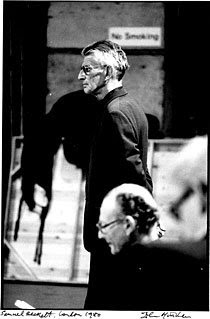
Samuel Beckett directs rehearsals for 'Endgame' in London, 1980. Photograph by John Haynes.
'I shall have to speak of things, of which I cannot speak, but also, which is even more interesting, but also that I, which is if possible even more interesting, that I shall have to, I forget, no matter.'

Samuel Beckett, 'The Unnamable'
I've spent this morning in the throes of a merciless eye infection, attempting to read Simon Critchley's Very Little... Almost Nothing: Death, Philosophy, Literature. A grand title for a book if ever there was one: a minimalist murmur on death, the greatest, most epic question of all. Critchley's book was written in part as a response to the death of his father, and constitutes an act of mourning in the form of a philosophical discussion. It might be said that this act of mourning is all the more poignant for its absence in the text itself; the death of Critchley's father informs the book completely, but is never mentioned.

I am just starting the book now, so I don't have any grand commentary on its thesis just yet. I'm reading it for the enjoyment of reading, and as a kind distraction from the pain in my skull. But, as I always have at least one eye open to anything relating to Beckett, I couldn't help sharing some of Critchley's ruminations on Beckett and Nothingness, or philosophical nihilism.

Through a brief outline of Western epistemology, Critchley recognizes an historical tendency towards nihilism, stemming from the breakdown of systemic Judeao-Christian values and ideals, where human beings are cast adrift in a universe of unstable meanings. Critchley goes on to describe some of the key theoretical approaches to nihilism, including Nietzsche's initial diagnosis, where the higher values 'devalue themselves' and the human subject becomes entrenched in a paradoxical movement forward towards truth and backward towards the comfort of a higher Messianic meaning; suddenly 'one cannot endure this world though one does not want to deny it' (Nietzsche).

And yet, the solutions to nihilism that Nietzsche suggests, according to Heidegger at least, offer little more than an overturning, or a reinscription, of the same nihilistic values. Heidegger suggests that instead we need a new theoretical vocabulary with which to confront the problems and complexities of Being. Heidegger reiterates that to simply cross out or overwrite the language of metaphysical nihilism will only lead to a reversal of the same values, the same dialectic, but not to an overcoming.

Theodor Adorno suggests that, in light of the Holocaust, the project of the Enlightenment has become dubious, and even dangerous to notions of humankind and subjectivity. And Adorno also recognizes that a straightforward overturning, or reversal, of the terms of the Enlightenment will lead to further oppression and subjugation. Adorno suggests instead that we should survey historical and theoretical events from the perspective of redemption, a state that might be easy to imagine but is in all likelihood impossible to ever realize. Which brings us to Critchley:

'[...] the most common and banal accusation levelled at Beckett's work is that it is apolitical and nihilistic because it lacks any of the critical social content evident, say, in the theatre of Brecht or Sartre. Yet, Adorno shockingly suggests that Beckett's work is the only appropriate response to the Holocaust, more so than direct witness accounts, precisely because it is not part of the manifest content of Beckett's work. What is being alluded to here [...] is Adorno's belief that the best modernist artworks, like Beckett's, is their aesthetic autonomy and their refusal of meaning (hence the superficial accusation of nihilism) function as determinate negations of contemporary society and can give formal semblance of a society free from domination.'

Simon Critchley, 'Very Little... Almost Nothing'
And so we have a bizarre formulation arising, where the only appropriate way of addressing a subject is to not mention it at all. Or, rather, if the form of a discussion refuses to engage with the terms of domination that reinscribe those same values, there is a greater opportunity for Adorno's idealized notion of redemption. But while redemption as such might seem outlandishly fanciful, the forms that Adorno praises can still offer a neutral space from which to interpret, discuss and dissect the problematic complications of nihilism, and of traumatic historical events.

Philippe Petit's Man on Wire, a documentary following the exploits of a tightroper balancing on a wire between the Twin Towers in New York, has been praised by many as the greatest 9/11 film yet made. Petit walked the wire between the towers of the World Trade Centre in the 1970s, and the tragedy of 2001 is never mentioned in the film; and yet, it is impossible to watch Man on Wire without some thought or reference to September 11th. Man on Wire, then, offers an optimistic portrait of a man willfully facing peril and adversity, while opening a new perspective and a new way of talking about a national tragedy.

It is this kind of resonance that Adorno suggests is imbued in the works of Samuel Beckett, an 'appropriate reaction' that does not reinstate values and meanings that will limit our interpretations or our power to understand. Instead, Beckett's work creates a space of ambiguity and meaninglessness from which we can refer and project meanings and discussions of our own. We have a freedom to situate ourselves differently, safe in the knowledge that our knowledge is incomplete, and will never hold us still.
'Beckett's sentences are a series of weak intensities, sequences of antithetical inabilities: unable to go on, unable not to go on. And yet, as Adorno astutely points out, what seems like Stoicism on Beckett's part ('I can't go on, I'll go on') is 'a legacy of action' that 'silently screams that things should be otherwise. Such nihilism implies the opposite of an identification with the Nothing. Thus, Beckett's 'nihilism' is not an affirmation of the Nothing, for there is no affirmation in his work. Rather, this 'nihilism' is redemptive in the specific sense discussed above - namely, the only philosophy that can be responsively practiced after Auschwitz is the attempt to view things from the standpoint of redemption, which is impossible, and yet this impossibility must be comprehended for the sake of the possible.'

Simon Critchley, 'Very Little... Almost Nothing'
Heady stuff! But fascinating nonetheless. This is but the most cursory explanation of some of the major themes running through Critchley's work, and doesn't do justice to the breadth and complexity of his argument. Nonetheless, I thought I'd share this small shard, and I'm sure that there will be more in the weeks to come.