29.4.09

Bob Dylan & His Band

Bob Dylan performs life at Cardiff's International Arena
  1. Rainy Day Women # 12 & 35
  2. Mr. Tambourine Man
  3. Lonesome Day Blues
  4. Under The Red Sky
  5. Rollin' And Tumblin'
  6. John Brown
  7. Stuck Inside Of Mobile With The Memphis Blues Again
  8. Tangled Up In Blue
  9. Tweedle Dee & Tweedle Dum
  10. Masters Of War
  11. Highway 61 Revisited
  12. Nettie Moore
  13. Thunder On The Mountain
  14. Like A Rolling Stone
  15. All Along The Watchtower
  16. Spirit On The Water
  17. Blowin' In The Wind
Setlist of Bob Dylan & His Band, Cardiff International Arena
28 April 2009
Last night I saw Bob Dylan and his band for the first time. Dylan was performing at Cardiff International Arena, and played a set that blended recent material with signature songs. I was surprised to see how sprightly and youthful he seemed, punctuating chorus and verse with a piano chord and a wry grin. The band were conservatively clad in light grey suits, and all wore hats that distinguished one from the other. Needless to say, Dylan's was the most extravagently-brimmed.

I've been a fan of Bob Dylan's music for two or three years, and remember an entire summer when I listened to nothing else. And I mean nothing. Whether I was walking through the city, running through the park, or sat writing at my desk, I would be listening to Blood on the Tracks or Desire or Blonde on Blonde, or just about anything I could lay my hands on. Time was principally divided between listening, and trawling collections in record shops. On hot, sultry nights I listened to Time Out of Mind with the window open.

I can say with some certaintly that I like almost everything Dylan has done. Ahem: with the exception of some of his '80s material. For a time his iconic image even extended towards something close to hero-worship and adoration. After watching documentaries and historic footage of the man, he became an image to aspire to and emulate. There's an element of this that persists even now. I'm a great admirer of the music, and of the man. And I think his ability to manufacture and maintain such a rich and compelling stage persona is unrivalled in the business. Robert Zimmerman, despite appearances, has always remained masked and anonymous.

The music last night spanned much of his career, and infused love, loss, and existence in a grand American tradition of blues chords and rhythms. The quality of his voice is at times harsh or sweet, but it was the humour in a turn of phrase or an emphasis that caught me off guard. Dylan has never been a singer, but he's one of the greatest singers we have. Familar lyrics found new meanings, or new allusions, and the performances cast each song in a different mood to one I was expecting. Masters of War had a particularly cold and biting impact, an apocalyptic version with the band cast in a burning orange light. Lonesome Day Blues played hard and fast, and was undoubtedly one of the highlights. But it was Tangled Up in Blue, a song originating on Dylan's deeply personal, mournful and bitter Blood on the Tracks that stole the show.

As for me? I think it's time I was reacquainted with some of his records. I'm already there in my mind, and that's good enough for now.
'Well, my heart's in the highlands at the break of day
Over the hills and far away
There's a way to get there and I'll figure it out somehow
Well, I'm already there in my mind, and that's good enough for now.'

Bob Dylan, 'Highlands'
27.4.09

A Godot Worth Waiting For

On a new production of Samuel Beckett's Waiting for Godot
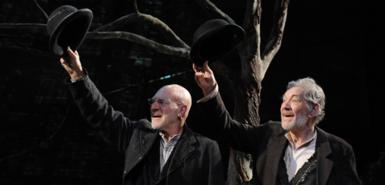
Patrick Stewart and Ian McKellen in Samuel Beckett's 'Waiting for Godot' 2009
'McKellen and Stewart play Gogo and Didi, essentially as old, damaged thespians. “They don't live together,” he points out. “They meet once a day, in the evening, and when night comes, they separate. Godot seems to be an employer of some sort. He has the prospect of work. Well, any actor or washed-up comic knows about an agent, or somebody who they met in a pub, or something.”'

Ian McKellen has spoken to The Times regarding his role in the UK revival of Samuel Beckett's Waiting for Godot. I'm beginning to feel the excitement now, as Jennifer has acquired tickets to an upcoming production at London's Haymarket Theatre. It will be the first time I've seen a Beckett play performed on the stage, which seems almost absurd considering how much I admire the man and his work. Needless to say, I can barely keep still.

McKellen reflects upon his stage and screen career, before offering some observations on his performance alongside Patrick Stewart. You can read the article in full by clicking here.
26.4.09

Screaming Popes: J. G. Ballard on Francis Bacon

Contemporary writer Ballard on the dark visions of the late Irish painter
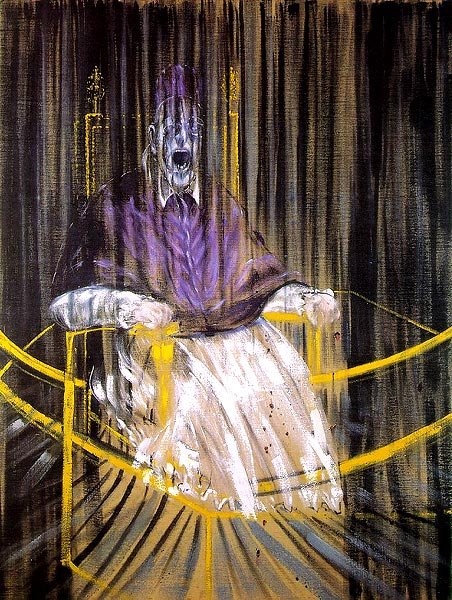
Francis Bacon, 'Study after Velazquez's Portrait of Pope Innocent X' (1953)
Excerpted from J. G. Ballard, Miracles of Life: Shanghai to Shepperton:
'In 1955 there was a modest retrospective of Francis Bacon's paintings at the Institute of Contemporary Arts, followed in 1962 by a far larger retrospective at the Tate Gallery, which was a revelation to me. I still think of Bacon as the greatest painter of the post-war world.' [...]

'Bacon's paintings were screams from the abattoir, cries from the execution pits of World War II. His deranged executives and his princes of death in their pontiffs' robes lacked all pity and remorse. His popes screamed because they knew there was no God. Bacon went even further than the surrealists, assuming our complicity in the mid-century's horrors. It was we who sat in those claustrophobic rooms, like TV hospitality suites in need of a coat of paint, under a naked light bulb that might signal the arrival of the dead, the only witnesses at our last interview.

'Yet Bacon kept hope alive at a dark time, and looking at his paintings gave me a surge of confidence. I knew there was a link of some kind with the surrealists, with the dead doctors lying in their wooden chests in the dissecting room, with the film noir and with the peacock and the loaf of bread in Crivelli's 'Annunciation'. There were links to Hemingway and Camus and Nathanael West. A jigsaw inside my head was trying to assemble itself, but the picture when it finally emerged would appear in an unexpected place.'
25.4.09

'A House of Life': Anthony Burgess on James Joyce

An excerpt from ReJoyce
James Joyce
Excerpted from Anthony Burgess, ReJoyce:
'I start thus book on January 13th, 1964 - the twenty-third anniversary of the death of James Joyce. I can think of no other writer who would bewitch me into making the beginning of a spell of hard work into a kind of joyful ritual, but the solemnisation of dates came naturally to Joyce and it infects his admirers. Indeed, this deadest time of the year (the Christmas decorations burnt a week ago, the children back at school, the snow come too late to be festive) is brightened by being a sort of Joyce season. It is a season beginning in Advent and ending at Candlemas. January 6th is the Feast of the Epiphany, and the discovery of epiphanies - 'showings forth' - of beauty and truth in the squalid and commonplace was Joyce's vocation. February 1st is St Bridget's Day. February 2nd is Joyce's birthday, and two massive birthday presents were the first printed copies of Ulysses and Finnegans Wake; it is also Candlemas Day and Groundhog Day. One is being very Joycean if one tempers the solemnity by remembering the groundhogs. Overlooked by Christmas shoppers, Saint Lucy, Santa Lucia, celebrated her feast on December 13th. To Joyce, who struggled most of his life against eye-disease, she had a special meaning, being the patron saint of sight, and his daughter Lucia was named for her. The theme of the whole season is light-out-of-darkness, and it is proper to rejoice (Joyce was well aware of the etymology of his name) in the victory of the light. We are to rejoice even in the death of the first Christian martyr on Boxing Day, and we remember why Joyce appears under the name of Stephen in his autobiographical novels. He too was a martyr, though to literature; a witness for the light, self-condemned to exile, poverty, suffering, vilification and (perhaps worst of all) coterie canonisation in life, that the doctrine of the Word might be spread. He was a humorous martyr, though, full of drink and irony. Out of the stones that life threw at him he made a labyrinth, so that Stephen earned the surname Dedalus. The labyrinth is no home for a monster, however; it is a house of life, its corridors ringing with song and laughter.'

Chris Petit on J. G. Ballard

Filmmaker and novelist on one of his key influences, writer J. G. Ballard
J.G. Ballard and Gabrielle Drake in ‘Crash!’ (1971; dir. Harley Cokliss).
'For Ballard, the key image of the last century was that of a man driving alone down a superhighway.'

The tributes just keep coming. Writer and critic Chris Petit has reflected on the passing of J. G. Ballard, who died earlier this week after a long illness. Petit is best known to me for his late-70s existential road movie Radio On, a downbeat black-and-white masterpiece about 'a man driving alone down a superhighway.' Petit's film is an excellent example of the Ballardian mood that pervades certain elements of British culture.

Incidentally, this isn't the first time the influence of Ballard has been felt in Petit's work. Iain Sinclair's Crash (BFI) draws a number of aesthetic parallels between Ballard and Petit. Chris Petit's debut novel, Robinson, even begins with a quotation from Ballard, taken from his autobiographical sequel to Empire of the Sun: The Kindness of Women. The quote reads: 'Deep assignments run through all our lives; there are no coincidences.'

You can read Petit's article, published in Granta, by clicking here.

David Cronenberg on J. G. Ballard

Director of Crash reflects on the recent passing of novelist J. G. Ballard
David Cronenberg
'Ballard was raised in Shanghai being driven around in Cadillacs and Packards. And when he came to England as an older kid, it was an alien place to him. He didn't know it at all. And I think that's in the book. When I read the book, I thought ... it certainly felt like North America. Because I guess he saw North America as a bit of future, not necessarily in a good way. A future in terms of what he called "the normalizing of the psychopathic."'

David Cronenberg, interviewed in The Toronto Star
Film director David Cronenberg speaks to his local newspaper The Toronto Star about J. G. Ballard and his adaptation of Crash. You can read the interview here.
24.4.09

Claire Walsh on her relationship with J. G. Ballard

J. G. Ballard
'For 40 years, author J G Ballard and his partner Claire Walsh enjoyed an unconventional relationship, living in separate homes several miles apart.

'But in the last months of his life as he lay dying of cancer, the novelist finally moved in with Ms Walsh, swapping his suburban home in Shepperton for her flat above a boarded-up shop in Goldhawk Road in west London.

'Today Ms Walsh told the Evening Standard of her devotion to Ballard, author of the bestseller Empire of the Sun, and how she cared for him in the weeks and months before his death yesterday at the age of 78.'


Claire Walsh, the long-term partner of J. G. Ballard, has shared her thoughts and her memories of the great British writer, who passed away earlier this week. The article was published in The Evening Standard, and you can read it in full by clicking here.

Tim Adams has also spoken to Claire Walsh for The Guardian newspaper in a full-length feature that has been published online. You can read it here.
23.4.09

Happy birthday, George Steiner

'The polymath Professor George Steiner said it is rather embarrassing that birthday celebrations are taking place in Florence, Rome and Germany. There is also an event at Churchill College, Cambridge, where he has been a Fellow since 1961. He is researching a book about how great philosophy gets itself written, called The Poetry of Thought. He enjoys walks with his Old English sheepdog, known as Monsieur Ben. Professor George Steiner is 80 today.'

The wonderful George Steiner is eighty today. To celebrate, I thought I'd post a link to a conversation between Steiner and Christopher Tayler of The Guardian - there is, I think, some hint of his character and outlook throughout. I've been interested in Steiner's work for a long time, not least for his insightful commentaries on controversial German philosopher Martin Heidegger. To read the article in full, click here.


Thank you to Mark Thwaite of ReadySteadyBook for drawing my attention.
21.4.09

Will Self pays tribute to J. G. Ballard

J. G. Ballard

From Will Self's tribute to the author J. G. Ballard, who passed away this week:
'I had absorbed Ballard's fictional work in my teens, undifferentiated from the science fiction it was shelved alongside in the local library. I reread Ballard in my twenties, when his underground reputation was steadily increasing — and found in the books a vital spur to my own fictional work. Like many before me, I went to interview Ballard (for this newspaper), and was struck by the strange dichotomy between the extremity of the writing and his orderly life in a somnolent suburb. Ballard had been in London for many years — but he was never exactly of it.


'Yet from his outpost in the leafy London dormitory town of Shepperton (where he lived from the early 1960s), Ballard was engaged in nothing less than a complete re-evaluation of the contemporary world — and the strangest thing about this re-evaluation was that it produced more foresight than a legion of professional futurologists or massed divisions of social-policy think-tanks.


'It was Ballard who, in his seminal experimental novel The Atrocity Exhibition (1970), closely analysed the emerging media landscape of celebrity obsession, and foresaw how politics and popular culture would become interfused. Of course, with such chapter headings as “Why I Want to Fuck Ronald Reagan”, The Atrocity Exhibition is no more likely to be a mass market bestseller in 2009 than it was 40 years ago.


'The same might have been said of the novel's companion piece, Crash (1973), a chilling exploration of the sexual potential of car accidents, seen through the eyes of a fictionalised “Jim Ballard”. However, while the book itself enjoyed a healthy underground celebrity, when David Cronenberg adapted it for film in 1996, the controversy became extremely public indeed, with Westminster council banning the film from exhibition in central London.


'While many more readers were attracted to Ballard's novel for prurient reasons, a significant proportion were struck by how the protagonist Vaughan's perverse desire to achieve orgasm at the same time as Elizabeth Taylor dies in a car crash on the Chiswick flyover so closely prefigured the mass orgy of grief that followed the car crash death of Diana Spencer.


'To the end of his life Jim Ballard was troubled by journalists asking him if he had “predicted” the Princess of Wales's death in Crash, and he was, naturally, dismissive. But the truth is that he did — well in advance — pick out the nightmare intersections of death and sexuality that were coming to dominate human consciousness. His early experiences led him to believe that in a world that had experienced the Holocaust and Hiroshima, a wholesale deadening of the emotions could only ensue — he termed this the “Death of Affect”, and believed that to go on writing well-mannered depictions of middle-class social and personal life under such circumstances was not only a mistake but an absurdity.'

Within Reach

Thomas Bernhard
Excerpted from Thomas Bernhard, Correction:

'The books that mattered the most to him don't take long to list, I knew them from his constantly reiterated remarks in which he established a connection with these books, they were always basically the same: Montaigne, Novalis, Hegel, Schopenhauer, Ernst Bloch, and, because he thought that he recognized himself in them, the writings of Wittgenstein, a native of the same region as Roithaimer and always a keen observer of Roithaimer's regional landscape, they were always just the same few books of philosophy and poetry which, with his name inscribed on the flyleaf, he always carried about with him no matter where he had been staying or working, so few that he had always been able to slip them into his traveling bag and take them along, they always had to be within reach.'
20.4.09

J. G. Ballard: How I Write

J. G. Ballard

Excerpted from J. G. Ballard, 'How I Write', in The Times 19 September 2000:
'I tend to write about one novel every three years. When I finish one I have a fallow period where I just jot down ideas, write short stories, and think that could take a year.

'I've never suffered from writer's block. I have plenty of ideas, sometimes too many. I've always had a strong imagination. If it dries up I'll stop and look for another career. But I wouldn't recommend writing. You can be a successful writer and never meet another soul. I'm not sure that's a good thing.'

J. G. Ballard: Portraits of the Artist

1987: JG Ballard working at his writing desk in his Shepperton home. Photograph: Martyn Goddard/Rex Features
'JG Ballard, who explored the contradictions of the modern world in a series of novels over a career which spanned over 50 years, has died aged 78. Here we look back at the life and work of a novelist whose writing was both mainstream and avant-garde.'

The Guardian offers a photographic retrospective of British author J. G. Ballard, who died yesterday morning aged 87 after a long illness. You can see the photographs by clicking here.
19.4.09

J. G. Ballard 1930-2009

J. G. Ballard
'[J. G. Ballard's agent], Margaret Hanbury, said tonight that it was "with great sadness" that the 78-year-old author had passed away yesterday morning after several years of ill health.

'Hanbury, who worked with Ballard for more than 25 years, said he was a "brilliant, powerful" novelist. "JG Ballard has been a giant on the world literary scene for more than 50 years. Following his early novels of the 60s and 70s, his work then reached a wider audience with the publication of Empire of the Sun in 1984 which won several prizes and was made in to a film by Steven Spielberg.

'"His acute and visionary observation of contemporary life was distilled into a number of brilliant, powerful novels which have been published all over the world and saw Ballard gain cult status."
It is with a great deal of sadness that I mention the loss of one of Britain's most valued authors. J. G. Ballard has passed away at his home after fighting a long battle with cancer. His work has been characterized as a bleak and apocalyptic vision of the twentieth-century landscape; there are certain obsessions which permeate a series of novels and literally hundreds of short stories, where psychological character study intersects with an exploration of celebrity culture and major historical events.

Ballard is perhaps best known for the novel Empire of the Sun, which was made into a blockbuster film by Steven Spielberg, and starred a young Christian Bale in the lead role. The book presented an autobiographical account of Ballard's childhood in Shanghai during the outbreak of the Second World War, and his subsequent internment at a Japanese prisoner-of-war camp. As the narrative unfolds, a reasonably sheltered middle-class boy begins to question the fragility of cultural norms and values held as stable and unchanging by modern civilization. When Ballard later became a writer, his childhood left a lasting impact on the character and tone his work would take.

J. G. Ballard's other major success was the subversive novel Crash, later made into a controversial film by David Cronenberg, which became infamous for its meticulous and often satirical explorations of modern technology, psychogeography and human sexuality. As an undergraduate, I wrote a thesis exploring humanism and posthumanism in the films of David Cronenberg, and was constantly refreshed and inspired by Ballard's incisive and often witty observations.

One of the most interesting things about Ballard's work, for me at least, was his ability to look at the world anew. Truly. Many of his works satirize and undermine contemporary value systems, and question the way we choose to live our everyday lives, but there remains a liberal conservatism at the heart of his writing. Much like Swift, Ballard's fiction cuts and bites, but if it shocks its audience it does so with a human purpose. His polemical narratives and bleak scenarios form a consistently cautionary message.

No author has articulated so well the trajectory of modern culture, be it mass consumerism or the cult of celebrity, and I would gamble that no author has better summarized the secret neuroses and obsessions of Western society than J. G. Ballard. No one has been more in touch with where we are at the present, or where we are going. He is sorely missed.
18.4.09

Inmate in the cosmic madhouse: Ballard on Burroughs

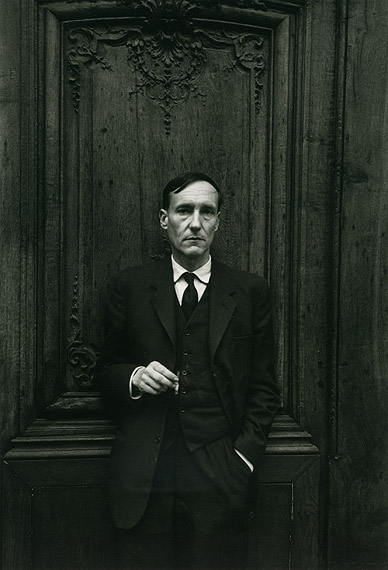
William Burroughs at the Institut française (Naked Lunch Launch series, Paris, October 1959)  by Brion Gysin
From J. G. Ballard's A User's Guide to the Millenium: Essays and Reviews:
'In Finnegans Wake, a gigantic glutinous pun, James Joyce brought the novel up to date, circa 1940, with his vast cyclical dream-rebus of a Dublin physician who is simultaneously Adam, Napoleon and the heroes of a thousand mythologies. William Burroughs takes up from here, and his fiction constitutes the first portrait of the inner landscape of the post-war world, using its own language and manipulative techniques, its own fantasies and nightmares [...]

'Whatever his reservations about some aspects of the mid-twentieth century, Burroughs accepts that it can be fully described only in terms of its own language, idioms and verbal lore. Dozens of different argots are now in common currency; most people speak at least three or four separate languages, and a verbal relativity exists as important as any of time and space. To use stylistic conventions of the traditional oral novel - the sequential narrative, characters 'in the round', consecutive events, balloons of dialogue attached to 'he said' and 'she said' - is to perpetuate a set of conventions ideally suited to a period of great tales of adventure in the Conradian mode, or to an over-formalized Jamesian society, but now valuable for little more than the bedtime story and the fable [...]

'In turn, Burroughs's three novels are a comprehensive vision of the individual imagination's relationship to society at large (Naked Lunch), to sex (The Soft Machine), and to time and space (The Ticket that Exploded). [...]

'Burroughs also illustrates that the whole of science fiction's imaginary universe has long been absorbed into the general consciousness and that most of its ideas are now valid only in a kind of marginal spoofing. Indeed, I seriously doubt whether science fiction is any longer the most important source of new ideas in the very medium it originally created.

'However, Burroughs contribution to science fiction is only a minor aspect of his achievement. In his trilogy, William Burroughs has fashioned from our dreams and nightmares the authentic mythology of the age of Cape Canaveral, Hiroshima and Belsen. His novels are the terminal documents of the mid-twentieth century, scrabrous and scarifying, a progress report from an inmate in the cosmic madhouse.'

J. G. Ballard, 'Mythmaker of the Twentieth Century'
New Worlds
1964
17.4.09

Samuel Beckett's Letters in the New Yorker

Samuel Beckett in the New Yorker. ILLUSTRATION: BARRY BLITT
'These letters are a quest for necessity—for what must be written about, at whatever cost.'


We have this hour a constant will to publish. Anthony Lane has written a review of Samuel Beckett's Letters for The New Yorker. You can the article by clicking here. I've also come across an article in The Washington Post by Michael Dirda, which you can find here.

J. M. Coetzee on Beckett's Letters

J. M. Coetzee

'The editorial work behind this project has been immense in scale. Every book that Beckett mentions, every painting, every piece of music is tracked down and accounted for. His movements are traced from week to week. Everyone he alludes to is identified; his principal contacts earn potted biographies. When he writes in a foreign language, we are given both the original and an English translation (save for some French verse that is left untranslated—a puzzling editorial decision). By page count, some two thirds of the volume is given over to scholarly apparatus, principally elucidatory commentary. The standard of the commentary is of the highest.'
J. M. Coetzee has written about the first volume of Samuel Beckett's Letters in the New York Review of Books. A superb piece of writing. You can read the article in full by clicking here. The web journal Ads Without Products has posted its own commentary of the article here.

Naked Lunch: The Fiftieth Anniversary

Retrospective essays and literary events
Author William S. Burroughs sitting at a crude table with typewriter, holding a cigarette and looking away. Photograph by Loomis Dean. Life Magazine
This year marks the 50th anniversary of the original publication of Naked Lunch, by William S Burroughs. Given the book's ongoing influence it goes without saying that this is a significant milestone. However, when the book first appeared in Paris in 1959 (mistitled as The Naked Lunch) on the small Olympia Press, it had little impact. Because of this, perhaps a more important anniversary is that of the novel's first US publication in 1962. For that's when Burroughs's controversial drug-and-sex-fuelled classic truly burst into the limelight, both because it was recognised by large numbers of critics and readers as a breakthrough piece of literature and also because of a series of obscenity trials it inspired.
William S. Burroughs' Naked Lunch celebrates the fiftieth anniversary of its publication this year. NakedLunch.org is celebrating the occasion with a series of retrospective essays and literary events. The website has been organized at least in part by the people over at Reality Studio, a longtime William Burroughs appreciation site, and for this reason alone it's worthy of any self-professed Burroughsian's attention. Enjoy the feast!

Waiting for Godot: Stewart argues with a fan at UK revival

Not amused... Patrick Stewart and Ian McKellen in rehearsal for Waiting for Godot, screengrab from BBC2's Culture Show Photograph: BBC
'Actor Patrick Stewart apparently lost his rag with an autograph hunter outside the stage door of the King's theatre in Edinburgh, after a performance of Waiting for Godot. "Are you the arsehole who was sitting in the front tonight?" was his introductory comment, before bellowing "You know, what I really want to know is how you can sleep at night? I really hope you're pleased with yourself."'


As the UK revival of Samuel Beckett's Waiting for Godot continues, Patrick Stewart is reported to have had an angry altercation with a member of the audience. This week the news just keeps rolling in. You can read the Daily Record report by clicking here, or The Guardian's commentary here. Nothing to be done.
16.4.09

Super Tramps: Star productions of Waiting for Godot

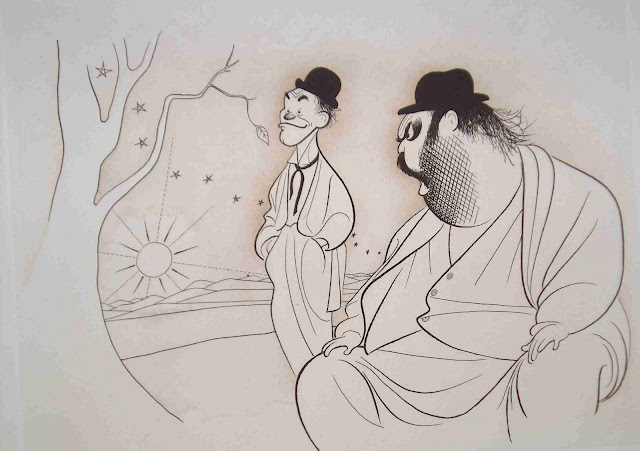
Zero Mostel and Burgess Meredith in Samuel Beckett's 'Waiting for Godot'. By George J. Goodstadt
'The playwright was Samuel Beckett. The play was Waiting for Godot. Fifteen years later, Gielgud urged Richardson to do Home, says Storey, “because of this terrible mistake he’d foisted on Ralph”. Thus began, in its English incarnation, the long and colourful casting history of the play widely regarded as the 20th century’s greatest. (En Attendant Godot had already taken its first bow at the Théâtre de Babylone in Paris in 1953. Lucien Raimbourg and Pierre Latour were Vladimir and Estragon.) In the intervening decades, an enduring question has tormented actors and audiences alike: who exactly is Godot? But before that, a director has to ask an altogether more pressing question: who are Vladimir and Estragon?'
The Sunday Times has hit the ground running with a series of Samuel Beckett articles and retrospectives this week. No doubt this is the result of Patrick Stewart and Ian McKellan's current UK revival of Waiting for Godot on the stage. In addition to a series of interviews with comedians influenced by his work (see previous post, 'Sam's A Laugh'), there is a short piece reviewing notable stars that have been attracted to Waiting for Godot over the years. 

Actors discussed include Alan Howard and Ben Kingsley, who co-starred in a production of Beckett's play at the Old Vic in 1997; and there is reflection on the Mike Nichols production of 1988, where comedic film stars Steve Martin and Robin Williams played the central parts:
'On occasion, too much advantage has been taken of the play's vaudevillian roots. In Mike Nichol's Lincoln Center production in 1988, Robin Williams played Estragon to Steve Martin's Vladimir. Williams predictably lacked the discipline to adhere to the sacred text, ad-libbing contemporary gags and breaking the fourth wall to sit among the audience.'
The stars of this particular article, however, are Ian McKellen and Patrick Stewart. There is ample space devoted to the duo, as they travel the UK with their current revival. You can read the article in full by clicking here.

Sam's a Laugh: Comedians on Beckett's Funny Side

Samuel Beckett. Photograph by Frank Herrmann
'I’ve loved Beckett for years — whether it’s Krapp’s Last Tape and the way he plays with repeated phrases, toying with the word “spool”, or Endgame, with the minutely detailed stage directions simply for positioning a stepladder. What annoys me most about Beckett is the audience. I went to see his sketches at the Young Vic directed by Peter Brook and there were skits with men dressed as women that the audience were howling with laughter at, and I thought, that’s just like Les Dawson, but if it actually was Les Dawson you wouldn’t find it funny. That audience wouldn’t go to the circus either, but Godot is like a weird, dribbly circus — at least, that’s what I thought the first time I saw it as a kid. If it wasn’t for the clowning it would be so unbearably, unremittingly bleak, which makes me wonder if Beckett began with the laughter or gave in to it. Beckett was essentially clowning, but it was such perfect, precise clowning.'

Mark Thomas
This week, two friends have kindly pointed me in the direction of an article in The Sunday Times, where popular comedians are climbing over each other to voice admiration for Samuel Beckett. The article, comprising interview snippets gathered by Stephen Armstrong, includes a number of personal encounters with Beckett's theatre, and reveals the influence the playwright has had on their own work.

Among the contributors are Ricky Gervais, Omid Djalili, Phill Jupitus, Mark Thomas, and the wonderful Stewart Lee pops up to offer his thoughts. Many of the quotations focus on Beckett's vaudeville stage antics, and there are a few references to the Laurel and Hardy dynamic of Vladimir and Estragon. Comedian Robin Ince puts it nicely:

'My envy of his writing is about two things: his absolute lack of wastage - even though his lines are about waste and futility - and his confidence with the pause. You can tell trly great stand-ups if they can get to a moment where they just pause for a moment of silence and they still have you can you can see what's going on in their head. I suppose that's why comedians are so obsessed with him [...] Beckett has somehow taken that and raised it to the kind of philosophical level that requires critical acclaim. The only thing that's come close is The Music Box with Laurel and Hardy, wjere they have a 10-minute sequence trying to get a piano upstairs, only to meet the delivery man, who says, "Why didn't you bring it by the road?" They pause, and you think, no, they won;t,m but they take it back down the stairs and p the road. In that scene, Stan Laurel is saying as much about the futility of any human task as Beckett at his most profound.'
You can read Stephen Armstrong's article in full at the Times Online website, by clicking here.
14.4.09

Samuel Beckett for President

'Samuel Beckett for President: Yes We Can't' by Matthew Guerrieri
Composer Matthew Guerrieri presented the above among a list of contenders for the 2008 US Presidential Election. You can find his original blog posting, dated September '08, by clicking here.
13.4.09

Happy Birthday, Samuel Beckett

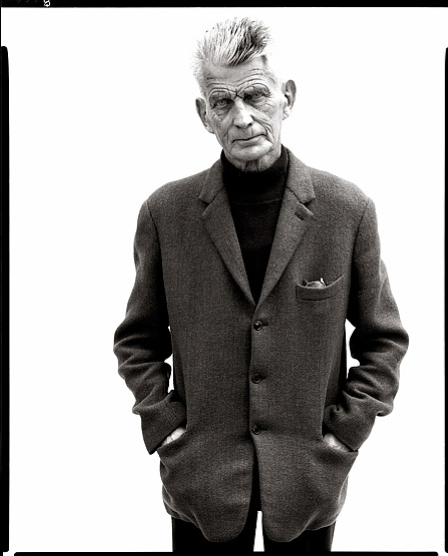
 Samuel Beckett, writer, Paris, April 13, 1979. Portrait by Richard Avedon
'On a fine sunny morning in the mid-1960s Samuel Beckett was walking to the Lord's Cricket Ground across Regent's Park. He had travelled to London from Paris specially for the test match between England and Australia, staying with the publisher John Calder at his house behind Wigmore Street. John Gibson, an Irish director in the BBC radio department, remembered how enthusiastic the playwright was about the green trees, the birds singing, the company of good friends, the beautiful blue sky. At this someone remarked, "Yes, on a day like this it's good to be alive." To which Beckett replied: "Well, I wouldn't go as far as that!"'

Enoch Brater,
'The Essential Samuel Beckett: An Illustrated Biography'
The photograph above is a portrait of Samuel Beckett taken by Richard Avedon on April 13th 1979: exactly thirty years ago today. It is notable in that it offers us an image of the writer ten years before his death, but it's also notable for another reason: April 13th is Samuel Beckett's birthday.

Today is the 103rd anniversary of Beckett's birth, and to mark the occasion I've included two links to quizzes The Guardian have devised on the man and his career. So, raise a glass of Jameson, or Bushmills if you prefer, and see how well you fare:
Happy birthday, Sam.
11.4.09

Waiting for Elmo

Today, we are proud to present a modern masterpiece. A play so modern and so brilliant it makes absolutely no sense to anybody...

Alistair Cookie, 'Monsterpiece Theatre'
'Monsterpiece Theatre', a popular skit on American children's television show Sesame Street, offers its own profound take on Samuel Beckett's Waiting for Godot. Sesame Street presents 'the puzzling story of two monsters waiting for their friend': Waiting for Elmo.
9.4.09

Mr. Movies: Mark Kermode talks to Mark Lawson

Mark Kermode
'Horror is at the (skewered, bleeding) heart of his obsession with films - not even the director of The Exorcist has name-checked it so often in public - and one inevitably seeks a Freudian explanation in his childhood. Did someone jump out of a cupboard and frighten him at an impressionable age?'

'[Kermode:] "Ha! From when I was very young, I always liked horror films. I remember very clearly seeing the trailer for The Exorcist when I was 11. I knew that I couldn't go to see the film - but just the idea of it was enough. A car pulling up outside a house, and a voice saying that something beyond comprehension is happening to someone inside. I remember the sense of transcendent terror; a sense of something beyond this world and beyond our comprehension. For some people it's football, for some people it's girls, for others it's pot and, for me, it was horror. And I want to be very clear about this: it made me very happy to be scared. I really liked the feeling and I cherished those nightmares."'

The Guardian has published a wonderful interview with popular film critic Mark Kermode, written by cultural commentator Mark Lawson. I've been an avid fan of Kermode's reviews since I was thirteen, after catching him in a documentary he wrote and presented on the film Blade Runner. His knowledge and his enthusiasm shine through whenever he is discussing the films he loves, but he is often equally passionate about the films that he hates. He co-hosts a Radio 5 programme with Simon Mayo on Friday afternoons, which has become popular for his rantings as much as for the banter. But whatever you might think of Kermode, or his opinions, he is rarely less than entertaining.

Lawson's interview touches on Kermode's radio programme, its possibilities for the future, and the reviewer's recent forays into presenting with BBC arts programme The Culture Show. Kermode shares his passion for the horror genre in particular, and discusses the influence that his wife, film professor Linda Ruth Williams, has on his reviews. Lawson suggests that Kermode's relationship with his wife could be his main weakness as an interpreter of modern cinema; I think that he's just an occasional sucker for sentimentality.

You can read The Guardian's interview in full by clicking here; you can find the official BBC Culture Show website here; or, if you'd like to find out more about Mark Kermode's weekly radio show with Simon Mayo, you can listen live or download a recent podcast here. Enjoy!

Samuel Beckett at CHELSEA Space (2006)

Samuel Beckett rehearsing in London
'At CHELSEA space, photographs of Beckett rehearsing taken by the late Chris HA-rris, Beckett's correspondence with David Gothard, and related ephemera (all from Gothard's personal archives) form a backdrop for a wide ranging series of rehearsals, workshops, and speculative discussions.

'During the exhibition musicians, artists, actors, writers, performers and directors will use CHELSEA space to explore the creative nature of rehearsal, improvisation, discussion, preparation, process, and the wider influence of Samuel Beckett.

'The schema for presenting David Gothard's personal archive of Beckett at the Riverside is by artist Jess Wiesner.'

To celebrate the Centenary of Samuel Beckett's birth back in 2006, cultural events were launched all over the world to mark the date. As I wasn't familiar with Beckett's work at that time, I missed out on a feast of social shin-digs and Beckettian gossip - a fact that I'm still sensitive about to this day. But, as the old man's birthday is approaching (April 13th), I thought I'd mention one of the Centenary exhibits in the spirit of nostalgia.

CHELSEA Space celebrated Beckett's 100th with a photographic exhibition, displaying photographs of the man himself plunged into rehearsals at a theatre in London. The photographs were taken in the early 1980s, in the last ten years of his life, they capture brief glimpses of his directorical posture. The CHELSEA Space website includes the original press release, images from the exhibition, and a review byNeil Stewart that was published in ArtSEEN. You can take a look at some of the highlights, old as they might be, by clicking here.

Withnail & I: Behind-the-scenes

Two go mad in Cumbria: McGann and Grant outside Sleddale Hall. Photograph: Murray Close/Proud Gallery

'Just opened at the Proud Gallery in London is a new exhibition going behind the scenes on Withnail & I, Bruce Robinson's cult classic, whose central location, Sleddale Hall, has just been sold. Your photographer: Murray Close, who cut his teeth shooting Stanley Kubrick's The Shining''

Proud Camden has opened an exhibition of photographs taken from the set of cult British film Withnail and I. The images were taken by Murray Close, who formed close ties with director Bruce Robinson and the principal cast. I've been a great fan of the film since my student days (surprise, surprise), and I've always been interested in all trivia and tidbits related it. The new exhibition not only promotes the more recognizable, iconic images from the film, but also reveals some of the lesser known photographs, and gives a new insight into the mood and atmosphere on-set. For any fan of Withnail and I, these are a must. Click here to view the online exhibition.
7.4.09

Joyce Carol Oates on reading Nietzsche

Joyce Carol Oates
From Antæs: Literature as Pleasure:
'And: I enter an empty classroom in the old Hall of Languages Building, Syracuse University, sometime in the fall of 1956, discover a lost or discarded book on ethics, an anthology of sorts, open it at random, and begin reading... and reading... so that the class that begins in a few minutes, whatever remarks, long-forgotten, by whatever professor of philosophy, also, alas, long-forgotten, is a distraction and an interruption. How profoundly excited I am by this unknown new voice, this absolutely new and unique and enchanting voice! - though I am familiar, I suppose, with some of the writers he read, and from whom he learned (Shakespeare, Dostoyevsky, Emerson), I am not at all familiar with Nietzsche himself - only the name, the word, the sound, mysterious and forbidding. This philosopher who is an anti-philosopher; a poet; a mystic (and anti-mystic); whose genius expresses itself in aphorism and riddle - "philosophy with a hammer." To have read Nietzsche, aged eighteen, when one's senses are most keenly and nervously alert, the very envelope of the skin dangerously porous, to have heard, and been struck to the heart, by that astonishing voice - what ecstasy! what visceral unease! - as if the very floor were shifting beneath one's feet. Late adolescence is the time for love, or, rather, for passion - the conviction that within the next hour something can happen, will happen, to irrevocably alter one's life. ("The danger in happiness: Now everything I touch turns out to be wonderful. Now I love any fate that comes along. Who feels like being my fate?") Whatever books of Nietzsche's I then bought in paperback or took out of the university library - The Birth of Tragedy, Human, All Too Human, The Gay Science, Thus Spake Zarathustra, Beyond Good and Evil, Twilight of the Idols - I must have read, or devoured, quickly and carelessly and with no sense of their historical context under the spell of an enchantment I had every reason to think was unique. And for me Nietzsche was unique - one of those voices out of a densely populted world that define themselves so brilliantly, in a way so poignantly, against that world, they become - almost - assimilated into one's very soul.'
Joyce Carol Oates, 'Literature as Pleasure, Pleasure as Literature'

Faber & Faber unveils new editions of Samuel Beckett's fiction

Samuel Beckett, 'Endgame'. Faber&Faber

Samuel Beckett, 'Murphy'. Faber&Faber

Samuel Beckett, 'Watt'. Faber&Faber
'Fifty years after turning down the opportunity to publish Samuel Beckett's work outside the theatre, Faber and Faber have snapped up the rights to his fiction, non-fiction and poetry. The complicated four-way deal involving John Calder, the writer's estate and French publishers Editions de Minuit unites the English-language publishing rights to his work as a whole for the first time.

'[...] Faber's poetry editor, Paul Keegan, said that the company was "honoured" to have acquired the rights, and pledged to pay "renewed attention" to his words.

'"It's early days yet," he continued, "but there's a sense that there's a lot of material that hasn't been brought to land, that's still in orbit."

'Keegan outlined plans to publish Beckett's prose in new combinations, and a re-examination the author's intentions. "We want to try to avoid bundling everything together into one volume," he said, "to give it a little more space."

'He promised to ensure that his prose works, which he suggested have maintained a low profile, would be "recognised alongside the works for theatre as the true partners of his canon".

'"It's a question of taking a little more care about what should stand with what and what should stand alone," he explained, "and also being a little more careful with the texts which are often corrupt."'

Since Faber & Faber purchased the rights to Samuel Beckett's poetry and fiction in 2007, editions of the writer's work in the UK have been relatively scarce. Beckett's long-term UK publisher, John Calder, has now retired, and significant editions of Beckett's writing have been sourced from overseas; the Grove Centenary edition of his work is a fine example, a four-volume edition published by the Grove Press. The Grove series was edited by Paul Auster, and came complete with short introductions from a number of prominent writers, including J. M. Coetzee and Salman Rushdie.

British publishers Faber & Faber are finally beginning to release their new editions of Samuel Beckett's poetry and fiction, while re-issuing his dramatic work in a similar design. The intention, no doubt, is to align the fiction and the poetry 'alongside the works for theatre as the true partners of his canon'. It's also nice to see that they are publishing each work as a stand-alone edition, to give the texts their own necessary 'space'.

I think that it's all wonderfully ambitious, and I'm looking forward to browsing copies in my local bookshop sometime soon. You can visit Faber & Faber's Samuel Beckett webpage by clicking here.