8.2.13

Twelve Seminars with W. G. Sebald

Luke Williams on Sebald as a teacher and a writer
W. G. Sebald
Luke Williams (New Writing) has written a reflective account of his experiences with W. G. Sebald, first as a writer, and then as a creative writing teacher at the University of East Anglia (link via 3:AM Magazine):
I want to write about the two incarnations in which I knew W. G. Sebald: first through his writing, and then through his being my tutor at UEA. When I first encountered his work, in the winter of 1999, I had recently moved to Paris, a city new to me. I had discovered my French was worse than I thought. Having arrived there with no plan, for no clear reason, I was experiencing a sense of mounting frustration and bewilderment.

What was frustrating was not the fact of my bewilderment – I had become used to the sensation – but that I wished to articulate it, and yet had found no way to do so. I did not want simply to forget or overcome my confusion, but, through writing, to examine its complicated paths. And yet the very confusion about which I wanted to write was preventing me from writing anything much at all. Whenever I tried to set something down, my prose seemed bleak and tedious. Reading Sebald offered me a brilliant example: here was writing which spoke honestly about loss and confusion, about a world on the verge of destruction, in a voice that was itself compelling and precise. What is more, Sebald’s voice seemed to recognise the difficulty, even the impossibility, of expressing that sense of loss and confusion, even as he set out to do so.

At the time I was trying to write my way into a novel. I had come to a standstill. I suspect now this was related to the books I had been reading. In my early twenties I had felt drawn to a cadre of writers who had opposed themselves to what has come to be known as literary realism: Fernando Pessoa, for instance, and Natalie Sarraute, Alain Robbe-Grillet, Georges Perec, Salman Rushdie. I had no desire to write the kind of novel which tried to imitate reality, at least the ‘realism’ of clock time and easy human empathy and knowing narrators, the kind that flourished in the nineteenth century and which, despite the insights of literary modernism, remains the predominant form.

What I especially resisted was the characterisation in realist novels: it was true that the heroes of those tales were sometimes confused or destabilised, but, it seemed to me, only superficially; because their confusion was not really confusion, not the kind of bafflement I was experiencing, which tended to unsettle all things, all feelings, and which pointed towards silence. No, these writers created a kind of teasing befuddlement, I felt. They toyed with confusion, tamed character and made internal disorder seem ultimately quite knowable.

Books such as Robbe-Grillet’s Jealousy or Rushdie’s Midnight’s Children were not so articulate. If they wrote about character at all they wrote of an empty vessel into which conflicting elements might be poured. They spoke of the world and its people not as repositories of meaning but as things impossible for the imagination to grasp. It was a notion to which my sense of bewilderment bore witness. So I wanted my own novel to exist in their company. But – and this is where my problem lay – I also felt tired of the empty play of character or absence of story in these books, which were at times too coolly intellectual, concerned only with abstract structural problems. They rarely gave me pleasure, and less often left me feeling emotionally engaged. What is more, I could not understand how the radical insights these novels offered up – the dissolution of character, the breakdown of language and perspective – could lead to such confident, endlessly playful books.

It was with these thoughts in mind, coupled with my feeling of isolation in a foreign city, that I discovered The Rings of Saturn. I read: ‘Lost in the thoughts that went round in my head incessantly, and numbed by this crazed flowering, I stuck to the sandy path until to my astonishment, not to say horror, I found myself back again at the same tangled thicket from which I had emerged about an hour before.’ I read: ‘he was convinced that everything he had written hitherto consisted solely in a string of the most abysmal errors and lies.’ And this: ‘It is difficult to imagine the depths of despair into which those can be driven who, even after the end of the working day, are engrossed in their designs and who are pursued, into their dreams, by the feeling that they have got hold of the wrong thread.’ This sentence appears in the end-section of The Rings of Saturn. [Read More]
Also at A Piece of Monologue:
29.9.10

WSJ reviews Gabriel Josipovici on Modernism

Eric Ormsby traces the literary revolution at the heart of Josipovici's new study

In the Wall Street Journal this week, Eric Ormsby weighs the strengths and weaknesses of Gabriel Josipovici's recent literary study, What Ever Happened to Modernism? (via Conversational Reading):
With the 20th century and his most cherished authors and artists, Mr. Josipovici comes into his own. Whether discussing a key passage in Thomas Mann's Doktor Faustus or quoting from an interview with the painter Francis Bacon, whether drawing on Rosalind Krauss's studies of Picasso or on Marcel Duchamp's comments on his own work, he is both passionate and lucid. If he is notably perceptive on such authors as Borges and Kafka, he is equally fine on less familiar authors, such as Claude Simon, the Nobel Prize-winning French novelist whom he cites to brilliant effect. Thus, in "The Flanders Road," Simon evokes the German invasion of France in 1940, depicting the "civilians who doggedly went on wandering about in incomprehensible fashion, dragging a battered suitcase after them or pushing one of those children's perambulators filled with vague belongings." In such a scene, the pathos is one with the absurdity, and we feel the force of a difficult truth. [...]

Mr. Josipovici has a gift for sweeping the reader along, but even so, reservations arise. One of the least attractive aspects of literary Modernism has been its penchant for casting what it dislikes into outer darkness. T.S. Eliot and Ezra Pound were especially skilled at such excommunicatory tosses. I've known poets who refuse to read Virgil or Milton because of the belittling judgments of the high modernists; and the judgments are always couched as a polarity: Homer but not Virgil, Marvell but not Milton. Mr. Josipovici betrays something of this doctrinaire tendency; he is scornful of Anthony Powell and V.S. Naipaul, both of whom he dismisses with a quip. But Powell's "Dance to the Music of Time" and Naipaul's "A House for Mr. Biswas" are great 20th-century novels.

Mr. Josipovici faults Philip Roth's fiction for lacking "that sense of density of other worlds suggested but lying beyond words, which we experience when reading Proust or James." Then he imagines his reader objecting that "Roth is an experimental writer!" and "Is that not what Modernism is about?" Here Mr. Josipovici displays a peevish side, remarking: "If that is your reaction you have not really been taking in what I have been saying." Well, maybe. He's baffled by intelligent reviewers, "many of whom have studied the poems of Eliot or the novels of Virginia Woolf," who "betray their calling" by praising what he considers second-rate work—not just Roth but Graham Greene, Toni Morrison, John Updike and Salman Rushdie.

Mr. Josipovici does not countenance the possibility that in the works of the Modernist writers, artists and composers he most admires there lay hidden some dimly willed element that led to their supersession. The caustic self-doubt, and doubt of the world, that drove their genius may have proved corrosive over time, diluting the severe standards they applied to art. He quotes Marcel Duchamp, for example, without acknowledging that his wry and cynical playfulness has led, decades later, to the trivial shenanigans of such poseurs as Damien Hirst and Jeff Koons.
Jorge Luis Borges (left) and Franz Kafka (right)
Perhaps the true question raised by What Ever Happened to Modernism? is about the way in which art grapples with reality. The 19th-century novelists created characters and set them within a narrative; this was an "arbitrary" process: David Copperfield and Père Goriot are as contrived as the marquise who went out at five. Balzac carried a cane inscribed with the motto "I smash all obstacles." Kafka noted that he himself should have a cane inscribed "All obstacles smash me." Kafka knew that, as Mr. Josipovici puts it, "to be modern is to know that some things can no longer be done."

For Mr. Josipovici, Modernism is ultimately an ethical proposition, and a stern one at that. He says that traditional fiction deludes us, encouraging us in the conviction that "we ourselves will never die"; it "actively prevents us from having a realistic attitude to ourselves and the world." This probably isn't Mr. Josipovici's final view—he hedges a bit here—but he does fault the conventional novel for giving the reader "the impression that he or she understands something." [Read more]


Also at A Piece of Monologue:
18.8.10

Paul Auster, Collected Prose

An expanded edition of the writer's personal essays and memoirs
Biblioklept reviews a new expanded edition of Paul Auster's Collected Prose: 'This month, the good folks at Picador are issuing an expanded edition of Paul Auster’s essays, memoirs, prefaces, true stories, anecdotes, and interviews. Inconspicuously titled Collected Prose and running to just under six hundred pages, the volume includes Auster’s début work The Invention of Solitude in its entirety.' Also included is a series of personal essays on a diverse range of influences, including Knut Hamsun and Franz Kafka, Nathaniel Hawthorne, Art Spiegelman, Salman Rushdie and Samuel Beckett (via Susan Tomaselli).

Source: 'Collected Prose — Paul Auster', Biblioklept, 18 June 2010

Also at A Piece of Monologue:
29.7.10

Gabriel Josipovici on the Contemporary British Novel

Writer and academic Gabriel Josipovici rejects the work of leading British novelists as hollow and self-satisfied
Ian McEwan
Novelist Ian McEwan: a prep boy showing off? Photograph: Eamonn McCabe

Dalya Alberge, writing on The Guardian website, reports recent comments from academic Gabriel Josipovici on the state of contemporary British literature. Josipovici rejects writers such as Ian McEwan, Martin Amis and Salman Rushdie for works he claims are without substance: little more than 'prep-school boys showing off'. He also singles out American novelist Philip Roth for criticism, suggesting that despite thought-provoking work there is too much self-assuredness in the prose. Alberge has more (via Susan Tomaselli):
"We are in a very fallow period," Josipovici said, calling the contemporary English novel "profoundly disappointing – a poor relation of its ground-breaking modernist forebears".

He said: "Reading Barnes, like reading so many other English writers of his generation – Martin Amis, McEwan – leaves me feeling that I and the world have been made smaller and meaner. The irony which at first made one smile, the precision of language which was at first so satisfying, the cynicism which at first was used only to puncture pretension, in the end come to seem like a terrible constriction, a fear of opening oneself up to the world.

"I wonder, though, where it came from, this petty-bourgeois uptightness, this terror of not being in control, this schoolboy desire to boast and to shock." Such faults were less generally evident in Irish, American, or continental European writing, he added.

Laurence Sterne's 18th-century novel Tristram Shandy remained more avant-garde than the so-called avant-garde today, Josipovici argued.

"An author like Salman Rushdie takes from Sterne all the tricks without recognising the darkness underneath. You feel Rushdie's just showing off rather than giving a sense of genuine exploration."

[...]

Such novels had a "lack of vision and limited horizons".

"One finishes them and feels, 'So what?' – so very different from the gut-wrenching experience of reading Herman Melville's Bartleby or William Golding's The Inheritors," said Josipovici.

[...]

Josipovici extended his criticism to one of the behemoths of modern US writing, Philip Roth.

"For all Roth's playfulness – a heavy-handed playfulness at the best of times – he never doubts the validity of what he is doing or his ability to find a language adequate to his needs. As a result, his works may be funny, they may be thought-provoking, but only as good journalism can be funny and thought-provoking."

Overall, he said, while the likes of Kafka were plagued by self-doubt, his modern peers seemed arrogant and self-satisfied, "which is mildly depressing".

Read the article: Dalya Alberge, 'Feted British authors are limited, arrogant and self-satisfied, says leading academic', guardian.co.uk, 28 July 2010

Also at A Piece of Monologue:
7.4.09

Faber & Faber unveils new editions of Samuel Beckett's fiction

Samuel Beckett, 'Endgame'. Faber&Faber

Samuel Beckett, 'Murphy'. Faber&Faber

Samuel Beckett, 'Watt'. Faber&Faber
'Fifty years after turning down the opportunity to publish Samuel Beckett's work outside the theatre, Faber and Faber have snapped up the rights to his fiction, non-fiction and poetry. The complicated four-way deal involving John Calder, the writer's estate and French publishers Editions de Minuit unites the English-language publishing rights to his work as a whole for the first time.

'[...] Faber's poetry editor, Paul Keegan, said that the company was "honoured" to have acquired the rights, and pledged to pay "renewed attention" to his words.

'"It's early days yet," he continued, "but there's a sense that there's a lot of material that hasn't been brought to land, that's still in orbit."

'Keegan outlined plans to publish Beckett's prose in new combinations, and a re-examination the author's intentions. "We want to try to avoid bundling everything together into one volume," he said, "to give it a little more space."

'He promised to ensure that his prose works, which he suggested have maintained a low profile, would be "recognised alongside the works for theatre as the true partners of his canon".

'"It's a question of taking a little more care about what should stand with what and what should stand alone," he explained, "and also being a little more careful with the texts which are often corrupt."'

Since Faber & Faber purchased the rights to Samuel Beckett's poetry and fiction in 2007, editions of the writer's work in the UK have been relatively scarce. Beckett's long-term UK publisher, John Calder, has now retired, and significant editions of Beckett's writing have been sourced from overseas; the Grove Centenary edition of his work is a fine example, a four-volume edition published by the Grove Press. The Grove series was edited by Paul Auster, and came complete with short introductions from a number of prominent writers, including J. M. Coetzee and Salman Rushdie.

British publishers Faber & Faber are finally beginning to release their new editions of Samuel Beckett's poetry and fiction, while re-issuing his dramatic work in a similar design. The intention, no doubt, is to align the fiction and the poetry 'alongside the works for theatre as the true partners of his canon'. It's also nice to see that they are publishing each work as a stand-alone edition, to give the texts their own necessary 'space'.

I think that it's all wonderfully ambitious, and I'm looking forward to browsing copies in my local bookshop sometime soon. You can visit Faber & Faber's Samuel Beckett webpage by clicking here.
2.3.09

Salman Rushdie on Adapting Literature into Film

The challenges of adapting a book for the big screen
Brad Pitt plays the title role in David Fincher's 'The Curious Case of Benjamin Button
'What is essential? It's one of the great questions of life, and, as I've suggested, it's a question that crops up in other adaptations than artistic ones. The text is human society and the human self, in isolation or in groups, the essence to be preserved is a human essence, and the result is the pluralist, hybridised, mixed-up world in which we all now live. Adaptation as metaphor, to paraphrase Susan Sontag, adaptation as carrying across, which is the literal meaning of the word "metaphor", from the Greek, and of the related word "translation", another form of carrying across, this time derived from Latin.'

Salman Rushdie is featured in today's Guardian newspaper expounding the pros and cons of films based on literary adaptations. In light of a recent spate of Academy Award successes, films using novels and short stories as their source material have become a sure-fire route to critical recognition and box office success. But perhaps that's all hyperbole and overstatement. Rushdie has a few thoughts on the subject.

In a whistle-stop tour of American and European filmmaking of the last 50 years, Salman Rushdie gives examples of some of the finest adaptations the industry has produced, alongside some of the turkeys.

There are instances where films have created brilliant reputations for themselves while still falling short of the original, such as The Dead (based on James Joyce's short story of the same name). On the other hand, Rushdie states 'ridiculous' examples such as David Lean's A Passage to India, which loses the thread of Lawrence's original novel and descends into blasphemy. But the process of adaptation isn't always negative. Rushdie boldly suggests that Peter Jackson's Lord of the Rings trilogy is superior to the novels by J.R.R. Tolkien, a statement that is sure to strike outrage in the hearts of loyal fans of the book, simply because 'Jackson makes films better than Tolkien writes'.

Rushdie summarizes his views on the act of adaptation, and translation from one artistic medium to another, in terms of a political, cultural and social perspective. In terms of 'what is essential, and what cannot be compromised'; He discusses David Fincher's adaptation of The Curious Case of Benjamin Button and Danny Boyle's Oscar-winning Slumdog Millionaire, among a wide range of others. You can read the article in full by clicking here.
8.6.08

Pleasures of Reading

My enduring fascination with literature

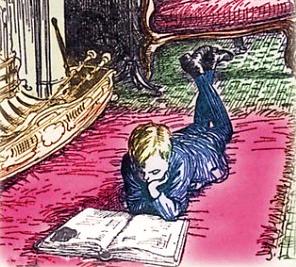
I've been a keen reader ever since I was a teenager. I remember work experience at a small village library where every lunchtime I would run down a hill to a bookshop that sold classic literature at a pound per novel. I was sixteen at the time, and can vividly recall the shelf in my bedroom creaking under the weight of War and Peace, Crime and Punishment and dozens of others. There are certain books from this period of my life that profoundly affected the way I think and feel about myself and the world around me.

Whenever I look back on the books that stood out most, from Albert Camus' The Outsider to Dostoyevsky's Notes from the Underground, I'm filled with a powerful sense of nostalgia. And it's a joyous feeling. These were books in which I could recognize something of myself, and find characters to identify with. It was comforting and exciting at the same time, and I don't think I'm exaggerating when I suggest that the foundations of my character may lie somewhere among these tatty old paperbacks. (Life never does more than imitate the book.)

I often wonder what it would be like to return to some of these novels now that some time has passed; there is a gulf between the person I am now, and the person I was when I read them - even if it is only the space of five or six years. It's an ambition of mine to return to some of my favourite books every ten years or so to see the ways in which my perceptions of them will evolve. I think it would be interesting to evaluate the changes that take place.


In 'The Pleasures of Reading', J. G. Ballard begins with the novels he treasured as a young child. There is no doubt that these stories exercised a profound influence on his imagination, and created lasting and memorable images that persist within him to this day. And yet, for Ballard, thinking about the books he devoured as a child brings more wonder and excitement than the original text ever could. Speaking of his experience, Ballard suggests it is as though the stories 'have long since left their pages and taken on a second life inside my head.' This is undoubtedly one of the major problems of revisiting a book from one's childhood or adolescence: just as there is a disparity between the present reader and the past reader, there is a gap between an original text and one's memories of it.

There are certain books that I feel I can never re-visit as a result of this tricky problem, and yet there are others for which the exact opposite applies. J. G. Ballard has on more than one occasion voiced regret about the fact that he read so much during his teenage years; he recalls that like many people of his generation, his 'reading of the great works of western literature was over by the time [he] was twenty'. And while this voracious appetite for literature surely has its benefits, there are many works, he suggests, that have suffered from this approach:
'In fact I now regret that so much of my reading took place during my late adolescence, long before I had any adult experience of the world, long before I had fallen in love, learned to understand my parents, earned my own living, and had time to reflect on the world's ways. It may be that my intense adolescent reading actually handicapped me in the process of growing up [...] That same handicap I see borne today by those people who spend their university years reading English literature [...] before gaining the experience to make sense of the exquisite moral dilemmas that their tutors are so devoted to teasing out.'
During my teenage years I read hungrily in my spare time, and studied English literature at university: I have no regrets. But I can understand Ballard's point perfectly well. It is the reader that brings meaning and significance to any given text, and one can only take out what one puts in. And so to read The Brothers Karamazov as a teenager is a different experience to reading it as a septuagenarian.

But, handicap or no handicap, I cannot imagine myself resisting the books that interest me until I achieve some hypothetical position of wisdom and hindsight. If the books I read make me the person I am, then abstinence may prove to be a handicap in itself. I remember Salman Rushdie's introduction to Samuel Beckett's Trilogy, where he speaks of the grip literature held over his salad days:
'When I was a college student, browsing in bookstores was meat and drink to me. I never studied English literature but, loving books, plunged into libraries and bookshops like a starving man, gobbling up whatever came to hand. I went on long idiosyncratic reading jags, experimenting with literature's mind-altering effects at a time when many of my contemporaries were fumbling with other, less verbal, keys to perception's doors.'
I do not think that an exposure to complex and challenging literature will impinge a teenager's development; I think it is rather a question of negotiating that which is obscure or oblique, and taking from it what one can. I've encountered a number of tricky and cumbersome books in my time, and there are large passages in most of them that have completely passed me by - I'm completely oblivious to their meaning. There are other, less complex works that are written in a subtle and nuanced way I am not yet ready to fully appreciate. But this is what inspires me to return to the books that interest me most.

In an episode of Seinfeld entitled 'The Ex-Girlfriend', George attempts to convince Jerry to collect books from his ex-girlfriend's apartment. Jerry is bewildered by George's persistence, and cannot understand the seemingly arbitrary attachment he has made with these essentially inanimate objects: 'What do you need it for after you read it?' After finally regaining possession of George's books, Jerry asks a question in passing: 'Have you re-read those books yet, by the way? You know the great thing? When you read Moby Dick the second time, Ahab and the whale become good friends.'

It's easy to see the absurdity of a book like Moby Dick fundamentally altering its narrative from one reading to the next. Anything that we consider to be a classic is often hailed for its static, unchanging nature: we cling to it precisely because it is certain never to change. We cling to favourite books from our youth for a similar reason: they appear to offer us a static foundation on which to build, and to trace the development of our characters. But in fact each re-reading brings a change in our interpretation, and each encounter with the same text gives a snapshot of our development at any given time. It's always changing; always evolving; and for me, this is what makes rereading certain books a sometimes exciting experience.

In 'Memories of James Joyce', J. G. Ballard relates that 'Ulysses opened my eyes to an infinitely richer and more challenging world [...] But Ulysses overwhelmed me.' Once again there is a suggestion that reading such a meticulous work so early was a mistake; but Ballard goes on to admit that the book's influence convinced him to abandon his medical studies and pursue a writing career. Ballard closes by saying that he had reread Joyce's colossal tome once again quite recently and was 'even more impressed than [he] was forty years ago.' Time and perspective changes everything.

I am currently twenty-two years old, and have recently read Samuel Beckett's Waiting for Godot. I wonder what I will think of it ten or twenty years from now, and I look forward to finding out.