3.6.14

Qiu Miaojin, Last Words from Montmartre

Late author's work published in English for the first time
Qiu Miaojin, Last Words from Montmartre.
From New York Review of Books:
When the pioneering Taiwanese novelist Qiu Miaojin committed suicide in 1995 at age twenty-six, she left behind her unpublished masterpiece, Last Words from Montmartre. Unfolding through a series of letters written by an unnamed narrator, Last Words tells the story of a passionate relationship between two young women—their sexual awakening, their gradual breakup, and the devastating aftermath of their broken love. In a style that veers between extremes, from self-deprecation to pathos, compulsive repetition to rhapsodic musings, reticence to vulnerability, Qiu’s genre-bending novel is at once a psychological thriller, a sublime romance, and the author’s own suicide note.

The letters (which, Qiu tells us, can be read in any order) leap between Paris, Taipei, and Tokyo. They display wrenching insights into what it means to live between cultures, languages, and genders—until the genderless character Zoë appears, and the narrator’s spiritual and physical identity is transformed. As powerfully raw and transcendent as Mishima’s Confessions of a Mask, Goethe’s The Sorrows of Young Werther, and Theresa Cha’s Dictée, to name but a few, Last Words from Montmartre proves Qiu Miaojin to be one of the finest experimentalists and modernist Chinese-language writers of our generation. [Read More]

Read an extract in Guernica Magazine [Read More]

Find on Amazon: US | UK
8.6.13

Odd Type Writers

Celia Blue Johnson on writers' habits
Gertrude Stein
Celia Blue Johnson shares research she has conducted for her new book, Odd Type Writers:
Poet and playwright Friedrich Schiller was very particular about his writing process. He worked mostly at night and hung red curtains in his study so sunlight never illuminated the room. If he grew tired, Schiller would dip his feet in cold water so that he could stay awake and write. His most peculiar habit, however, involved fruit. He kept a drawer full of rotten apples in his study. The spoiled food created a stench that Schiller's friend Johann Wolfgang von Goethe found repugnant. However, according to Schiller's wife, he "could not live or work without" the awful aroma.

[...]

Gertrude Stein found inspiration in the driver's seat of her Model T Ford. Stein would wait in the car while her partner, Alice B. Toklas, ran errands. She jotted down poetry and prose on scraps of paper while busy Parisian traffic zipped by. Stein owned two Fords in her lifetime: the first she dubbed Auntie after a relative who "behaved fairly well most of the time if she was properly flattered," and the second, which lacked any bells and whistles, was named Godiva, after the naked heroine.

As a young writer Virginia Woolf preferred to stand while she wrote. Her desk was three and a half feet tall. Quentin Bell, Woolf's nephew, concluded that the habit was spurred by sibling rivalry. Woolf's sister Vanessa was an artist who painted at an easel. Bell noted, "This led Virginia to feel that her own pursuit might appear less arduous than that of her sister unless she set matters on a footing of equality." Eventually Woolf transitioned from standing to sitting.

In his late twenties, James Joyce wore a white coat while he worked. He'd put it on, climb into bed, and compose his work with a blue pencil. His sister Eileen noted that the coat "gave a kind of white light" that helped him see the page. Joyce battled eye diseases throughout his life. As his sight worsened, the resourceful author magnified his entire creative process, writing intricate sentences with colored crayons on large pieces of cardboard. [Read More]

Those interested in writer routines and eccentricities might also be tempted by Mason Currey's fascinating collection, Daily Rituals: How Artists Work.

Also at A Piece of Monologue:
8.3.13

W. H. Auden's University Syllabus

Over 6,000 words of required reading over one semester
W. H. Auden's course syllabus
From New York Daily News: ‘Poet W. H. Auden was a professor at the University of Michigan during the 1941-42 academic year, teaching "Fate and the Individual in European Literature." His syllabus required over 6,000 pages of reading including Dante's "The Divine Comedy," Dostoevsky's "The Brother's Karamazov" and Melville's "Moby-Dick."’ [Read More]

Also at A Piece of Monologue:
27.9.12

Kafka and the Paradox of the Universal: International Conference 2012

University of Antwerp · 12 - 14 December 2012
University of Antwerp
Kafka and the Paradox of the Universal
An International Conference
University of Antwerp, 12-14 December 2012
(Hof van Liere, Prinsstraat 13, 2000 Antwerpen)

Jean-Paul Sartre’s saying that “Kafka’s testimony is all the more universal as it is profoundly singular” is indicative of a key paradox in the 20th century Kafka reception which has wide-reaching implications for our understanding of the interface between literature and philosophy. Kafka is indeed often regarded as the ultimate witness to the human condition in the 20th century and, like Dante, Shakespeare, and Goethe in their times, is attributed a universal significance. Yet Kafka’s work is also known for expressing the irreducibly singular and unclassifiable. The various conceptions of universality and singularity that underlie these attributions as well as the different guises in which the paradox of their simultaneity appears will be explored in this three-day conference at the University of Antwerp.

Organizing Committee:
Prof. Vivian Liska; Prof. Arthur Cools, Dr. Jo Bogaerts, Dr. David Dessin

Keynote speakers:
Prof. Stanley Corngold - Princeton University
Prof. Rodolphe Gasché - University at Buffalo, State University of New York
Prof. David Suchoff - Colby College
Prof. Jean-Michel Rabaté - University of Pennsylvania

Thank you to Wayne Stables for alerting me to the conference.

Also at A Piece of Monologue:
30.8.12

Teju Cole on Sebald's Poetry

A review in the New Yorker
W. G. Sebald
Teju Cole, author of Open City, looks over W. G. Sebald's poetry: 'Throughout his career, W. G. Sebald wrote poems that were strikingly similar to his prose. His tone, in both genres, was always understated but possessed of a mournful grandeur. To this he added a willful blurring of literary boundaries and, in fact, almost all his writing, and not just the poetry and prose, comprised history, memoir, biography, autobiography, art criticism, scholarly arcana, and invention. This expert mixing of forms owed a great deal to his reading of the seventeenth-century melancholics Robert Burton and Thomas Browne, and Sebald’s looping sentences were an intentional homage to nineteenth-century German-language writers like Adalbert Stifter and Gottfried Keller. But so strongly has the style come to be associated with Sebald’s own work that even books that preceded his, such as those by Robert Walser and Thomas Bernhard, can seem, from our perspective as readers of English translations, simply “Sebaldian.”' [Read More]

Also at A Piece of Monologue:
7.4.12

J. M. Coetzee on Goethe's The Sufferings of Young Werther

Coetzee reviews a new translation of the classic German novel
Goethe, The Sufferings of Young Werther
In The New York Review of Books, J. M. Coetzee surveys the original cultural reception of Goethe's The Sufferings of Young Werther, and evaluates the methods of Stanley Corngold's new translation: 'The Sorrows/Suffering of Young Werther has not lacked for translators. Among first-rate modern versions are those by Burton Pike, Michael Hulse, and Victor Lange. Corngold’s new translation is of the very highest quality, punctiliously faithful to Goethe’s German and sensitive to gradations of style in this extraordinary, trail-blazing first novel.' [Read More]

Also at A Piece of Monologue:
31.12.11

Christopher Hitchens on James Joyce's Ulysses

Written for the 100th Bloomsday in 2004
In a June 1994 article for Vanity Fair, the late Christopher Hitchens reflects on James Joyce's classic modernist novel, Ulysses, in celebration of its centenary (link via Times Flow Stemmed): 'A surly English overseer is standing at the entrance to a construction site in London. It’s a filthy, wet day. He sees approaching him a shabby figure, with clay pipe clenched in mouth and a battered raincoat, and scowlingly thinks, Another effing Mick on the scrounge. The Irishman shambles up to him and asks if there’s any casual job going. “You don’t look to me,” says the supervisor, “as if you know the difference between a girder and a joist.” “I do, too,” says the Irishman indignantly. “The first of them wrote Faust and the second one wrote Ulysses.”' [Read More]
13.10.11

W. G. Sebald as Academic

Academia, literary fame and post-war Germany's culture of silence
W. G. Sebald
Uwe Schütte, director of German studies at Aston University. discusses his acquaintance with W. G. Sebald in the Times Higher Education: 'From the late 1970s, the "angry young academic" underwent quite a transformation, with Sebald now focusing his critical attention on empathetic discussions of writers who had been marginalised or ignored by mainstream German studies. Sebald never wrote an essay - let alone a book - on any of the "biggies" of German literature: Goethe, Thomas Mann, Brecht just don't feature, although Kafka, himself an outsider figure, is a major interest. Rather, he concerned himself with "minor poets" such as the autodidact Herbert Achternbusch, the schizophrenic poet Ernst Herbeck, the Austrian-Jewish Holocaust survivor Jean Améry - writers, who in his view wrote "against" the prevalent conception of culture and/or literature.' [Read More]

Also at A Piece of Monologue:
30.8.11

Goethe voted greatest German in poll

German poet, playwright and scientist beats Einstein in poll
J. H. W. Tishbein, 'Goethe in the Roman Campagna' (1787)
The Independent reports: 'German poet, playwright and scientist Johann Wolfgang von Goethe has been voted the greatest German of all time in a new poll, beating runners-up chancellor Konrad Adenauer and physicist Albert Einstein.' [Read More]

Also at A Piece of Monologue:
12.7.11

Beckett's Germany

The artistic and philosophical influence of German culture on Beckett's writing
Rembrandt, The Money Changer (1627)
Derek Scally surveys a new way of thinking about Samuel Beckett's work:
After Beckett’s death, in 1989, his nephew, Edward, discovered six notebooks in a trunk: diaries from his first German phase, a six-month journey through the country in 1936-7.

It was a sensational find: 500 handwritten pages of the only diary Beckett ever kept, extracts of which were first published in Prof James Knowlson’s 1996 biography, Damned to Fame.

Since then the diaries, though studied and cited by academics, have remained unpublished and are a matter of speculation, dispute and friction among Beckett scholars. How best to reconcile the known Beckett, the Irish Nobel Prize literary laureate who lived in France, with the unknown, “German” Beckett?

“The idea of Beckett as the Irish Frenchman is deeply entrenched and may be difficult to dislodge, both in academic and non-academic circles,” says Dr Mark Nixon, a Beckett scholar and the head of the Beckett International Foundation at the University of Reading.

But, slowly, efforts are gaining momentum to establish Germany next to Ireland and France as part of a triumvirate of Beckett’s cultural influences.

For Beckett scholars Germany is no longer just a place where his work was well received after he became a name, but a cultural spring from which Beckett drank thirstily in his formative years.

Erika Tophoven produced Beckett’s Berlin, in 2005, an illuminating and accessible volume putting his first stay in the capital in its historical context. Last month Nixon published the first critical analysis of Beckett’s German diaries. Now Beckett’s German publisher, Suhrkamp, has secured agreement with Edward Beckett, executor of the estate, to publish a three-volume annotated edition of the diaries.

Two decades after his death, what Knowlson calls Beckett’s “artistic pilgrimage” has moved into the limelight, offering an intriguing portrait of the artist as a young Germanophile.

“People will be surprised,” says Knowlson, “at how much Germany had an impact on him and how much some of his later attitudes – politically as well as aesthetically – were nurtured and moulded at this stage.”

[...]

“He is formulating an aesthetic,” says Knowlson. “He is going into a whole zone of being that has not been explored by artists, the zone of loneliness, the inner world, probing into the inner world, probing a whole area of ignorance and impotence, and I think that began in Germany.” Although he spent much time alone – “how I ADORE solitude” – Beckett left his Baedeker guidebook bubble and forced himself to meet locals to improve his spoken German.

“How absurd,” he wrote, “the struggle to learn to be silent in another language.”

After learning French and Italian he began a serious effort to teach himself German around 1930. To his friends’ amusement, he was soon ploughing through heavy fare such as the philosopher Arthur Schopenhauer.

“Beckett liked the precision of the German language, which the French language didn’t have,” says Nixon. “He liked reading Schopenhauer for his style rather than content.”

Before his departure for Germany he began an exhaustive course of German art and culture while trying to teach himself German. In a lengthy trawl of German literature, he studied closely Goethe’s use of the autobiographical in his work just as he, Beckett, was struggling with his own “self-writing”.

He had much to do in his tour: after visiting public galleries, often dismayed at works deemed “degenerate” and removed by the Nazis, he had introductions to meet artists forbidden from exhibiting.

Despite the intense earnestness of his endeavour, a sociable and humorous Beckett emerges from the diaries, too. In Hamburg, his first stop, the diary is filled with bar jokes and lewd remarks spotted on toilet walls. Scribbled over a men’s urinal: “Come closer to prevent envy arising.”

Artist Roswitha Quadflieg, who used Hamburg diary extracts in a 2006 exhibition in the city, says, “It was all so exhausting for him because trying to register, filter, retain everything.” Her show caused a sensation, she says, because Beckett’s youthful diary entries were such a contrast to what she calls the humourless “grey eminence” that emerged from the later German translations of his work.

Beyond his deep immersion in the language, his German trip infused Beckett with a rich store of images he would draw on throughout his career, stored in a “photographic memory”, says Knowlson. The stage set of Krapp’s Last Tape , he suggests, is a “virtual reproduction” of Rembrandt’s The Moneychanger , which Beckett saw in Berlin.

In Dresden, Beckett records in his diary a “pleasant predilection” for a painting by Caspar David Friedrich, Two Men Observing the Moon , reflected in the staging of Waiting for Godot.

On his final stop, in Munich, Beckett records a memorable encounter with Karl Valentin, a tragic comedian located somewhere between Charlie Chaplin and Buster Keaton, whose trademark shambling style may equally have fed into Godot.

Beckett left Nazi Germany on April 1st, 1936, physically and emotionally exhausted, but with a rich cultural-linguistic collage forming in his head. It changed him as an artist and left indelible marks on him as a man, too. [Read More]

Also at A Piece of Monologue:
16.9.10

Literature & Philosophy Desktop Wallpapers

Philosophical and literary quotes for your desktop
What follows is a small selection of the desktop wallpapers available at Sentense.me, a website devoted to quotations from writers, philosophers, musicians, artists and celebrities:


30.8.10

Disjecta: This week's links

Your guide to this week's best cultural links
Saul Bellow, Letters

Literature:

Will Self: This month's Featured Artist on A Piece of Monologue
Johann Wolfgang von Goethe: Goethe's Light
Paul Celan: Stephen Mitchelmore on the Bachmann/Celan correspondence
Saul Bellow: Letters, to be published 04 November 2010
J. M. Coetzee: Nobel Prize Lecture
10 Classic Stories of Suburban Ennui
Bret Easton Ellis: Interview with AskMen
Apocalypse in Literature and Film
Chick Lit: NPR discusses the genre
Thomas Bernhard: A guide to the complete English translations of Thomas Bernhard
Thomas Bernhard/Thomas Mann
Barney Rosset: Obscene, a documentary on Rosset and Grove Press
Paul Auster: An excerpt from Auster's forthcoming novel, Sunset Park

Philosophy & Critical Theory:

Samuel Beckett: Online academic journal sends call for papers on Beckett and cliché
Sigmund Freud: One-day conference at the Anna Freud Centre: Psychoanalysis and Surrealism in the digital age
David Lynch: Video footage now available of the Mapping the Lost Highway Conference

Theatre

Thomas Bernhard: Canadian production of Ritter, Dene, Voss

Film & Television:

David Lynch: Video footage now available of the Mapping the Lost Highway Conference
Twin Peaks Weekender: 30 hour marathon of every episode at Battersea Arts Centre, London
Watch Chris Petit's Radio On free online
Barney RossetObscene, a documentary on Rosset and Grove Press

Art, Design & Photography:

Stanley Donwood: San Francisco exhibition, 2010
Caspar David Friedrich: A short extract from Joseph Leo Koerner's The Subject of Landscape
40+ Stunning Minimalist Book Covers
Vincent van Gogh: Painting recovered after being stolen from Cairo museum
Visual Editions

Etc.

Will Self: Bigness and Littleness

Thank you to all link contributors, who can be found on the A Piece of Monologue Twitter page.
20.6.10

Disjecta: This week's links

Marilyn Monroe reading James Joyce's 'Ulysses'
This is so sexy, precisely because it’s Marilyn reading James Joyce’s Ulysses. She doesn’t have to pose, we don’t even need to see her face, what comes off the photo is absolute concentration, and nothing is sexier than absolute concentration.

Literature:

Samuel Beckett: Beckett's Correspondence Letterhead
Samuel Beckett: Desktop Wallpapers
Samuel Beckett: Peter Gay on Beckett and Modernism
Johann Wolfgang von Goethe: When Goethe met Napoleon
Dante Alighieri: A brief biography
James Joyce: Publisher wins battle to distribute graphic novel of Ulysses on iPad
James Joyce: Jeanette Winterson on Solitary Pleasures: Marilyn Monroe reading Ulysses
James Joyce: Weekly podcast, Re:Joyce, of Frank Delaney reading Ulysses
Jack Kerouac's typewriter to be sold at auction
Bret Easton Ellis: 25th anniversary of Less Than Zero sees release of sequel, Imperial Bedrooms
Anthony Burgess: Writer, composer, critic and more
J. G. Ballard manuscripts now at British Library
Vaclav Havel: Winner of this year's prestigious Franz Kafka Prize
New Issue: The Quarterly Conversation

Philosophy:

Simon Critchley: This month's featured writer on A Piece of Monologue

Theatre:

Holocaust on Stage: Hotel Modern stage Kamp.
Will Self: On why theatre audiences are a poor show

Music

Franz Schubert: Letters and Manuscripts
The Jazz Evangelism of Woody Allen

Film & Television:

Samuel BeckettDirector Atom Egoyan discusses Beckett's television play, Eh Joe

Art:

The Surreal House: New exhibition at the Barbican in London
Letterheady: Interesting and unusual letterheads

Bauhaus Explained 
Germaine Greer on Louise Bourgeois

Thank you to all link contributors, who can be found on the A Piece of Monologue Twitter page.
1.11.09

Susan Sontag on Simone Weil

An excerpt from Against Interpretation

Mark Thwaite at ReadySteadyBook quotes Susan Sontag on Simone Weil:
The culture-heroes of our liberal bourgeois civilization are anti-liberal and anti-bourgeois; they are writers who are repetitive, obsessive, and impolite, who impress by force—not simply by their tone of personal authority and by their intellectual ardor, but by the sense of acute personal and intellectual extremity. The bigots, the hysterics, the destroyers of the self—these are the writers who bear witness to the fearful polite time in which we live. It is mostly a matter of tone: it is hardly possible to give credence to ideas uttered in the impersonal tones of sanity. There are certain eras which are too complex, too deafened by contradictory historical and intellectual experiences, to hear the voice of sanity. Sanity becomes compromise, evasion, a lie. Ours is an age which consciously pursues health, and yet only believes in the reality of sickness. The truths we respect are those born of affliction. We measure truth in terms of the cost to the writer in suffering—rather than by the standard of an objective truth to which a writer's words correspond. Each of our truths must have a martyr.

What revolted the mature Goethe in the young Kleist, who submitted his work to the elder statesman of German letters "on the knees of his heart"—the morbid, the hysterical, the sense of the unhealthy, the enormous indulgence in suffering out of which Kliest's plays and tales were mined—is just what we value today. Today Kleist gives pleasure, Goethe is to some a duty. In the same way, such writers as Kierkegaard, Nietzsche, Dostoyevsky, Kafka, Baudelaire, Rimbaud, Genet—and Simone Weil—have their authority with us because of their air of unhealthiness. Their unhealthiness is their soundness, and is what carries conviction. [Read More]

Susan Sontag, 'Simone Weil'
in Against Interpretation and Other Essays
19.10.09

Goethe on philosophies of life

Quotation from the distinguished German writer


From Goethe's Maxims and Reflections:

806. Every stage of life corresponds to a certain philosophy. A child appears a realist; for it is as certain of the existence of pears and apples as it is of its own being. A young man, caught up in the storm of his inner passions, has to pay attention to himself, look and feel ahead; he is transformed into an idealist. A grown man, on the other hand, has every reason to be a skeptic; he is well advised to doubt whether the means he has chosen to achieve his purpose can really be right. Before action and in the course of action he has every reason to keep his mind flexible so that he will not have to grieve later on about a wrong choice. An old man, however, will always avow mysticism. He sees that so much seems to depend on chance: unreason succeeds, reason fails, fortune and misfortune unexpectedly come to the same thing in the end; this is how things are, how they were, and old age comes to rest in him who is, who was and ever will be.

Johann Wolfgang von Goethe, Maxims and Reflections
Translated by Elisabeth Stopp
More on Goethe:
7.6.09

Reading for Summer 2009

An ambitious plan
Dante Alighieri Statue Erected in 1922. Sculptor: Ettore Ximenes. Photograph by southbound_07 at Flickr.com

One of the major appeals of my job is the free time it affords me. I work at a university library during the academic year, but as term-time staff I'm cut loose for the summer months. This enables me to happily pursue my interests and obsessions at an easy pace, and measure my days by sunshine rather than stopwatch. I have a relatively slim income, but it affords time to sit still and relax for three months of every year.

My summer hiatus begins in one week, and I'm steadily compiling a reading list to see me through the months to follow. I can already see myself wandering free through cafes, parks and pubs with good company and a good book. I can't wait.

Tentative Reading list:
  • Samuel Beckett: The old chestnut. Hope to revisit the shorter fiction, the Letters, and whatever takes my fancy. I might take another look at James Knowlson's excellent biography, Damned to Fame, while I'm at it.
  • Thomas Bernhard: Whatever novels I can get my hands on. I was greatly impressed by Old Masters: A Comedy, and am already pushing my way through Correction. Every synopsis of every novel he's written appeals to me for one reason or another. Marvelous stuff.
  • Walter Benjamin: To inform myself. For someone with an interest in literary theory and criticism, I don't feel I know enough about Benjamin.
  • Simon Critchley: Another look at Very Little... Almost Nothing. It's so rare to see so many of my major interests collected together in one place, let alone one book. Critchley's philosophical reflections on death and literature, including key studies of Blanchot and Beckett, are both fascinating and compelling.
  • Arthur Schopenhauer: A philosopher who, while often flawed, is wonderfully entertaining to read.
  • Friedrich Nietzsche: A grand and novelistic visionary. Just for fun, this one.
  • Johann Wolfgang von Goethe: At last! The only real question is where to start: the poetry, drama, verse, conversation, autobiography. I'm looking forward to finding out what the German wordsmith has to offer - all in English translation, though, alas.
  • Dante Alighieri: The Divine Comedy, at least in part for its influence on Beckett.
  • Maurice Blanchot: Some of his reviews and criticism.
Ambitious, I know. I'm sure I won't get through everything, but I'll take each day as it comes and play it by ear. The list is nowhere near as rigid in my mind as it appears on the page: it's just an enjoyable way to pass the hours. I think it'll be fun to just sit back, flick the pages, and see what I can find.
10.5.09

Purest Enjoyment: Bernhard on flicking pages

An excerpt from the novels of Austrian writer, Thomas Bernhard
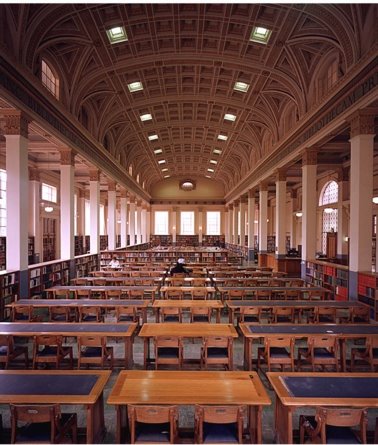
Reading Room
Excerpted from Thomas Bernhard, Old Masters: A Comedy:
'I have, in my life, turned pages a million times more often than I have read them, and always derived from turning pages at least as much pleasure and real intellectual enjoyment as from reading. Surely it is better to read altogether only three pages of a four-hundred-page book a thousand times more thoroughly than the normal reader who reads everything but does not read a single page thoroughly, he said. It is better to read twelve lines of a book with the utmost intensity and thus to penetrate into them to the full, as one might say, rather than read the whole book as the normal reader does, who in the end knows the book he has read no more than an air passenger who knows the landscape he overflies. He does not perceive the contours. Thus all people nowadays read everything and know nothing. I enter into a book and settle in it, neck and crop, you should realize, in one or two pages of a philosophical essay as if I were entering a landscape, a piece of nature, a state organism, a detail of the earth, if you like, in order to penetrate into it entirely and not just with half my strength or half-heartedly, in order to explore it and then, having explored it with all the thoroughness at my disposal, drawing conclusions as to the whole. He who reads everything has understood nothing, he said. It is not necessary to read all of Goethe or all of Kant, it is not necessary to read all of Schopenhauer; a few pages of 'Werther', a few pages of 'Elective Affinities' and we know more in the end about the two books than if we had read them from beginning to end, which would anyway deprive us of the purest enjoyment.'